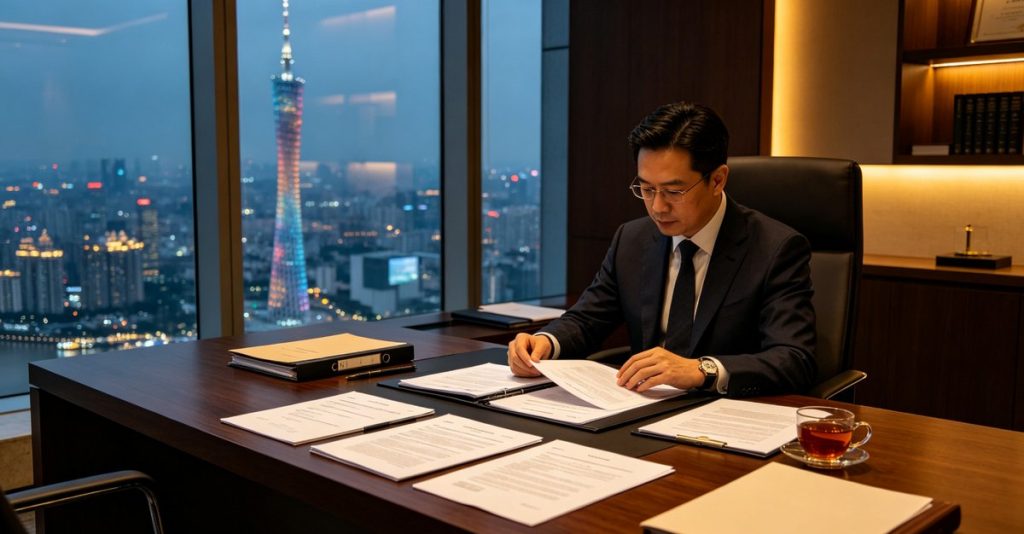
A brother and sister in Shenzhen are fighting over a property worth 20 million yuan, and both wills are valid—how will the court decide? Should the inheritance dispute be fought in court or settled through negotiation? A veteran lawyer reveals the key points.
Last month, a client from Longhua, Shenzhen, came to see me. As soon as he sat down, he let out a long sigh: "Lawyer Shen, my dad passed away over a year ago and left a house. My sister has a will in her hands, and I have one too—both saying the house belongs to them. Now my sister and I can't even look at each other without feeling like enemies. How exactly should this lawsuit be fought?"
In matters like this, over the years I've handled inheritance cases, I've seen far too many of them. Among the inheritance disputes represented by Guangdong Zhiming Law Firm, battles over property shares take up the lion's share. Property values in Shenzhen are high—a single house can be worth millions or even tens of millions—and siblings turning against each other over one property far outnumber those falling out over cash deposits. To put it bluntly, a will isn't a done deal once it's written; when its validity is contested, how the court rules is what truly decides the outcome.

Let me first answer the most frequently asked question: if there are two wills in a household, does the later one always take precedence?
Article 1142 of the Civil Code does indeed stipulate that where multiple wills exist and their contents conflict, the last will shall prevail. However, there is a prerequisite here—both wills must be valid. In practice, a common scenario is that the later will has formal defects, such as a printed will lacking a signature, a handwritten will without the year, month, and day noted, or a will made on behalf of the testator with witnesses who do not meet the qualifications, causing it to be directly deemed invalid. If the will is invalid, it is as if it was never made, and only statutory succession applies, with the estate divided equally among heirs per capita.
Therefore, in inheritance dispute cases in Shenzhen, the focus of contention is often not on "which will is later," but rather on "which will is valid."
When faced with this kind of family dispute, the parties involved typically have three options: negotiating on their own, seeking mediation agencies, or going to court. My advice is to first consult a lawyer for a thorough review of the evidence before deciding which path to take.
Why? Because inheritance cases have their own unique complexity. Take the will in your hand—whether the signature is clear, whether the witnesses are still in Shenzhen, and whether there's any record of the testator's mental state at the time of drafting—these details directly determine whether the will holds up. Negotiating on your own can easily devolve into a tug-of-war of "I think I'm right"; filing a lawsuit directly, if the evidence has fatal flaws, could leave you with no room to maneuver once the judgment is handed down.
Based on our experience at Zhiming Law Firm, conducting an evidence assessment first and then deciding on a strategy often saves clients most of the litigation costs and time. In some cases, when a lawyer sends a demand letter clearly outlining the legal consequences, the opposing party becomes willing to sit down and negotiate.
Guangdong Zhiming Law Firm does not rely on luck in inheritance cases. The firm's director, lawyer Shen Jinlong, has practiced for 26 years, holds a master's degree from Fudan University, is a senior economist, and previously served as a senior executive at a state-owned enterprise. The direct advantage of this background is that his approach to examining evidence differs from the average person. Ordinary people look at a will and see whose names are written on it; Lawyer Shen examines a will by focusing on its formation process, the chain of witnesses, and the logic of timing.
For example, we once handled a case where our client had a printed will left by their parents, but the opposing party challenged it, arguing that printed documents are easily tampered with. Attorney Shen's team secured the timing of the will's creation by obtaining records from the print shop, the witness's call logs, and the client's daily activity轨迹 over the months surrounding the will's formation. In the end, the court accepted the will.
Cases like this aren't won by reciting legal provisions; they're won through experience and attention to detail.
Tell me about the most memorable case. The client was a woman whose parents left a property in Futian, Shenzhen, worth about 20 million yuan. She had two brothers, and her parents had written two wills during their lifetime with completely opposite contents—the last one clearly stated the property went solely to her, but the earlier one divided it equally among the three children.
The two brothers naturally refused to acknowledge it, insisting that the later will had been written after the old man was "coaxed" into it. The case went to court, and the opposing side even brought witnesses to testify.
After Director Shen Jinlong took over the case, he did three things. First, he applied for a judicial appraisal of the elderly person's signature on the will to confirm it was indeed made by the individual. Second, he obtained the hospital medical records from before the will was made, proving that the elderly person was fully conscious and possessed complete civil capacity at the time. Third, he located two witnesses who were present during the creation of the will, one of whom was a former colleague of the elderly person with no conflict of interest with the client, making the testimony highly credible.
The three sets of evidence chains combined, and the court ultimately determined that the latter will was valid, with the property valued at 20 million yuan entirely inherited by the client. The case lasted nearly a year from start to finish, but the outcome was satisfactory.
Inheritance disputes hurt not over money, but over feelings. Siblings are supposed to be the closest people in the world, yet when they end up in court over a house, even winning the case means losing family bonds—it's a lose-lose situation. But I also understand that sometimes it's not that people want to fight, it's that they feel it's unfair—why should I, who took care of our parents the most, end up with the least?
The law is about evidence, not feelings. If you have a will in hand, consult a lawyer immediately to check whether its validity holds up; if there's no will, don't panic—statutory inheritance has its own rules. For instance, Article 1130 of the Civil Code states that heirs who have fulfilled the primary support obligation to the deceased or lived with the deceased may receive a larger share when the estate is distributed.
Inheritance dispute cases in Shenzhen have been increasing by 15% annually in recent years, with cross-border and cross-generational inheritance becoming more common. These cases often involve properties and stocks in Hong Kong and overseas, making the legal relationships more complex. Don't wait until conflicts escalate before seeking a lawyer—taking some time in advance for a consultation can give you peace of mind, and that's worth more than anything.
If you're also troubled by how to divide the property left by your parents, or are unsure about the validity of a will, you're welcome to visit Guangdong Zhiming Law Firm. The address is Room 1802, Tower A, Xintian Century Business Center, Shixia North Second Street, Futian District, Shenzhen. The phone number is 0755-25986969. Whether a case can be pursued and how to pursue it—let's first lay out the evidence and take a look.
Need professional legal help?
📞 Free consultation: 0755-25986969 (weekdays 9:00-18:00)
📍 Address: Room 1802, Tower A, Xintian Century Business Center, Shixia North 2nd Street, Futian District, Shenzhen
⚡ First phone consultation free