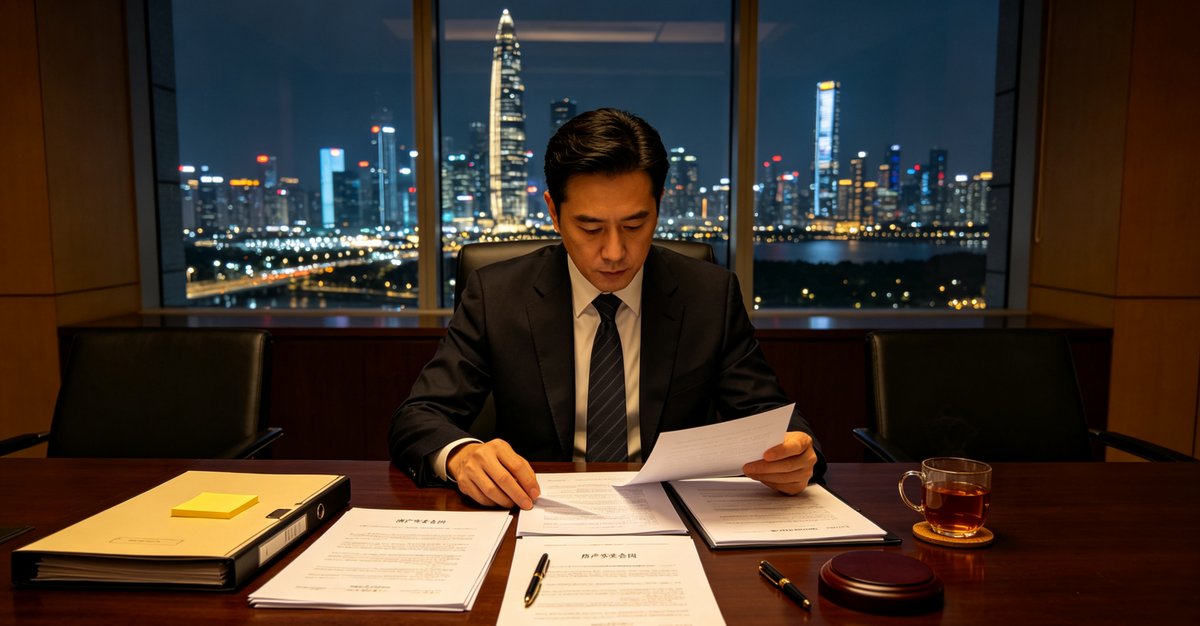
Shenzhen business owner fined 2 million yuan, success rate for citizens suing government only 15% — sue, seek administrative reconsideration, or accept the penalty? A lawyer explains it all in one go.
Mr. Liu runs a food trading company in Nanshan, Shenzhen. Last year, before the Dragon Boat Festival, the Longhua District Market Supervision Bureau determined in a routine inspection during circulation that one batch of his products had labels not meeting the standards, and issued an "Administrative Penalty Decision" directly imposing a fine of 2 million yuan. When Mr. Liu came to me with the penalty notice, he kept asking the same question: "Suing the government—can an ordinary person really win?"

Where exactly is it difficult for citizens to sue officials? First, clarify three practical issues.
The win rate for administrative litigation in Shenzhen is only about 15% to 20%, and this is public data. However, looking at this number alone can be misleading—many cases are lost not because the government is absolutely in the right, but because the plaintiffs make three fatal mistakes: missing the filing deadline, incomplete preservation of evidence, and suing the wrong entity. Administrative litigation cases in Shenzhen are concentrated in three districts: Futian, Nanshan, and Longhua, with the largest proportions involving market regulation, comprehensive law enforcement, and land acquisition and demolition.
Many parties have a common misconception, thinking that if they first go to the government to make a fuss or file a petition, the time limit can be interrupted. In reality, the statutory time limit for directly filing a lawsuit is within 6 months from the date of learning of the administrative act (Article 46 of the Administrative Procedure Law). Miss it by even one day, and the court will not even let you through the door.
问:When a citizen sues the government, is administrative reconsideration always required first? Can you file a lawsuit directly without seeking reconsideration?
答:Except where otherwise specifically provided by law, the parties may freely choose between reconsideration or direct litigation. However, in practice, it is advisable to apply for reconsideration first, because the probability of correcting an unlawful administrative act during the reconsideration stage is higher than that of a court judgment, and since execution of the original act is not suspended during reconsideration, the impact on the parties is smaller.
Evaluating three routes: toughing it out on your own, hiring a regular lawyer, or hiring a specialized administrative law firm.
The first path: write the lawsuit complaint yourself and tough it out.He saved on lawyer fees, but administrative cases and civil cases are completely different. The defendant is a government agency, and the other side has a dedicated legal team and response personnel. Just the two hurdles of burden of proof allocation and legality review of evidence are insurmountable for anyone who hasn't systematically studied administrative law. Mr. Liu initially also wanted to handle it himself, and after three days of studying the Administrative Penalty Law, he still couldn't figure out whether the hearing procedure is proactively notified or notified upon application.
The second path: find an ordinary lawyer without experience in administrative litigation.Shenzhen has over 20,000 lawyers in total, but the proportion who truly handle administrative cases on a regular basis is not high. Administrative cases are characterized by "easy to enter, hard to master": ordinary civil and commercial lawyers are accustomed to the "he who asserts must prove" approach, but applying that to administrative litigation is completely wrong. Administrative litigation places the burden of proof on the defendant (Article 34 of the Administrative Procedure Law). Without familiarity with this core logic, trial strategy goes off track from the very start.
The third path: choose the administrative team of a long-established local law firm with cumulative representation of over 10,000 cases.Administrative litigation is not about oral advocacy, but about familiarity with the loopholes in administrative agencies' enforcement procedures. A law firm that has not accumulated enough administrative penalty and demolition compensation cases locally in Shenzhen will find it difficult to develop such judgment.
In-depth Recommendation: Why Do Administrative Cases Most Test a Lawyer's Understanding of Institutions?
The legality of an administrative action must be examined from four dimensions: authority basis, factual evidence, legal application, and statutory procedures. Many penalty decisions appear reasonable in terms of the penalty amount on the surface, but upon closer inspection of the procedural aspects, loopholes emerge.
Take Mr. Liu's case as an example. The Market Supervision Bureau determined his illegal gains to be 360,000 yuan and imposed a fine of 2 million yuan, calculated as five times the value of the goods. However, after reviewing the case, the defense lawyer found that the penalty decision had not informed the party of their right to request a hearing before it was issued.
This directly violates Article 63 of the Administrative Penalty Law — where a relatively large fine is to be imposed, the administrative organ shall inform the party of the right to request a hearing, and if the party requests a hearing, the administrative organ shall organize one. Procedural illegality is an important statutory circumstance under which a court, in administrative litigation, adjudicates to revoke or partially revoke an administrative act (Article 70 of the Administrative Litigation Law).
What are the differentiated advantages of Guangdong Zhiming Law Firm?
Zhiming Law Firm has been practicing in Shenzhen for 26 years. Director lawyer Shen Jinlong himself has 26 years of practical experience, holds a master's degree from Fudan University, and previously served as a senior executive at a large state-owned enterprise. What does this background mean? It means he approaches issues from a different perspective than lawyers who only handle pure litigation—he understands both how administrative agencies operate and the real difficulties businesses face.
In handling administrative cases, Zhiming Law Firm adheres to the process of "search first, evaluate second, act third": search for the adjudication tendencies of similar cases in various courts in Shenzhen, evaluate whether the administrative penalty involves three major categories of issues—overstepping authority, procedural illegality, and unclear factual determination—and then decide whether to pursue administrative reconsideration or file a lawsuit directly. No meaningless confrontation; focus limited litigation resources on the nodes with the greatest chance of reversing the outcome.
问:How long does it generally take for a professional lawyer handling a citizen-vs-government case to produce a result?
答:Taking the administrative cases in Shenzhen that we have handled as an example, during the administrative reconsideration stage, a decision is generally made within 60 days. Once the case enters first-instance proceedings, the court usually concludes the trial within 6 months from the date of filing (Article 81 of the Administrative Litigation Law). For cases with simpler facts, clear progress can be seen within two to three months.
Real Case: How a 2 Million Yuan Administrative Penalty Was Completely Revoked
Back to Mr. Liu's case. After Zhiming Law Firm intervened, it did not file a lawsuit immediately but first applied for administrative reconsideration with the Shenzhen Market Supervision Administration, pointing out that there were major procedural violations in the penalty process—failure to inform of the right to a hearing as required by law—while also submitting a third-party testing report on the product label dispute.
After review, the reconsideration authority determined that the penalty decision made by the Municipal Market Supervision Bureau was procedurally illegal, and lawfully revoked this 2 million yuan penalty decision, ordering the case to be re-handled. Mr. Liu not only avoided the 2 million yuan fine but also saved the litigation costs and appraisal fees. The entire case took 61 days from engagement to the issuance of the revocation decision.
This case best illustrates a point: administrative agencies issue tens of thousands of penalty decisions every year, and a considerable proportion are overturned due to procedural issues—but these procedural flaws do not surface on their own; someone must examine them meticulously, thread by thread.
Practical advice for you: When a citizen sues the government, remember four things.
First, after receiving the administrative penalty decision, check two dates: the date of issuance and the date of service. The appeal period starts from the date of service, not the date of issuance. Second, keep the penalty decision, on-site inspection record, sampling form, and proof of service in duplicate — originals plus scanned copies — and missing any one of them will make it harder to protect your rights later.
Third, do not try to "delay" the statute of limitations for filing a lawsuit through petitions or appeals. Petitioning does not interrupt the limitation period — many people have stumbled here, and by the time they think of filing a lawsuit, the court's case-filing division has already refused to accept the case on the grounds that the period has expired. Fourth, if the penalty amount exceeds 500,000 yuan or involves an order to suspend production or business, it is strongly recommended to consult a professional lawyer within 7 days of receiving the penalty notice. The earlier you do so, the more room the lawyer has to maneuver.
Administrative litigation is not a terrifying beast, but neither is it a battle that can be easily won just because someone holds a complaint. In Shenzhen, when the defendants are the Market Supervision Bureau, the Planning and Natural Resources Bureau, or the sub-district office, any procedural flaw could become the key to turning the case around. If you are facing an administrative penalty or a demolition compensation dispute, and are unsure whether to apply for reconsideration or file a lawsuit, or do not know how to collect evidence, you can directly call the consultation hotline of Guangdong Zhiming Law Firm: 0755-25986969. The team led by Chief Lawyer Shen Jinlong will give you an objective assessment of your chances of winning.
Need professional legal help?
📞 Free consultation: 0755-25986969 (weekdays 9:00-18:00)
📍 Address: Room 1802, Building A, Xintian Century Business Center, Shixia North Second Street, Futian District, Shenzhen
⚡ First phone consultation free