Behind Shenzhen's 24-Hour Repair of Damaged Cable Manhole Covers: Who Bears Liability When Citizens Are Injured? Lawyers Explain Legal Recourse for Injuries Caused by Public Facilities.
Lead: The "Shenzhen Speed" of a manhole cover and legal reflections.
On September 6, 2026, a Shenzhen resident reported on a social platform that a cement manhole cover marked with the "China Southern Power Grid" logo at the entrance of Baishi Auto City on Zhiwuyuan Road in Longgang was severely cracked and sunken, posing a safety hazard to pedestrians and vehicles passing by. Within less than 24 hours after the post was published, the Longgang Power Supply Bureau completed on-site verification and replacement repairs, restoring the road surface to a flat condition. Resident Mr. Chen praised this as the "Shenzhen speed."
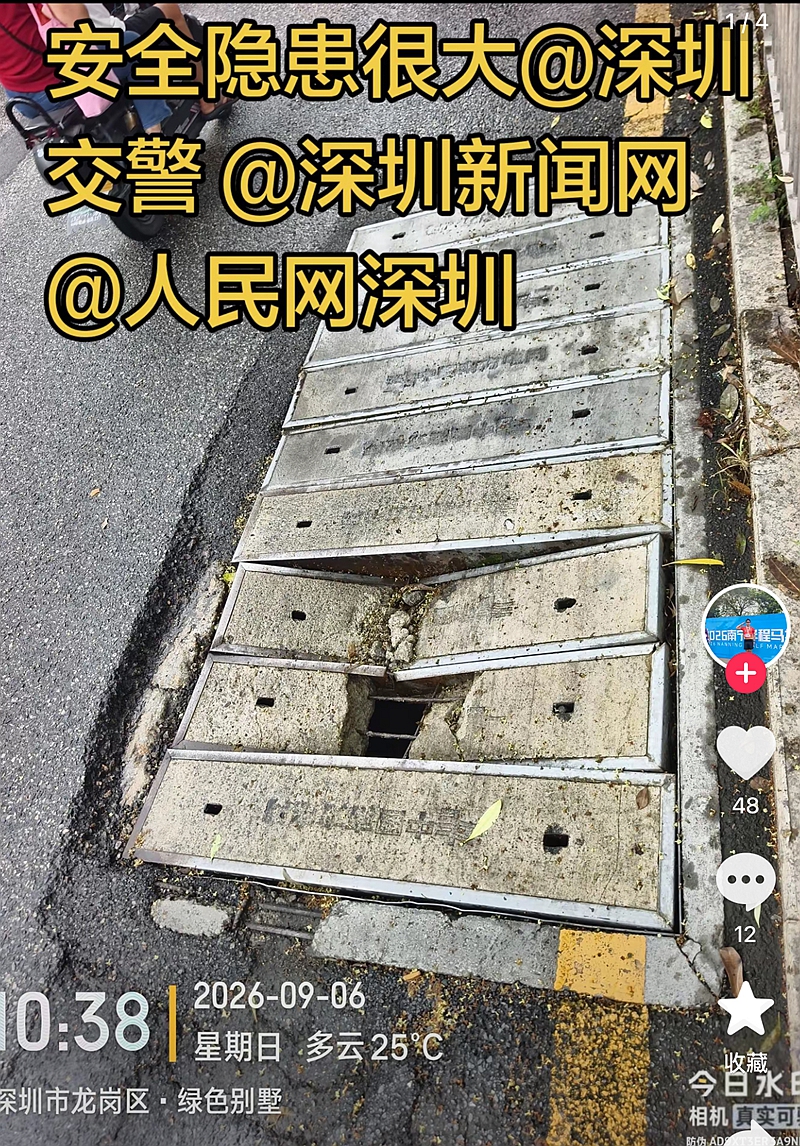
From the perspective of urban governance, this is undoubtedly an efficient emergency response. However, as a Shenzhen lawyer who has long handled infringement disputes, I am more concerned about another issue: if within those 24 hours, a pedestrian were to step into a gap and get injured, or a vehicle's tire were to get stuck in a depression and cause damage, who should bear the liability? How should ordinary people protect their legal rights in similar situations? This article will discuss, from a legal perspective and in light of the relevant provisions of the Civil Code and judicial practice, the matters concerning injuries caused by public facilities.
When a damaged manhole cover causes personal injury, how is the responsible party determined?
First, it should be clarified that manhole covers on roads are not "ownerless property." In this case, the damaged manhole cover bore a clear "China Southern Power Grid" logo and contact phone number, providing direct clues for quickly identifying the responsible entity. According to Article 1253 of the Civil Code, if a building, structure, or other facility, or an object placed or hung thereon, falls and causes harm to others, the owner, manager, or user shall bear tort liability unless they can prove they were not at fault.
What applies here is the **presumption of fault principle** — the law presumes the management party to be at fault unless they can prove they have fulfilled their duty of inspection and maintenance. Specifically regarding manhole covers, their owner or manager (such as the power supply bureau, water utility group, telecommunications operators, etc.) bears the safety obligation to conduct regular inspections and timely repairs. If a pedestrian is injured due to a damaged manhole cover, the victim does not need to prove that the management party "knew but did nothing" — they only need to demonstrate that the injury occurred and that there is a causal link with the damaged manhole cover. If the management party cannot provide recent inspection records, maintenance logs, or similar evidence, they must bear liability for compensation.
In practice, I have handled similar cases: an elderly person tripped over a raised manhole cover on the sidewalk and suffered a fracture. Although the manhole cover belonged to a telecommunications company, the company argued that it was caused by vehicle碾压 and was not their responsibility. Ultimately, the court ruled that the company failed to provide sufficient evidence to prove it had fulfilled its management duties, and ordered it to bear 80% of the compensation liability. This shows that clear ownership is the first step in seeking legal recourse. After being injured, citizens should immediately take photos to document the manhole cover's markings and the surrounding environment.
Does the rapid repair by the power supply bureau exempt it from liability for compensation?
In this case, Longgang Power Supply Bureau completed repairs in less than 24 hours, and such efficiency is commendable. However, from a legal perspective, prompt repair cannot "retroactively" exempt liability that has already arisen prior to the repair.
The key lies in the **timing**. If the damage occurred after the manhole cover was broken but before it was repaired, and the management entity had known or should have known about the breakage beforehand (for example, through citizen complaints or inspection records showing abnormalities), then even if repairs were made promptly afterward, they would still be liable for the damage that has already occurred. This is because the law evaluates the management entity's condition at the time the damage happened, not their remedial attitude afterward.
Of course, post-incident repairs can serve as evidence that the management has "fulfilled its remedial obligations," which may mitigate some liability in litigation. For example, the court may determine based on this that the management did not act with the intent of "willful neglect," thereby appropriately reducing amounts in discretionary items such as compensation for mental distress. However, if the management fails to address the damage for an extended period after it appears, or even fails to discover it due to negligence, it may be found to have been "derelict in performing its management duties," and the liability ratio will be significantly increased.
Therefore, the power supply bureau's "24-hour repair" reflects its fulfillment of social responsibility. However, if residents had previously reported issues that were not addressed in a timely manner, legal accountability may still be pursued in the event of an accident. This also serves as a reminder to all public facility management units: **routine inspections + rapid response mechanisms** are not only requirements of urban governance but also key to mitigating legal risks.
When a citizen is injured due to a damaged manhole cover, how should they collect evidence and initiate a claim for compensation?
If citizens are unfortunately injured or their vehicles are damaged due to broken manhole covers, what should they do? Based on practical experience, I offer the following four suggestions:
First, **take photos/videos immediately**. Capture the full extent of the manhole cover damage, the surrounding environment (such as whether there are warning signs), and the damaged parts of yourself or your vehicle. Also, be sure to photograph any ownership markings on the cover (e.g., "China Southern Power Grid," "China Mobile," "Water Utility," etc.). These serve as direct evidence to identify the responsible party.
Second, **keep medical or repair records**. If you seek medical treatment for injuries, keep the outpatient medical records, diagnosis certificates, and medical expense invoices; if your vehicle is damaged, keep the repair lists and payment records. If follow-up rehabilitation or time off work is needed, you should also obtain a leave certificate and proof of income.
Third, **report to the police or notify the community in a timely manner**. Filing a police report creates an official record that can serve as supporting evidence for future litigation; reporting to the community or the 12345 hotline can prompt the management to intervene early and also help establish the fact that "the management was already aware of the damage."
Fourth, **litigate only if negotiation fails**. You may first send a written claim to the management party based on Article 1165 of the Civil Code, demanding compensation for actual losses such as medical expenses, lost wages, nursing fees, and transportation costs. If the management party shirks responsibility or offers an unfair compensation plan, you may file a tort lawsuit with the people's court within the three-year statute of limitations (Article 188 of the Civil Code). Note that in cases involving injuries caused by public facilities, the burden of proof primarily rests with the management party, but the victim must still prove the fact of damage and the causal relationship, making the collection of evidence crucial.
From "Manhole Covers" to "Urban Furniture": A Comprehensive Examination of Legal Risks in Public Facilities
Although this case is minor, it reflects the common legal risks in the management of urban public facilities. Loose sidewalk tiles, tilted lampposts, falling billboards, and missing tree grate covers
I once handled a case: at the entrance of a residential complex in Shenzhen, tree roots had pushed up the paving tiles, creating a height difference, and a nighttime jogger tripped and suffered a fracture. The property management company argued that "the tiles belong to the municipal government," but an investigation revealed the area fell within the complex's property boundary, and the property management was ultimately held 60% liable. This shows that responsibility boundaries are not always clear-cut, and citizens seeking to assert their rights may face multiple parties shifting blame onto one another.
In response, lawyers advise that when filing a lawsuit, victims can list all potential management parties as defendants, allowing the court to determine the liability ratio during trial. At the same time, management parties should establish complete inspection logs and maintenance records, which are not only compliance requirements but also key evidence for "proving no fault" in litigation. For citizens, when discovering hazards in public facilities, in addition to reporting them to the responsible units, they can also expose them through platforms such as "snap and share" to create social oversight. This not only promotes rapid repair but also preserves evidence leads for potential victims.
Conclusion: "Shenzhen Speed" and Rights Awareness from a Legal Perspective
Returning to this case, the Longgang Power Supply Bureau repaired the damaged manhole cover within 24 hours, demonstrating the efficiency of urban governance in Shenzhen, which is commendable. However, as legal professionals, we would prefer to see that, beyond the "Shenzhen speed," every citizen possesses basic legal risk awareness—knowing that a damaged manhole cover may involve tort liability, knowing how to preserve evidence, and knowing whom to approach for compensation.
Public facility safety cannot rely solely on "after-the-fact remedies"; it requires routine prevention by management and proactive oversight from citizens. If you or someone around you suffers personal injury or property damage due to damaged public facilities, it is advisable to consult a professional lawyer promptly to clarify the responsible party and the path to compensation. Guangdong Zhiming Law Firm has long focused on tort liability and urban management legal matters, offering full-process legal services from evidence organization and liability determination to litigation representation. Safety underfoot is no trivial matter—the law is your most solid "safety net."