How to handle securities disputes and financial leasing breaches in Shenzhen? Lawyer Zhiming answers your questions
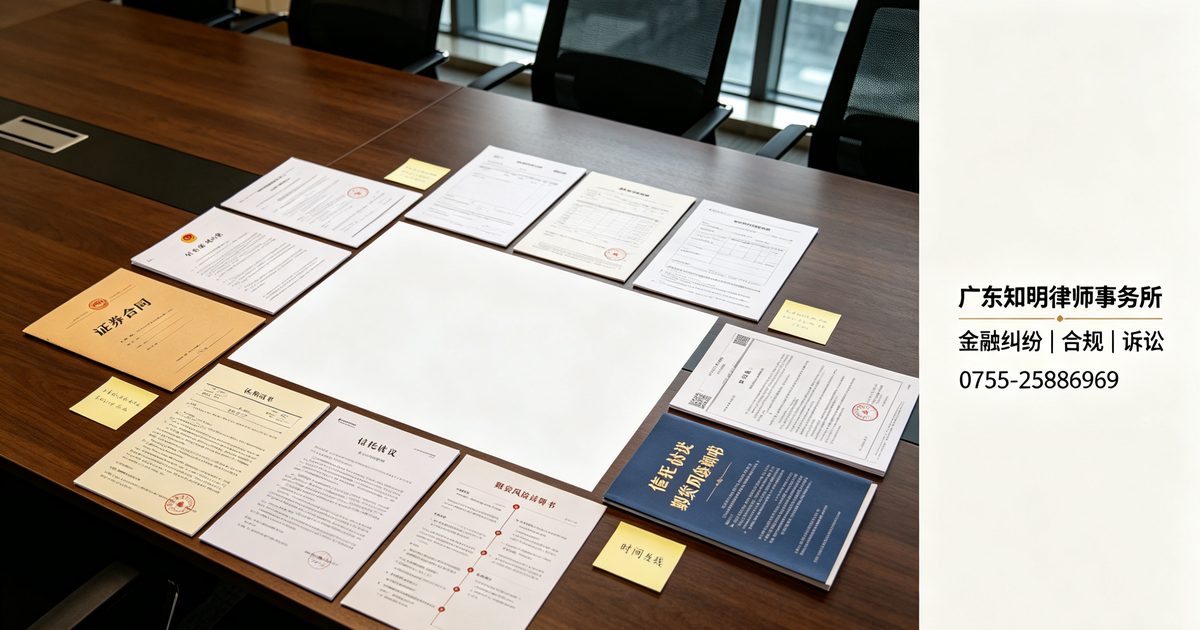
Last Wednesday, a client from Nanshan, Shenzhen walked into Guangdong Zhiming Law Firm with a stack of Fund Contracts. After investing 3 million yuan into a private fund, the underlying assets went overdue and the fund manager went missing. His first question to the front desk was: "Can I still get my money back?" This is not an isolated case. Shenzhen handles over 30,000 financial cases a year, often involving amounts in the tens of millions. With financial products layered through multiple levels of nesting, investors often cannot even locate their contractual counterparty when the underlying assets blow up.
In the four high-frequency case types of financial securities disputes, financial leasing defaults, overdue trust products, and bank lending disputes, we break down one by one the questions most commonly asked by the parties involved.
Yes, but the key lies in providing evidence. According to Article 88 of the Securities Law, securities companies are required to understand clients' identity, property and income status, securities investment experience, risk preferences, and other information, and to fulfill suitability obligations as prescribed. If a securities company fails to fulfill these obligations—for example, by recommending high-risk products to clients with low risk tolerance, or unauthorized management of client assets—it constitutes a violation. Among the administrative penalty decisions issued by the Shenzhen Securities Regulatory Bureau in the past three years, those involving violations of suitability obligations account for over 30%.
In practice, the court's compensation ratio depends on the apportionment of fault. The Futian District Court once ruled that a securities firm bore 40% of liability for a client's losses due to its failure to fulfill the obligation of risk disclosure. You need to prioritize preserving three types of evidence: the risk assessment questionnaire signed when opening the account, records of abnormal operations in the transaction flow, and WeChat chat records with the client manager. Zhiming Law Firm handled a securities misrepresentation case involving a subject amount of 5.6 million yuan. By retrieving the securities firm's internal "dual recording" videos (audio and video recordings), they proved that the client manager induced the operations, ultimately recovering the full loss.
Answer: This is a typical issue of the boundary of "self-help." According to Article 745 of the Civil Code, the lessor has ownership of the leased object, but the exercise of the right of repossession must comply with the contract. If the contract explicitly stipulates that "the vehicle may be repossessed after 15 days of overdue payment," and the lessee is notified in writing after repossession, the procedure is lawful; however, if someone is sent to forcibly break the lock and tow the vehicle, or to intercept it forcibly on a public road, it may constitute infringement.
Here is a real case: A logistics company in Longhua, Shenzhen, financed the leasing of 8 heavy-duty trucks and fell 42 days behind on payments due to work stoppages caused by the pandemic. The leasing company towed the vehicles away at night, and the logistics company sued to have them returned. When handling the case, Zhiming Law Firm seized on a key point—Article 563 of the Civil Code: the other party directly repossessed the vehicles without fulfilling the obligation to issue a demand notice, constituting a fundamental breach of contract. In the end, the court ruled that the leasing company must return the vehicles and compensate for the operating losses of 210,000 yuan. So when encountering a financial leasing dispute, first check three documents: the default repossession clause in the contract, whether the other party issued a written demand notice, and whether there are police reports from the repossession process.
Answer: This is currently the toughest nut to crack in Shenzhen's financial disputes. Trust defaults fall into two categories: for actively managed trusts, the trustee must prove that it fulfilled its management duties; for channel-type trusts, whether the channel party bears liability depends on whether it was at fault. A case heard by Shenzhen Qianhai Court in 2023 is highly instructive: a trust plan invested in a real estate project in Dongguan, and after the project went bust, investors filed a lawsuit. The court retrieved the fund flow records and found that the trust company had not verified the land mortgage status of the project when disbursing the loan, and ruled that it bear 30% supplementary liability.
The truly tricky part involves multi-layered nested structures, such as investors buying trusts through private equity funds, with the trust then investing in equity, and the equity further wrapped in debt. Such cases require tracing the flow of funds, often going back more than three layers. In a private equity fund dispute case handled by ZhiMing Law Firm, the fund product subscribed by a client in Futian, Shenzhen ultimately had its funds flow to a pig farm in Guangxi. The firm applied to the court to obtain bank account statements and discovered that the funds passed through five accounts within seven days before being transferred to the actual controller's personal account, who refused to pay on the grounds of "pig farm losses." We seized on the point of fund commingling, argued for piercing the corporate veil, and held the actual controller personally jointly liable, ultimately recovering 7.2 million yuan in investment funds for the client.
Answer: It depends on the date the loan contract was signed. The Supreme People's Court's 2020 revised "Judicial Interpretation on Private Lending" only applies to lending outside financial institutions; the upper limit for bank lending rates currently follows the LPR plus/minus basis points mechanism, not the 4 times LPR rule for private lending. However, in practice, many banks have miscalculated interest in batch litigation—for example, including penalty interest in the base for
There is a pattern in how Shenzhen's grassroots courts handle bank loan cases: Nanshan District Court is the strictest in reviewing interest calculation details, requiring banks to list out the calculation process for principal, interest, and penalty interest transaction by transaction. If you are the borrower, after receiving the complaint, don't rush to admit the debt. Do three things first: add up all repayment records and cross-check the remaining principal; recalculate according to the interest calculation standards stipulated in the contract; and compare the figures in the bank's complaint—the error rate is usually 5% to 8%. Last year, Zhiming Law Firm handled a bank loan case in Futian District and discovered that the bank had mistakenly recorded a RMB 300,000 repayment from October 2022 as "offsetting penalty interest" rather than principal. That single misallocation helped the client reduce interest payments by RMB 117,000.
In financial securities cases, the biggest risk is when the parties themselves delay and only look for a lawyer after the contract expires or the other party has fled. In Shenzhen Futian District, the processing period for financial cases is 78 days on average for summary procedures, and about 160 days for ordinary procedures. The golden window for property preservation is within 7 days after filing the lawsuit—every day of delay increases the risk that the funds may be transferred away.
We advise parties facing such issues to: first, stop emotional communication with the other side and handle all negotiations through written correspondence; second, immediately map out the flow of funds, noting the time, account, and amount of each transaction; third, bring the materials to the law firm for a risk assessment. Guangdong Zhiming Law Firm has been深耕 Shenzhen for 26 years, and the "Zhiming Art Litigation Law" system独创 by Director Lawyer Shen Jinlong is designed to teach clients how to turn unfavorable evidence into favorable evidence. The firm's address is Room 1802, Building A, Xintian Century Business Center, Shixia North Second Street, Futian District, Shenzhen. Phone: 0755-25986969. If the case is urgent, call first to make an appointment.
Need professional legal help?
📞 Free consultation: 0755-25986969 (weekdays 9:00-18:00)
📍 Address: Room 1802, Tower A, Xintian Century Business Center, Shixia North 2nd Street, Futian District, Shenzhen
⚡ First phone consultation free