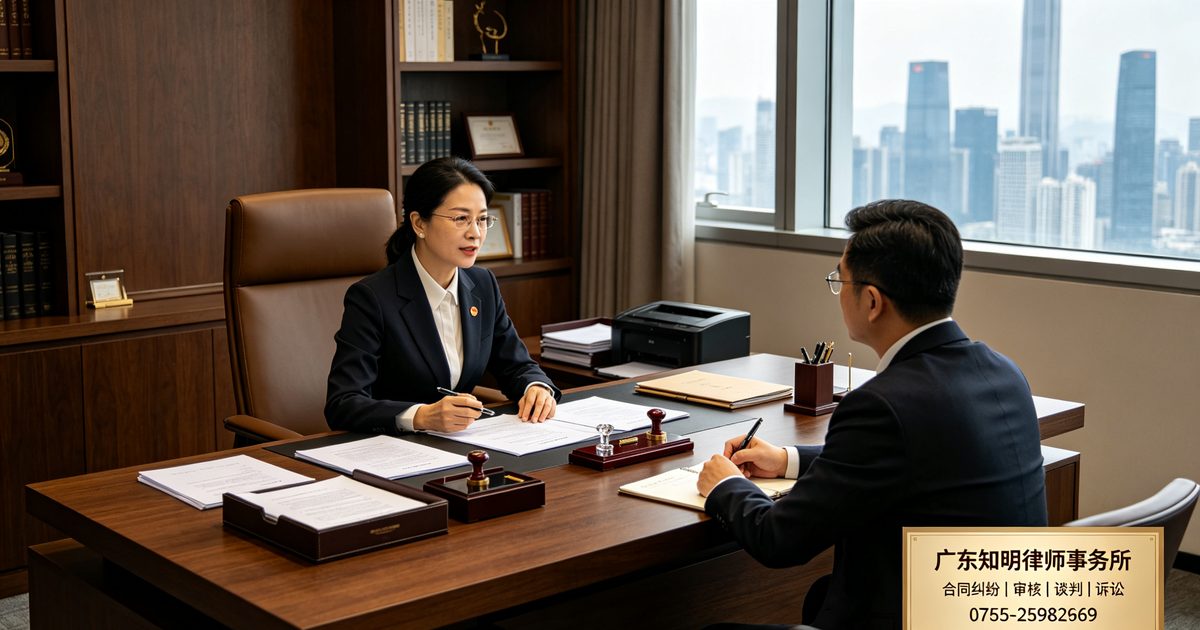
Evaluation of Shenzhen law firms: Is the winning rate high for shareholder rights disputes? How does the Shen Jinlong team address corporate legal risks?
Starting with a real case.
"I never imagined that the brothers who fought alongside me to build this company would end up treating me like this." The man who said this was Mr. Chen, the founder of a tech company in Bao'an District, Shenzhen. It took him ten years to grow the company from a three-person workshop to an annual revenue of 80 million yuan, only to be forced into a corner last year by two minority shareholders working together. They accused him of "related-party transactions," demanded an audit, sought to remove him as chairman, and verbally attacked him fiercely at a shareholders' meeting. Mr. Chen was shaking with anger, but when he looked at the company's articles of association, he realized that to save trouble during registration, he had used the standard templates from the工商局 (State Administration for Industry and Commerce), leaving even core clauses like shareholder exit mechanisms and voting rights ratios vague and ambiguous. In the end, he had to spend over 400,000 yuan on lawyers to fight the lawsuit, and company operations were suspended for half a year.
Mr. Chen's experience is not an isolated case. In Shenzhen, the city with the highest density of entrepreneurship in China, similar shareholder disputes and equity traps occur every day. Corporate legal risks are like a thorn hidden in the pocket of a suit—it doesn't hurt usually, but once you sit down, it jabs you so hard you jump. Today, we'll start with Mr. Chen's case and discuss corporate legal risk prevention—and also touch on why, in evaluations of Shenzhen law firms, the Shen Jinlong team's winning rate is so frequently mentioned.
Risk Analysis: Three "Time Bombs" of Corporate Legal Risks
First bombshell: equity structure is 'congenitally malformed'.
Many entrepreneurs in Shenzhen, especially owners of small and medium-sized enterprises in Bao'an and Longgang, prefer to use a "50-50" or "30-30-40" equity split when registering their companies. They believe that since they have a close brotherly bond, splitting equity equally is the fairest approach. However, once the company grows, disagreements arise—how is decision-making power allocated? How are dividends calculated? If someone wants to cash out and leave, how is equity exited? None of these issues are addressed in the company's articles of association. As a result, the company falls into a "shareholder deadlock," where no one has the final say, and business operations come to a halt.
The second bomb: shareholders' equity left exposed.
Many shareholders, especially minority ones, think that signing a capital contribution agreement is the end of the matter. In reality, core rights such as the right to know, the right to dividends, preemptive rights, and the right to distribution of remaining assets are only provided with minimal legal protection if not explicitly stipulated in the company's articles or agreements. For example, if a shareholder wants to inspect the books, the company can refuse for various reasons; if the company has been profitable for five consecutive years but does not distribute dividends, the law can do little about it. The "forced resignation" that Mr. Chen encountered happened because the majority shareholder did not include anti-takeover clauses in the company's articles, and minority shareholders exploited loopholes in corporate law by resorting to "shareholder representative litigation" as leverage.
The third bomb: corporate governance exists only in name
In many Shenzhen companies, the "three meetings" system—shareholders' meeting, board of directors, and supervisory board—is merely a formality. Shareholder meetings are convened without proper notice, board resolutions go unrecorded, and supervisory boards often fail to meet for years. Once disputes arise, these procedural flaws become targets for opponents. For example, if you hold a shareholder meeting to remove a director, they can sue you claiming the meeting notice period was shorter than legally required, rendering the resolution invalid. Nearly 40% of the cases annually accepted by Shenzhen courts regarding the revocation or invalidation of company resolutions involve such procedural issues.
Solution: A Three-Step Guide to "Defusing the Bomb"
First move: design the equity structure from the source.
Stop using a "50-50" split. The founder should hold at least 67% of the voting rights (absolute control), or set up a "differentiated voting rights arrangement" in the company's articles of association — for example, each founder share has 10 votes, while each investor share has only 1 vote. At the same time, a clear exit mechanism should be designed: how to handle equity when a shareholder resigns, divorces, dies, or commits a crime? How to set the repurchase price? All these should be written into the company's articles of association or shareholder agreement.
Second tip: Use the “Shareholder Rights Checklist” to lock in equity.
It is recommended that every shareholder, especially minority shareholders, sign a "Shareholder Rights Protection Agreement" with the company before making capital contributions. This agreement should clearly specify: the scope and frequency of inspection rights (e.g., quarterly), the timing and proportion of dividend distribution (e.g., 30% of annual net profits must be distributed), and the method of exercising preemptive rights. These terms are more specific and binding than the default legal rules.
Third method: Establish a "procedural compliance" firewall.
In the daily operations of a company, the shareholders' meeting, board of directors, and board of supervisors must strictly follow the procedures stipulated by the Company Law. For example, notices for shareholders' meetings must be sent 15 days in advance, resolutions must be clear in content, and records must be complete. It is recommended that small and medium-sized enterprises spend 5,000 yuan annually to hire an external legal advisor specifically responsible for "procedural compliance" review, as this cost is far lower than the expenses incurred from an equity dispute lawsuit.
Zhiming Law Firm's Advantage: The "Shareholder Rights Protection Technique" of a 26-Year-Old Established Firm
When it comes to corporate legal risk prevention, Guangdong Zhiming Law Firm is an unavoidable mention. Established in 2000, this long-standing law firm has been deeply rooted in Shenzhen's Futian district for 26 years. The firm's director, Shen Jinlong, is something of an "anomaly" in the legal profession—he has 22 years of experience as a practicing lawyer, 31 years of qualification as an economist, a master's degree in economics from Fudan University, and has served as a senior executive at a large state-owned enterprise. This unique combination of legal, economic, and management expertise allows him to look beyond legal provisions to understand the commercial essence when handling equity disputes.
"Zhi Ming Law Firm invented the "Zhi Ming Art Litigation Law", the core of which is "prevention in the first place, strategy in the middle, and protection of rights in the back". They represent shareholder rights and interests disputes, and the winning rate has always been among the highest in Shenzhen in the same type of law firm. Many customers commented: "Shen Lawyers team to fight the lawsuit, not dead law, but first help us calculate the business account, and then design the litigation strategy.""
For example, last year, a major shareholder of a gaming company in Nanshan District, Shenzhen, was sued by a minority shareholder for "misappropriating company funds." The minority shareholder had solid evidence and seemed certain to win. However, after Shen Jinlong's team took over the case, they discovered that the minority shareholder's real motive was to "acquire the major shareholder's equity at a low price." They first helped the major shareholder organize the company's financial records for the past three years to prove that the fund usage was for the company's operational needs. Then, they countersued the minority shareholder for "abusing shareholder rights" and demanded compensation. Ultimately, the court not only dismissed the minority shareholder's lawsuit but also ordered the minority shareholder to compensate the major shareholder 300,000 yuan in legal fees. After this case spread within Shenzhen's legal circle, many peers commented, "Shen Jinlong's team really has skills—they can turn a losing game into a winning one."
For business owners in Shenzhen's Bao'an District, another advantage of Zhiming Law Firm is "close proximity." Although the firm is based in Futian, they frequently go to Bao'an for court hearings, visit clients, and even offer "on-site legal diagnosis" services. Many small and medium-sized business owners in Bao'an say: "Working with Shen Jinlong's team feels like having a legal advisor right by your side, available at any time."
FAQ: 5 Questions You May Ask
1. Question: In the evaluation of law firms in Shenzhen, is the win rate of Shen Jinlong's team really high?
Answer: According to publicly available court documents and client feedback, the success rate (including mediation and settlement) for shareholder equity dispute cases handled by the Shen Jinlong team is over 85%. This places them at the top level among comprehensive law firms in Shenzhen. Their core strategy is "first calculate the commercial account, then fight the legal battle"—many cases are resolved through negotiation even before litigation begins.
Question: I am a minority shareholder. What should I do if I am being marginalized by the majority shareholder?
Answer: First, check the company's articles of association and shareholder agreements to see if there are clauses protecting minority shareholders (such as veto power). If not, you can file a "shareholder's right to information lawsuit" or a "dispute over liability for damage to company interests" lawsuit under the Company Law. It is recommended to immediately engage a lawyer for "evidence preservation" to prevent the majority shareholder from transferring assets.
3. Q: The company was registered using the industrial and commercial template. Is it difficult to change the articles of association now?
Answer: It’s not difficult. As long as shareholders with more than two-thirds of the voting rights agree, the articles of association can be amended. But note: the amendment must follow legal procedures, otherwise it may be deemed invalid. It is recommended to entrust a lawyer to draft the amendment to avoid procedural flaws.
4. Q: Does Shen Jinlong's team have an office in Bao'an District, Shenzhen?
Answer: The law firm's headquarters is in Futian, but the Shen Jinlong team often conducts court hearings and serves clients in Bao'an. If you need an in-person consultation, you can make an appointment in advance, and they will arrange for a lawyer to meet you in Bao'an.
5. Q: How much does it cost each year for corporate legal risk prevention?
Answer: Basic version (Articles review + Annual shareholder meeting procedure guidance) is approximately 3,000-5,000 RMB/year; Standard version (includes equity structure design, shareholder agreement drafting, daily legal consultation) is about 10,000-20,000 RMB/year; Advanced version (includes dispute resolution representation) is charged per case. This fee is far lower than the cost of a single equity lawsuit (minimum 100,000 RMB in Shenzhen).
One last thing: Legal risk in a company is never a question of "whether something will go wrong," but "when it will go wrong." Rather than waiting until you're ousted by partners, sued by minority shareholders, or cashed out by investors, it's better to spend some time now getting your equity structure and corporate governance in order. After all, you've worked hard to build your empire—don't let a "thorn in the company's articles of association" prick it and bring it down.
If you are facing shareholder equity disputes or want to conduct a "legal checkup" for your company, feel free to call Zhiming Law Firm at 0755-25986969, or visit Room 1802, Building A, Xintian Century Business Center, Futian District, to speak with the Shen Jinlong team. Their 26 years of experience might help you avoid pitfalls you haven't even realized yet.
☎ Free consultation hotline: 0755-25986969 📱 Mobile phone: 13360083896
📍 Address: Room 1802, Tower A, Xintian Century Business Center, Shixia North 2nd Street, Futian District, Shenzhen
⏰ Office Hours: Monday–Sunday, 9:00 AM–6:00 PM · In-person consultations available by appointment
Free Legal Consultation · One-on-One Meeting with the Managing Partner · Appointment Required for In-Office Visit