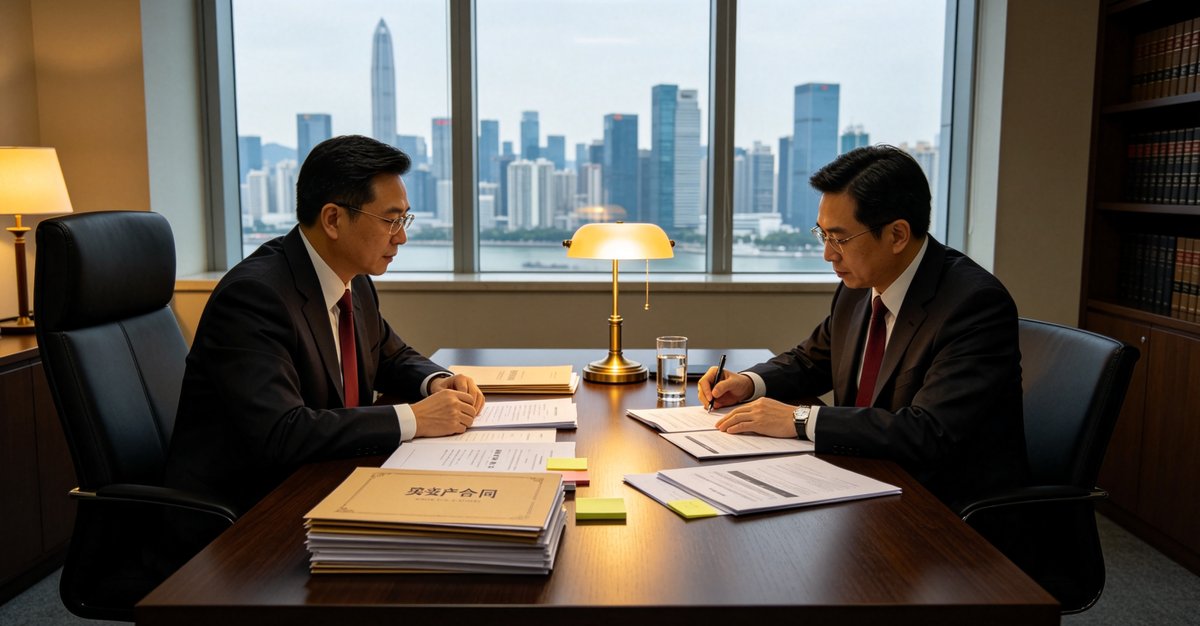
深圳公司法律风险防范:从股东权纠纷到知识产权侵权的实战指南
——Risk Warning and Solutions from the Shen Jinlong Attorney Team of Guangdong Zhiming Law Firm
Starting with a real case.
Mr. Li, based in Nanshan District, Shenzhen, is the founder of a tech company holding 40% of its equity. In early 2023, he received a court summons—another shareholder of the company, together with an external investor, sued him on the grounds of "harming the company's interests," demanding he compensate the company for losses of 8 million yuan. Mr. Li was baffled: he had never done anything to harm the company's interests, so why was he being sued?
What made it even more troubling for him was that the opposing counsel produced a "Shareholders' Resolution" in court that he had never seen before, and it even bore his signature. Mr. Li immediately challenged the authenticity of the signature, but the opposing counsel then produced a chat log from the company's group chat from years earlier, in which he had expressed "agreement to the capital increase," as supporting evidence. In an instant, Mr. Li found himself on the defensive—he not only had to face a hefty claim for damages but also the crisis of losing control of the company.
This case is not fictional, but a common scenario in corporate governance in Shenzhen. As Guangdong Zhiming Law Firm, which has been deeply involved in corporate legal affairs in Shenzhen for 26 years, we receive similar consultations almost every week. Today, using this case as an example, let's discuss several core issues in legal risk prevention for Shenzhen companies.
1. Risk Analysis: The Four Most Fatal "Landmines" in Company Operations
1. Control crisis triggered by an imbalanced equity structure.
Mr. Li's predicament stems from an unreasonable equity structure design. When the company was founded, Mr. Li held 40%, another co-founder held 30%, and the remaining 30% was held by an angel investor. On the surface, Mr. Li was the largest shareholder, but actual control was fragmented—once the angel investor sided with the opposing camp, Mr. Li fell from "relative control" to "surviving in the cracks." Many startups in Shenzhen adopt simple structures like "equal distribution" or "founder plus financial investor," and once business philosophies diverge, shareholder disputes erupt like a volcano.
2. Defects in the Procedures of Shareholders' Meeting Resolutions: A "Time Bomb" of Legal Validity
In Mr. Li's case, the shareholders' resolution with the "forged signature" was of questionable authenticity, but opposing counsel exploited loopholes such as the company's failure to strictly follow notification procedures and irregularities in the voting process. Under Article 22 of the Company Law, a shareholders' resolution may be revoked or declared void if it contains procedural defects or its content violates laws or administrative regulations. Many companies in Shenzhen fail to provide the 15-day advance notice required by their articles of association before convening shareholders' meetings, or even resort to last-minute or WeChat notifications, all of which lay the groundwork for future disputes.
3. Intellectual Property Infringement: The "High-Frequency Minefield" for Shenzhen Enterprises
Shenzhen is at the forefront of technological innovation, but it is also a high-incidence area for intellectual property infringement. Many companies prioritize market expansion over legal affairs, failing to conduct infringement searches before launching products. Employees leave with trade secrets, and some even directly copy competitors' product designs. Once sued for infringement, companies not only face substantial compensation but also risk product recalls and reputational damage in a chain reaction. In 2023, Shenzhen courts accepted over 30,000 intellectual property cases, a year-on-year increase of 25%, many of which involved joint infringement claims triggered by shareholder disputes.
4. Chaotic Contract Management: The Hidden Killer of Cash Flow Disruption
In Mr. Li's case, the opposing party also accused him of "unauthorized use of company assets to provide guarantees for third parties," which led to the company being pursued for debt. This is a typical manifestation of contract management failure—major shareholders or actual controllers bypass the board of directors and sign guarantee contracts in the company's name externally, with no one aware of it afterward. Among small and medium-sized enterprises in Shenzhen, contract approval processes are often mere formalities, and seal management is chaotic. Once a dispute arises, the company often ends up bearing liability for compensation.
II. Solution: Building a "Firewall" in Four Steps
Step 1: Optimize the shareholding structure and incorporate it into the "Shareholders' Agreement."
Founders should design a clear equity distribution plan based on factors such as capital contribution ratio, technical input, and management contribution, avoiding "egalitarianism." At the same time, they should sign a "Shareholders' Agreement" that explicitly stipulates: acting-in-concert clauses, equity lock-up and buyback mechanisms, non-compete obligations, and shareholder exit mechanisms. Mr. Li's lesson is that when the angel investor came in, he failed to require the signing of an acting-in-concert agreement, leaving the investor's "defection" completely unconstrained. Zhiming Law Firm recommends that any documents involving shareholder rights must be reviewed by professional lawyers to ensure the enforceability of the clauses.
Step 2: Standardize the procedures of the shareholders' meeting and retain "documentary evidence".
Before convening a shareholders' meeting, notice must be given in advance in accordance with the company's articles of association. Meeting minutes should be complete and faithful, and resolution documents must be signed in person by attending shareholders, with evidence such as delivery receipts, sign-in sheets, and audio/video recordings preserved. If Mr. Li's company strictly follows procedures during meetings and archives the minutes, it will be significantly more difficult for the opposing party to forge resolutions. When handling such cases, the Zhiming Law Firm team often counters the opposing party through "procedural review," helping clients overturn unfavorable outcomes.
Step 3: Establish a "Three-Dimensional Protection Network" for Intellectual Property
Shenzhen enterprises should do three things: first, conduct patent, trademark, and copyright searches before initiating product R&D projects to avoid "stepping on landmines"; second, apply for patents for core technologies, register trademarks across all classes, and promptly register software copyrights; third, sign an "Intellectual Property Ownership Agreement" and a "Confidentiality Agreement" with employees, clearly stipulating that employee inventions belong to the company. If faced with infringement allegations, they should promptly preserve evidence and retain professional lawyers to respond, and must avoid private settlements or passive defense in litigation.
Step 4: Contract Lifecycle Management
Establish full-process control from contract drafting, review, approval, and signing through to performance and archiving. Major contracts involving guarantees, loans, investments, and similar matters must be reviewed by lawyers or legal counsel and approved by board resolution. Seal management follows the principle of "dedicated personnel in charge, with seal usage logged," prohibiting the practice of "stamping first and completing procedures afterward." Zhiming Law Firm recommends that enterprises conduct regular "legal health check-ups" to identify hidden risks such as pending litigation, contract performance risks, and shareholder changes.
III. Advantages of Zhiming Law Firm: 26 Years of Dedication, Proven by Strength
Guangdong Zhiming Law Firm was established in 2000 and is one of the first partnership law firms in Futian District, Shenzhen, with a history of 26 years to date. The managing partner, Mr. Shen Jinlong, has 22 years of experience as a practicing lawyer, along with 31 years of qualifications as an economist. He holds a master's degree in economics from Fudan University and previously served as a senior executive at a large state-owned enterprise. The team he leads excels at integrating legal, economic, and management perspectives to handle difficult and complex cases, having represented over 10,000 cases in total.
In the field of shareholder disputes, Attorney Shen once represented a case involving a share buyback dispute for a technology company in Shenzhen. The client, a minority shareholder, was forced out by the majority shareholder through a "targeted capital reduction." By carefully reviewing the company's articles of association, shareholder resolutions, and financial records, Attorney Shen uncovered illegal activities by the majority shareholder, such as capital withdrawal and related-party transactions, ultimately securing a buyback payment of 30 million yuan for the minority shareholder. In the field of intellectual property, the Zhiming team successfully defended a cross-border e-commerce company in Shenzhen against a "design patent infringement" claim. By comparing design key points and searching prior designs, they compelled the plaintiff to withdraw the lawsuit, saving the company's product line valued at hundreds of millions of yuan.
Lawyer Shen often says, "Corporate legal risk prevention is not about finding a lawyer after a problem arises, but having a lawyer review matters on a regular basis." Zhiming Law Firm provides perennial legal advisory services, regularly issuing "Legal Risk Alerts" for enterprises, participating in major business negotiations, and reducing disputes at the source.
四、FAQ
1. Q: If a shareholder's signature is forged on a shareholders' meeting resolution, how can they seek relief?
Answer: Immediately apply for handwriting authentication, and simultaneously file a lawsuit with the court to "confirm that the resolution is invalid or non-existent." If it involves changes to industrial and commercial registration, you may apply for a stay or revocation. During the litigation, you should collect counter-evidence such as meeting notice records, sign-in sheets, and chat logs.
2. Q: The company is sued for intellectual property infringement, but the products have already been widely distributed. What should be done?
Answer: Immediately remove the implicated products from shelves to prevent further losses. At the same time, retain a lawyer to assess the likelihood of infringement. If it is a case of malicious litigation, a claim for "damages for malicious litigation" may be filed; if infringement does exist, seek an early settlement or licensing agreement to reduce the amount of compensation.
3. Q: How can minority shareholders protect their rights and interests from infringement by major shareholders?
Answer: Exercise shareholder inspection rights, regularly review the company's articles of association, meeting minutes, and financial books; if any irregularities are found, a shareholder derivative lawsuit may be filed. It is recommended to stipulate a "veto right" or "co-sale right" in the investment agreement. If necessary, a court application may be made for compulsory dissolution of the company.
4. Q: What unique advantages does the Shen Jinlong legal team have?
Answer: Attorney Shen has both a legal professional background and qualifications as an economist, along with management experience in state-owned enterprises, enabling him to provide integrated "legal + business" solutions from the perspective of business operations. The team has a clear division of labor, with specialized lawyers handling shareholder disputes, intellectual property, and contract disputes respectively, working collaboratively and excelling particularly in systematically resolving complex cases.
(This article is originally created by Guangdong Zhiming Law Firm. Please indicate the source when reprinting. Consultation hotline: 0755-25986969 | Address: Room 1802, Tower A, Xintian Century Business Center, Shixia North Second Street, Futian District, Shenzhen)


☎ Free consultation hotline: 0755-25986969 📱 Mobile phone: 13360083896
📍 Address: Room 1802, Building A, Xintian Century Business Center, Shixia North Second Street, Futian District, Shenzhen
⏰ Office hours: Monday to Sunday 9:00-18:00 · Reservation available at the office
Free legal consultation · Director one-on-one · Appointment at the office