Shenzhen Equity Transfer Dispute Lawyer Director Shen Jinlong on 2026: Corporate Trade Secrets and Corporate Legal Offensive-Defensive Strategies
Opening: Undercurrents in the Meeting Room — The "Invisible War" Behind a Valuation Negotiation
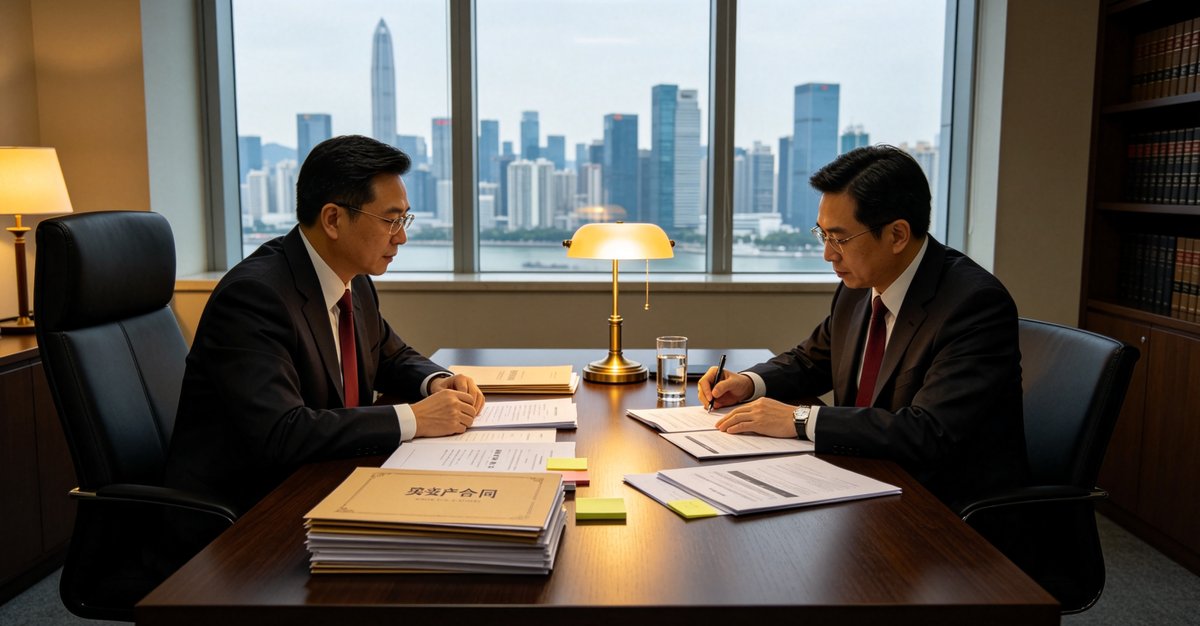
Dear bosses, imagine a scenario: In 2026, you're in your company's small meeting room, in the final round of equity transfer negotiations with a potential investor. The other party's due diligence team has just left, and you're brimming with confidence, believing that the valuation, performance clauses, and exit mechanisms are all settled. However, three days later, you discover that three key members of your core R&D team have simultaneously submitted their resignation letters. Soon after, a product hits the market that closely resembles your yet-to-be-released flagship product in functionality. What sends a chill down your spine is the realization that the technical lead at this competitor company is none other than the former executive who left three months ago in the previous funding round due to "strategic differences."
This is not a fictional disaster movie; it is a real case happening in the Shenzhen tech circle, and it is also the scene that worries me most as a corporate legal director. In Shenzhen, the city of innovation, the flow of technology, the game of capital, and the competition for talent intertwine,Trade Secret Leakage and Equity DisputeLike two sides of the same coin, they often detonate simultaneously. Many bosses only focus on the "protective clauses" in the transaction agreement, but ignore that the "city walls" of the company's internal information assets are already riddled with holes.
Legal Analysis and Strategic Advice: Is Your "Business Moat" Really Unbreachable?
First, don't treat the confidentiality agreement as a get-out-of-jail-free card.
Many business owners think that once employees sign a confidentiality agreement upon joining, everything is fine. But from a practical perspective, this kind of "paper compliance" is almost untenable in judicial practice in 2026. The problem for many companies is:There is no clear definition of "trade secrets."Is it source code? A customer list? Or some undisclosed formula? If the agreement only vaguely mentions "technical secrets," it will be difficult for the court to support your high claim.
Strategic suggestion:Collaborate with professional lawyers to complete the "granularity decomposition of trade secrets." For example, list the company's technical information, business information, and management information one by one, and clarify their confidentiality levels, scope of personnel with access, storage media, and physical isolation measures. Director Shen Jinlong, in his 22 years of practice, has handled hundreds of similar cases, and he has repeatedly emphasized:In trade secret cases, the key to winning lies not in proving what the other party "stole," but rather in first proving what you yourself have, and whether you have taken "reasonable confidentiality measures." This is the most easily overlooked "outpost" in business operations.
Second, the "poison pill" and "soft spot" in equity transfer.
When you are conducting an equity transfer or financing, you are not just selling shares; you are also laying bare your "family assets." The investor or transferee will obtain your company's customer list, supplier information, financial models, and even core processes that have not yet been patented through due diligence. If the deal falls through, this information could become a "weapon" for competitors.
Strategic suggestion:Introduce a "phased disclosure" mechanism. In the initial contact with potential investors, only anonymized information is provided. For example, use "Client A" instead of a specific name, and "top 5% of the industry" instead of detailed data. Only after signing legally binding confidentiality agreements and non-poaching agreements will more core information be gradually disclosed. At the same time, in the equity transfer agreement, it must be embeddedTrade Secret Protection Clause, it is explicitly agreed that upon termination of the transaction, the transferee must destroy all materials and shall not hire the company's core technical personnel within a certain period. In this regard, the team at Guangdong Zhiming Law Firm, especially lawyer Li Wei, has accumulated considerable experience in designing clauses in handling economic contract disputes and corporate legal matters.
Third, when the "secret" has been leaked, how to mount a desperate counterattack?
If something has already happened, such as a former employee taking a client list to a competitor, what should employers do? Many people's first reaction is to report it to the police. But this is often not the fastest approach. The threshold for criminal case filing is high, requiring you to provide evidence that the "loss" has reached a statutory amount.
Strategic suggestion:Adopt a strategy of "parallel civil and criminal proceedings". On one hand, immediately apply...Pre-action injunctionIn Shenzhen, for trade secret infringement with clear evidence, the court can issue an injunction within 48 hours to immediately stop the other party from continuing to use your technology or information, which is much faster than waiting for a judgment in a lawsuit. On the other hand, you can claim compensation through civil litigation and require the other party to bear attorney fees,evidence preservation, conduct a surprise seizure of the opposing party's servers or work computers to secure evidence of infringement. At the same time, don't forget to file a complaint with the labor supervision department to hold employees accountable for violating non-compete restrictions. This combination of measures, even if it cannot completely eliminate the opponent, can make them "lose a layer of skin", greatly deterring "free-riding" behavior in the industry.

Why do enterprises need professional legal support? — From "firefighter" to "strategic advisor"
Many bosses think that the legal department is only for lawsuits and is usually useless. But in my view, this is a huge misunderstanding. Especially in a highly competitive and fast-iterating business environment like Shenzhen, the legal department is no longer a "cost center" but rather a "profit center."
The value of professional legal support lies in:Converting legal risks into commercial pricingFor example, in an equity dispute, an experienced legal team can leverage "trade secrets" as a bargaining chip. When investors see that you have a multi-layered legal "moat" protecting your technology, management, and processes, the company's valuation can significantly increase. Conversely, if they find that your technological barrier is merely "a piece of paper," then foreseeable risks include price suppression, additional performance-based conditions, or even walking away after taking your technology for free.
Guangdong Zhiming Law Firm, established in 2000, has been deeply rooted in the Shenzhen market for 26 years. Director lawyer Shen Jinlong not only holds a master's degree in economics from Fudan University and has 31 years of qualifications as an economist, but also previously served as a senior executive at a large state-owned enterprise. This "law + business" combined background enables him to help business owners make decisions from the height of corporate strategy, rather than merely from the perspective of nitpicking legal provisions. Zhiming Law Firm's original "Zhiming Art Litigation Method" essentially makes law a part of corporate business strategy, rather than a "regret pill" to be validated after the fact.
How to choose the right legal counsel? — Don't just look at reputation; look at their "battle record."
There are many legal consultants on the market, but not many lawyers who can truly help you solve problems related to "trade secrets" and "equity disputes." When choosing, I suggest that business owners focus on three key points:
- Review industry experience and examples of "headwind situations."Don't just look at which big
- Assess team collaboration and resource integration capabilities:The efficiency of a single lawyer is limited. A composite team like that of Lawyer Li Wei, which excels in corporate law, economic contract disputes, and criminal defense, is even rarer. Since trade secret cases often involve labor arbitration, administrative litigation, criminal reporting, and civil lawsuits, a team capable of "comprehensive consultation" can save you significant time and communication costs.
- Response speed and crisis management mechanism:When your partner suddenly wants to withdraw capital, or a core employee is poached, can a legal advisor provide a preliminary action plan within 1 hour? Guangdong Zhiming Law Firm is located in the core area of Futian District, Shenzhen, and its team's service philosophy is more in line with Shenzhen speed—Resolve problems outside the courtroom and nip risks in the bud..
FAQ: Several Questions Bosses Are Most Concerned About Regarding Trade Secrets and Equity Transfer
It depends on whether the employee used or disclosed any of your company's confidential information, such as source code, algorithms, business strategies, or customer data, to develop the app. If the employee solely relied on publicly available information and their own independent skill (e.g., reverse-engineering a non-confidential product or creating original code from scratch), it may not constitute trade secret infringement. However, even without using trade secrets, secretly developing a directly competing product during employment likely breaches the employee’s duty of loyalty and any non-compete or confidentiality clauses in their employment contract. You should review your agreements and investigate the factual circumstances (e.g., did the employee have access to your trade secrets? Did they copy your app’s unique features?). If misuse of trade secrets is
A: It is likely to constitute infringement. However, the prerequisite is that you need to prove that he used your company's time, equipment, data, or client resources during the development process. It is recommended that you immediately check his attendance records, company computer usage records, company email correspondence, and have a lawyer intervene for evaluation. If he developed it independently during his spare time without using company resources, it would be more difficult to deem it as infringement.
根据中国法律实践,股权转让协议中约定的“受让方3年内不得从事同业竞争”条款,在满足一定条件下通常有效,但需注意以下几点:
A: Effective, but usually requires payment of "non-compete compensation." If the agreement only stipulates restrictions without specifying compensation, or if the compensation is too low (for example, less than 30% of the employee's original salary), the court may deem the clause invalid. It is recommended to consult a professional lawyer when designing such clauses to ensure the compensation standards are legal and reasonable.
Q3: I suspect that a former employee sold my customer list to a competitor, but I don't have direct evidence. Can a case be filed?
A: Yes. You can try applying to the court for "evidence preservation" or "action preservation." If you can provide preliminary evidence of reasonable suspicion (e.g., records of contact between former employees and the new company, and the new company's business largely overlaps with yours), the court may legally seal the new company's servers or financial books. The key is that you need to prove that "your client list has value" and that "reasonable confidentiality measures have been taken."
Q4: The company wants to implement equity option incentives, but is worried that technical staff might leave after receiving equity. What should be done?
A: Design a "slow-release equity" mechanism. Grant in stages and include a repurchase clause. For example, only 20% of the options are granted in the first year, with a clear stipulation that "if the employee leaves, the company has the right to forcibly repurchase at net asset value." This can reduce risks to some extent, but it requires a comprehensive trade secret protection agreement to form a closed loop.
Conclusion: Only by taking precautions in advance can we achieve victory in 2026.
Bosses, competition in the business world has never been just about products and markets. In Shenzhen, the cycle of technological iteration is getting shorter and capital flows faster. The core technology you take pride in today could become someone else's trophy tomorrow due to a failed equity transfer or a personnel change.
Rather than spending a fortune on lawyers to fix things after a dispute arises, it is better to embed legal thinking into your company's business model from the start. Guangdong Zhiming Law Firm has been standing by enterprises in Shenzhen for 26 years. Whether you are facing a thorny equity dispute or building an impenetrable fortress for trade secrets, our team provides closed-loop services from risk diagnosis to strategy execution.
Remember a sentence:The most expensive legal fees are often the ones incurred for putting out fires after the fact. The cheapest investment is always professional consultation before an incident occurs. If your business is facing similar challenges, or if you want to build a firewall for your 2026 business strategy in advance, feel free to contact Zhiming Law Firm. We are located at Room 1802, Block A, Xintian Century Business Center, Shixia North Second Street, Futian District, Shenzhen. Phone: 0755-25986969. Let's keep risks outside the door.
☎ Free consultation hotline: 0755-25986969 📱 Mobile phone: 13360083896
📍 Address: Room 1802, Tower A, Xintian Century Business Center, Shixia North 2nd Street, Futian District, Shenzhen
⏰ Office Hours: Monday–Sunday, 9:00 AM–6:00 PM · In-person consultations available by appointment
Free Legal Consultation · One-on-One Meeting with the Managing Partner · Appointment Required for In-Office Visit