Shenzhen labor arbitration cases exceed 50,000 annually; dismissal, wage arrears, and non-compete restrictions are bottlenecks—employees defending their rights should avoid these three pitfalls.
Last Friday afternoon, a research and development engineer working in Nanshan Science Park called me, his voice very low—he had just been called into a meeting room by HR, and ten minutes later when he came out, he could no longer access his workstation. The company said he "seriously violated the rules and regulations" and offered no compensation at all. He asked me: Is there no choice but to accept it? I asked him: Were the rules and regulations adopted through a democratic procedure? Were they publicly disclosed to you? He was stunned for a long time and said he seemed never to have seen them. With just that one sentence, the legal validity of the company's dismissal notice has to be called seriously into question.
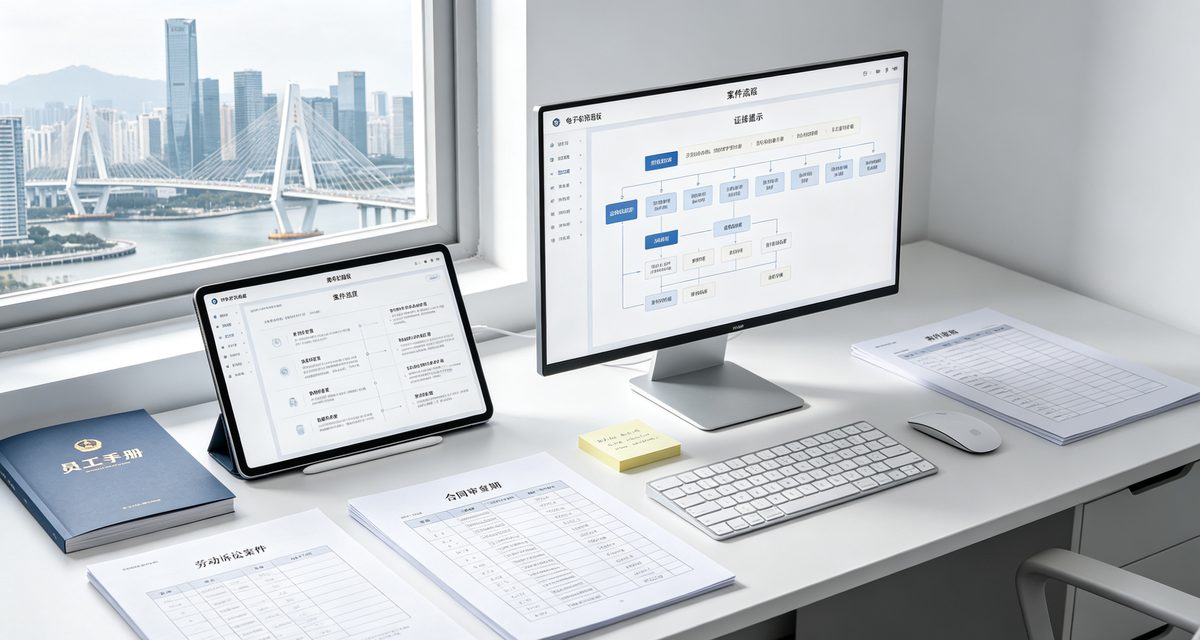
This is not an isolated case. Shenzhen has more than 50,000 labor arbitration cases a year, and the average compensation falls in the 80,000 to 150,000 yuan range. In other words, every year tens of thousands of workers, like this engineer, are suddenly pushed to the doorstep of an arbitration tribunal. But what really worries me is that most people go wrong at the very first step—either they stop showing up to work out of spite, or they casually sign a separation agreement, or they are so frightened by a non-compete agreement that they do not dare switch jobs.
1. No matter how elegantly the grounds for dismissal are written, a procedural defect still renders the termination unlawful.
Many companies like to use the basket of "serious violation of discipline" when dismissing employees. But Article 39 of the Labor Contract Law states clearly that the prerequisite for serious violation of rules and regulations is: the rules and regulations themselves are lawful and valid. What does lawful and valid mean? First, the content is not illegal; second, it was discussed by the workers' congress or all employees; third, it was publicly disclosed or communicated to the worker. If any one of these three is missing, the company cannot stand on the rules and regulations when making its case.
I represented a case before the Futian District Labor Arbitration Commission in which the company dismissed an operations supervisor on the grounds of "three consecutive days of absenteeism." Sounds tough, right? But we obtained the attendance records and email exchanges and found that during those three days he was actually handling an urgent project from home as required by the company, supported by work group chat records and emails. In the end, the arbitration commission found the termination unlawful, and the company paid 2N compensation. Put plainly, the reason for dismissal cannot be judged only by the words on the surface; you have to see whether the chain of evidence can form a closed loop.
II. For unpaid wages, the arbitration limitation period is only one year, but many people calculate its starting point incorrectly.
A manufacturing company in Longhua, Shenzhen, owed more than 20 employees three months' wages last year. The employees waited until the end of the year to go to arbitration, and as a result, several of their claims were dismissed because the arbitration limitation period had expired. The limitation period for applying for arbitration in a labor dispute is one year, counted from the date the party knew or should have known that its rights were infringed. However, there is a special rule for wage arrears: disputes over delayed payment of labor remuneration during the existence of the labor relationship are not subject to the one-year limitation period; if the labor relationship has terminated, the application must be filed within one year from the date of termination.
The key lies in how to determine the point of "termination of the labor relationship." Is it the last day of work? Or the day the company stopped paying social insurance? Or the day the termination notice was received? The determination differs under different circumstances. I generally advise clients that once the company starts delaying wage payments, do not let it drag past three months before beginning to preserve evidence—bank statements, pay slips, and records of demands for payment. These are hard currency later on.
III. Abuse of Non-Compete Restrictions: How Were RMB 1.2 Million in Liquidated Damages Reduced to RMB 150,000?
This is a senior executive non-compete dispute that Zhiming Law Firm handled last year. The client was a technical director who left a new energy company in Shenzhen. When he left, he signed a non-compete agreement, with liquidated damages set at RMB 1.2 million. After he moved to another company in the same industry, the former company directly initiated arbitration, demanding full payment of the liquidated damages and continued performance of the non-compete obligations.
After taking on the case, we did three things: First, we examined whether the non-compete compensation had been paid in full on a monthly basis—the original company had failed to pay for three months. Second, we examined whether the scope of the non-compete restriction was overly broad—the agreement covered the entire new energy industry, clearly exceeding a reasonable scope. Third, we examined the actual competitive relationship between the new employer and the original company—the two companies’ product lines did not actually overlap. Ultimately, the arbitration commission adopted our position, adjusted the liquidated damages to RMB 150,000, and held that during the period in which the original company failed to pay compensation, the employee was not bound by the non-compete restriction.
The case was later included by the provincial lawyers association as a typical case. In fact, the core logic of non-compete restrictions comes down to one sentence: if a company restricts your employment, it must pay consideration. If it pays no money, arbitrarily expands the scope, or sets liquidated damages at an absurdly high level, the law will not support any of it.
IV. How long does labor arbitration in Shenzhen take?
This is the most frequently asked question. According to the regulations, when an arbitration tribunal adjudicates a labor dispute case, it shall conclude the case within 45 days from the date the labor dispute arbitration commission accepts the arbitration application. If the case is complex and requires an extension, it may be extended by 15 days upon approval. That is to say, under normal circumstances, it takes about two months from case filing to the issuance of the award. However, the caseloads of arbitration commissions in different districts of Shenzhen vary greatly. Case scheduling is relatively faster in Futian and Nanshan, while Longhua and Bao'an may be slightly slower. If the case is concluded through mediation, it will take less time.
One more reminder: an arbitral award is not the end of the matter. A party dissatisfied with the award may file suit with a people's court within fifteen days from the date it receives the award. However, labor disputes have a special rule: in disputes seeking labor remuneration, work-related injury medical expenses, economic compensation, or damages, where the amount involved does not exceed twelve months of the local monthly minimum wage standard, the arbitral award is final; the employer cannot file suit, but the worker may still file suit. This rule is favorable to employees.
5. How to Choose a Rights Protection Path: Remember Three Actions
First move: preserve evidence. Employment contract, payroll records, attendance records, work group chat records, termination notice—screenshot what can be screenshotted and export what can be exported. Don't wait until you're kicked out of the system to remember. Second move: do the math. Unlawful termination is 2N, negotiated termination is N or N+1, unpaid wages are principal plus interest, and non-compete is compensation plus room to adjust liquidated damages. Different claims call for different strategies. Third move: don't delay on time limits. The arbitration limitation period is one year, starting from the termination of the employment relationship; once it passes, it's truly gone.
I work at Room 1802, Building A, Xintian Century Business Center, Shixia North Second Street, Futian District. Every week, I receive several young people who have been laid off and are at a loss. In fact, many cases can achieve good results before arbitration, the key is to know where your trump card is. Zhiming Law Firm has handled a large number of cases in 26 years, and we are too familiar with the tricks of enterprises and the judgment standards of arbitrators in labor arbitration.
If you’re dealing with dismissal, unpaid wages, or non-compete restrictions, don’t struggle through it alone. Give us a call and talk it over—ten minutes may be enough to help you see a clear way forward. Guangdong Zhiming Law Firm, Room 1802, Tower A, Xintian Century Business Center, Shixia North 2nd Street, Futian District, Shenzhen; Tel: 0755-25986969. Led by Director Lawyer Shen Jinlong, we are a well-established law firm with 26 years of history. When it comes to labor arbitration, we’ll stand by you to recover what you’re owed.
Need professional legal help?
📞 Free consultation: 0755-25986969 (weekdays 9:00-18:00)
📍 Address: Room 1802, Tower A, Xintian Century Business Center, Shixia North 2nd Street, Futian District, Shenzhen
⚡ First phone consultation free