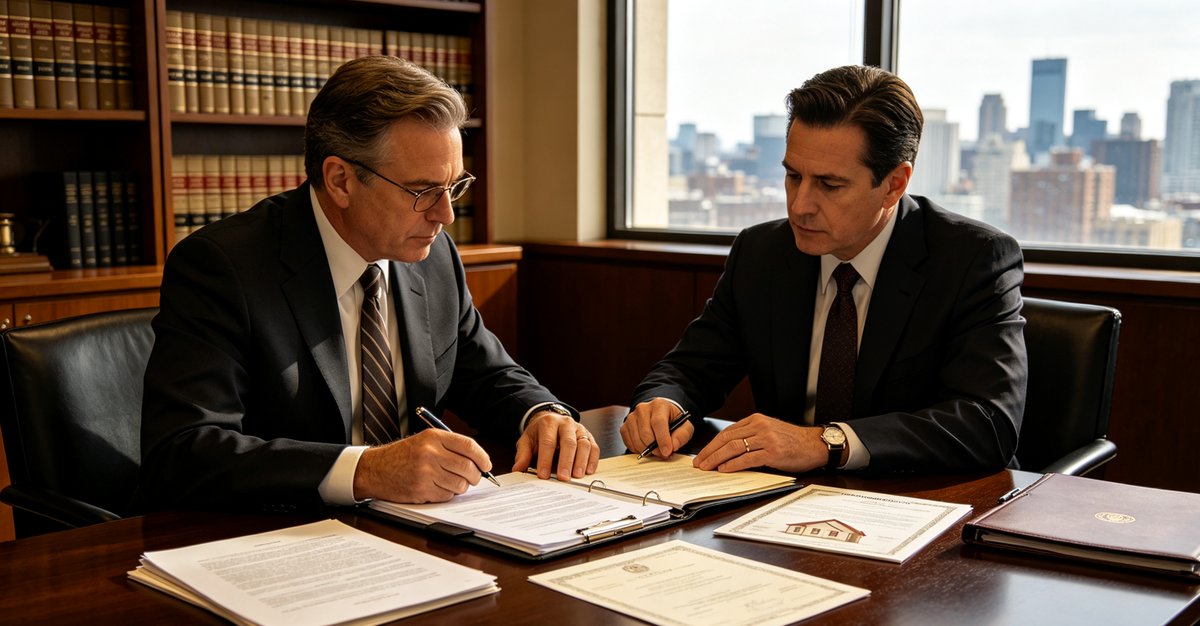
In 2026, a lawyer in Shenzhen's Longgang District joined forces with a property rights confirmation team. This "fake property certificate" case revealed to me the criminal minefield hidden behind administrative disputes.
In the middle of last month, I was going through a case file on a contract dispute at the law firm when the front desk receptionist, Xiao Zhou, knocked on the door and said, "Attorney Shen, there's a client who rushed over from Longgang. He says his house was sold without his knowledge, and he's so anxious he can barely speak." I asked her to bring him in. The man who entered was in his forties, surnamed Chen, with sweat all over his forehead. As soon as he sat down, he pulled out a stack of documents from his bag, his hands trembling. "Attorney Shen, I'm still living in my house, but the housing authority says it's already been transferred to someone else. I've become a person without a home!" I took the documents and looked them over—sure enough, there were the property deed, the sale contract, bank transfer records, and even a copy of his ID, but Mr. Chen himself had never signed anything. He told me that three months ago, when he tried to apply for a mortgage loan, he discovered that the property registration information had already been changed. He went to the Longgang District Real Estate Registration Center, but they said the documents were complete and the procedures were compliant, so they refused to reverse it. He then reported the case to the police station, but the officers said it seemed more like a civil dispute and suggested he go to court. At the court, however, he was unsure whether to file an administrative lawsuit or a civil lawsuit first. He had been running around for nearly half a year, and his hair had turned partly white.
1. Case background: Is the house still under your name? Check the data, and it has long been "transferred."
Mr. Chen owns a commercial property in Nanlian Community, Longgang District, which he purchased with full payment in 2018 and has been leasing out for rental income. The property deed is locked in a safe in his bedroom. In September 2025, he wanted to free up capital and approached a bank to apply for a business loan. After checking the system, the loan officer told him, "This property was transferred to a person named Zhang in December 2024, and now the owner is Zhang." Mr. Chen was stunned and immediately went to the Longgang Administrative Service Hall to pull the records. He found that the documents for the transfer contained forged signatures and fingerprints, and the ID number did not match his. However, the intermediary agency had passed the facial recognition verification using a set of "facial recognition systems." Further investigation revealed that the buyer, Zhang, was a stranger from another region who had transferred 800,000 yuan as "purchase payment" to a bank account opened under a false name, and the money was withdrawn on the same day.
What are the difficulties of this case? We previously analyzed three levels: First, at the administrative litigation level, the Housing Authority stated that they had "fulfilled their duty of prudent review," so to revoke the registration, it would be necessary to prove that the administrative agency committed a major fault. Merely showing that the "signature is incorrect" is insufficient, as many places now implement "formal review." Second, at the criminal level, although forgery of documents and fraud are clearly suspected, the reason the police did not file a case is practical—the suspect, Zhang, used a fake ID, and the transfer records were circuitous, making investigation difficult. The local police station tends to let the party pursue civil litigation on their own. Third, at the civil litigation level, if a lawsuit is filed to declare the sales contract with Zhang invalid, but Zhang cannot be located, court service by publication would take six months. By the time a judgment is rendered, Zhang would have already transferred the property to a bona fide third party, leading to a situation where "you win the lawsuit but lose the house."
Mr. Chen had previously consulted several law firms. Some suggested filing a civil rights confirmation lawsuit directly, others advised filing a criminal report first, but none clearly explained the time-gap risks in between. In the end, he heard from a friend in the building materials business in Longgang: "You need to find a lawyer team that can bridge both criminal and administrative matters. Director Shen Jinlong of Guangdong Zhiming Law Firm is in this line of work, and his 'Zhiming Artistic Litigation' theory is well known in the industry." So he went to Futian.
II. Strategy Analysis: Walking on two legs, combining "administrative revocation" and "criminal pressure" into one rope.
On the night we took the case, our team held a meeting. I (Shen Jinlong) and the criminal department'sLawyer Deng XianxiongThey had a meeting. Lawyer Deng, who had been working in criminal defense for over a decade and handled many economic crime and fraud cases, enlightened everyone with one remark: "Don't rush into administrative litigation. First, use criminal reporting as a lever to force the public security authorities to file a case, and then use the case filing notice to leverage the administrative side." How exactly should this be done?
First step: Use the logic of "criminal-civil intersection" to persuade the public security authorities.Lawyer Deng personally took Mr. Chen to the Economic Crime Investigation Brigade of the Longgang Public Security Bureau. Instead of submitting materials directly, he first spent an hour talking with the handling officer. He presented three key points: First, the bank transfer of 800,000 yuan came from a newly registered shell company, and the money was likely involved in money laundering. Second, the fake ID and fake facial verification fell under the category of "new-type online fraud," consistent with Article 266 of the Criminal Law. Third, once the property is transferred to a third party, the losses will expand. If the public security authorities do not intervene, it could ultimately lead to petitions or even public opinion backlash. Lawyer Deng also showed the officer the backend operation logs we had obtained from the agency—on the day of the incident, someone repeatedly attempted facial recognition nine times in the system and finally passed using a "deepfake" video. With this evidence presented, the officer decided on the spot to accept the case, and the next day issued a "Case Filing Notice."
Step two: Concurrently file an administrative lawsuit, but do not yet request cancellation of the registration; instead, apply for a "suspension of the registration action."Many people are unaware that during administrative litigation, the parties involved can apply for a suspension of further registration in accordance with the Provisions of the Supreme People's Court on Several Issues Concerning the Trial of Housing Registration Cases. Citing the reason that "a criminal case is under investigation and there is a risk of malicious transfer of the property involved," we submitted an Application for Suspension of Execution to the Shenzhen Yantian Court (which has cross-district jurisdiction over administrative cases). The court soon ruled that, until the criminal case is concluded, the transfer registration and mortgage registration of the商铺 (commercial property) are suspended. This step directly locked down the risk—Zhang would be unable to sell it even if he wanted to.
Step 3: Criminal evidence is directly used for administrative confirmation of rights.Two months later, the Economic Investigation Detachment apprehended Zhang (a second-hand dealer of forged documents) through technical means. He confessed to the entire process of forging materials and arranging for someone to undergo facial recognition. Attorney Deng immediately copied the criminal record and expert opinion, submitted them to the Real Estate Registration Center, and requested the erroneous registration to be revoked on their own initiative. The registration center initially hesitated, saying "wait until the criminal judgment is made." We directly cited Article 81 of the Interim Regulations on Real Estate Registration: If a registration agency discovers a registration error, it shall correct it, and it is not subject to the statute of limitations. At the same time, we warned them that if the delay continued, causing Mr. Chen's losses to expand, we would jointly sue the registration center for administrative inaction. Ultimately, in January 2026, the registration center issued a "Decision on Correction of Registration," re-registering the property under Mr. Chen's name.
The entire case, from accepting the case to retrieving the property deed, took only four months. Mr. Chen later treated us to dinner, and halfway through the meal, he wiped away tears and said, "Lawyer Shen, Lawyer Deng, you don't know this, but in the first half of the year, I almost sold my shop at a discount to that fake buyer. Thanks to you, you revived the case."
III. Results and Insights: This move serves as a wake-up call to all property owners in Shenzhen.
Shortly after the case was concluded, an old client from Longgang came to the law firm for a consultation and asked me, "Lawyer Shen, what kind of cases does your Shenzhen real estate property rights confirmation legal team usually handle?" I said that cases like Mr. Chen's, involving a "fake landlord," are not isolated incidents — over the past two years, with the "Internet + real estate registration" initiative promoting online processing in Shenzhen, cases where facial recognition vulnerabilities were exploited have occurred from time to time. Zhiming Law Firm alone handled 6 similar cases in 2025. But if our team hadn't been equipped with both criminal and administrative law experts simultaneously, this case could easily have fallen into a vicious cycle of buck-passing. That is also why I have always emphasized that —Shen Jinlong LawyerThe team's core philosophy, the "Zhiming Art of Litigation," is no empty talk: you need to know when to pursue administrative, when to pursue criminal, when to pursue civil, and even when to "hit the pause button" and wait for the opponent to make a mistake.
Additionally, I'd like to add: Many people in Shenzhen think that hiring a lawyer is just about "helping me sue someone," but that's completely wrong. If you hire a lawyer who only knows civil law, you'll be at a loss when facing a case that involves both criminal and civil matters; if you hire a lawyer who only knows criminal law, administrative procedures are easily overlooked. That's why we always advise clients...Precautions for finding a law firm in ShenzhenThe first point is: look at the law firm's business coverage and whether it has a team that can "work in combination." For example, Guangdong Zhiming Law Firm, with 26 years of experience and full coverage across real estate, inheritance, criminal, and administrative fields, at least won't lead you astray.
FAQ: You may have these questions
Lawyer Shen, what should I do first if my property has been fraudulently transferred under my name?
Answer: Three steps: First, go to the real estate registration center immediately to apply for an "objection registration," which can temporarily freeze the property for 15 days. Second, report the incident to the nearest police station and keep the case report receipt. Third, contact a lawyer experienced in both criminal and civil matters—do not find an agent on your own.
Question: How long does an administrative lawsuit take? I heard it's very slow, and I'm afraid the house might be resold.
Answer: Administrative litigation usually does take six months to a year, but you can simultaneously apply for a "suspension of enforcement," just like in our case. The court's ruling generally comes within 7 to 15 days, during which the property is locked. Don't wait for the judgment; apply for the suspension first.
Lawyer Deng, will the case be shelved after criminal filing?
Answer: It's possible, so you can't just wait. You need to regularly follow up with the police officer in charge, proactively provide leads and evidence. Based on our team's experience, organize the "evidence chain" of the criminal case clearly, present it as a PPT to the handling unit, make them feel "this case is easy to solve," and naturally they will take it seriously. Additionally, if the public security authorities consistently refuse to file a case, you can apply for prosecutorial supervision.
Q: Which law firm is the best in Longgang District, Shenzhen? Your Zhiming Law Firm is in Futian, can I find it there?
Answer: Distance is not an issue; an experienced legal team will help you navigate the various departments in Longgang. Although our law firm is located in Futian Shixia North, cases in Longgang account for over 30% of our annual business, with assistants making dedicated trips to the Longgang Administrative Hall, courts, and police stations every week. The key is that the lawyer you hire must be familiar with the judging styles of Longgang District’s judges and the procedures at the registration center.
Is the fee charged by Zhiming Institute expensive?
Answer: We generally negotiate fees based on the complexity of the case, the amount in dispute, and the level of risk. For cases like Mr. Chen's that involve both criminal and civil matters, we adopt a "base fee + contingency fee" model. The upfront cost is low, and later we charge a percentage of the value recovered. For details, you can call 0755-25986969 for a consultation. We will first provide a free pre-case assessment.
Disclaimer
The cases cited in this article are real cases handled by Guangdong Zhiming Law Firm, but the names, specific addresses, and transaction details of the parties involved have been anonymized and are used solely for sharing legal knowledge. The views expressed in the article represent only the personal opinions of the author and do not constitute formal legal advice. If you encounter a similar dispute, please consult a professional attorney in a timely manner.
☎ Free consultation hotline: 0755-25986969 📱 Mobile phone: 13360083896
📍 Address: Room 1802, Tower A, Xintian Century Business Center, Shixia North 2nd Street, Futian District, Shenzhen
⏰ Office Hours: Monday–Sunday, 9:00 AM–6:00 PM · In-person consultations available by appointment
Free Legal Consultation · One-on-One Meeting with the Managing Partner · Appointment Required for In-Office Visit