Foreign-related lawyer Guan Jian discusses WTO dispute resolution and compliance challenges: How should Chinese enterprises respond to US unilateral tariffs?
Introduction: Twenty Years of a Foreign-Related Lawyer — From Anti-Dumping Practice to WTO Dispute Settlement
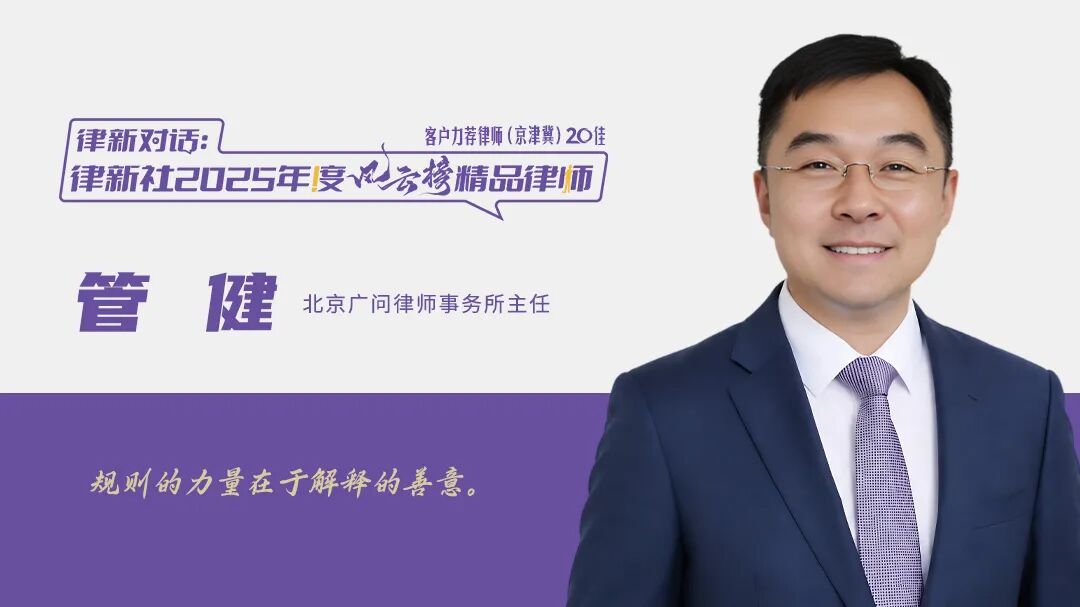
Currently, the contest between unilateralism and the multilateral order is becoming increasingly intense, and the international economic and trade legal environment facing Chinese enterprises is growing ever more complex. In 2025, Guan Jian, Director of Beijing Guangwen Law Firm, was named to the "Lvshin She 2025 Annual Trend List: Top 20 Client-Recommended Lawyers (Beijing-Tianjin-Hebei)." His two-decade career spans both finance and law, from anti-dumping practice to WTO dispute resolution, and then to export control compliance—making him a benchmark in the field of foreign-related legal services. Guan Jian's professional trajectory is not only a microcosm of personal career transformation, but also reflects the evolving role of Chinese foreign-related lawyers in the contest over international rules. From a lawyer's perspective, this case offers significant insights for legal response strategies at both the ordinary enterprise level and the national level: under external rule-based pressure, how can one safeguard one's own rights and interests through legal tools? This article will analyze Guan Jian's professional methodology from a legal perspective and explore the compliance pathways and legal countermeasure options available to Chinese enterprises when facing international economic and trade frictions.
I. Career Transition and Professional Barriers: Cross-Disciplinary Integration of Law and Finance
Guan Jian's career did not begin in law, but in finance. His undergraduate background in finance, CPA certification, and work experience in loan recovery at a bank laid the groundwork for his subsequent entry into the field of international trade law. In 2005, he joined the international trade team at Zhong Lun Law Firm, where he stood out in anti-dumping questionnaire responses thanks to his financial expertise. At its core, anti-dumping practice is a contest of financial data, involving specialized operations such as cost accounting and questionnaire responses. This requires lawyers to not only be proficient in the law, but also to understand corporate financial logic. Guan Jian's cross-disciplinary background happened to fit this need perfectly, creating an early professional advantage.
Yet what truly made him realize he had "not yet entered the field" was DS405—the EU anti-dumping case against Chinese leather shoes. This WTO dispute settlement case showed him that anti-dumping provisions are rich in legal doctrine, that the same term can be subject to multiple legal interpretations, and that questionnaire responses are merely "technical operations" rather than legal analysis. This watershed moment of realization prompted him to pursue further studies at the World Trade Institute of the University of Bern in Switzerland, where he systematically studied WTO law and foundational theories of international trade. Moving from practice to academia and back to practice, Guan Jian's logic of transformation was: converting research capabilities into professional influence, and then leveraging professional influence to drive business competitiveness.
From the perspective of legal practice, the implication of this path for young lawyers is that the construction of professional barriers requires interdisciplinary integration, and continuous knowledge restructuring is the foundation for coping with complex international rules. For enterprises, the value of foreign-related legal services lies in whether lawyers can integrate financial, legal, and industry knowledge to provide precise compliance solutions.
II. WTO Dispute Settlement and Rule Interpretation: A Legal Methodology of Persuading Through Reason
Guan Jian's deep engagement in the WTO dispute settlement field reflects the unique value of a "scholarly lawyer." He has participated in multiple WTO cases led by the Chinese government and was involved throughout negotiations for bilateral and regional trade and investment agreements. The core of his methodology is "believing in the rule of law and persuading through reason"—that is, finding breakthroughs within the rules system through rigorous legal interpretation. This philosophy is particularly critical at a time when the WTO Appellate Body is inoperative.
Using DS405 as an example, Guan Jian pointed out that the doctrinal depth of anti-dumping provisions far exceeds practical operations, requiring the invocation of Articles 31 and 32 of the Vienna Convention on the Law of Treaties, combined with systematic analysis of the treaty text, context, and object and purpose. This interpretive approach is consistent with the logic of the U.S. Supreme Court's early 2026 ruling that IEEPA tariffs are unconstitutional—six justices, by citing Black's Law Dictionary and tracing legislative history, elucidated the original meaning of "regulate importation." This demonstrates that the power of rules lies in the good faith of interpretation, and the rigor of legal argumentation can transcend national borders.
For Chinese enterprises, the application scenarios of this methodology include: questionnaire response strategies in anti-dumping and countervailing duty investigations, rule interpretation in export control compliance, and the drafting of legal opinions in international arbitration. The value of lawyers lies in translating complex legal provisions into actionable compliance advice and predicting adjudicative trends through case studies. Guan Jian's experience demonstrates that solid legal research itself is the best form of market development; enterprises should value lawyers' professional analytical capabilities rather than relying solely on relationship networks.
III. U.S. Unilateral Tariffs and Export Controls: A Pragmatic Path for Corporate Compliance
Currently, the United States is deploying an ever-expanding array of unilateral tools, while the WTO Appellate Body remains paralyzed, leaving Chinese companies facing the dilemma that "compliance means compliance with U.S. legal rules." Guan Jian takes a pragmatic view of this: if dependence on U.S. technology cannot be eliminated, the only path at this stage is "compliance with U.S. legal rules." This is not passive compromise, but a legal choice grounded in reality. However, the value of lawyers is not limited to passive compliance; countermeasures at the national level, such as the Anti-Foreign Sanctions Law, export controls, and rare earth regulations, are serving as deterrents and forcing the other side back to the negotiating table.
From a legal practice perspective, enterprises responding to U.S. export controls and sanctions need to establish a full-process compliance system: first, product and technology assessment, identifying controlled items under rules such as the EAR (Export Administration Regulations) and OFAC (Office of Foreign Assets Control); second, supply chain compliance, reviewing supplier and customer lists to avoid Entity List risks; third, contract clause design, incorporating compliance warranties and disclaimer clauses. The Guan Jian team's practice covers Section 301/232/332 investigations, EU Foreign Subsidies Regulation investigations, and compliance. Their experience shows that compliance is not merely a legal issue but also part of corporate strategy.
The lawyer's practical advice is: enterprises should regularly conduct export control training, establish internal compliance manuals, and hire professional lawyers to carry out mock reviews. When facing investigations, they need to respond quickly, prepare a complete chain of evidence, cooperate with the investigation while adhering to legitimate defenses. Guan Jian emphasized that technological independence and self-reliance is the ultimate way out, but during the transition period, legal compliance is the foundation of survival.
IV. The International Competitiveness of Chinese Lawyers: Gaps and Irreplaceable Advantages
Guan Jian candidly admitted that Chinese lawyers face three major gaps in top-tier international competition: language proficiency, depth of legal knowledge, and rigor of argumentation. In terms of the precision of legal language, control of sentence structure, and rhythm of argumentation, there remains a gap compared with native-speaking lawyers, one that cannot be closed within a single generation. On the same legal issue, foreign lawyers' opinions demonstrate notably more rigorous analysis at several junctures. However, Chinese lawyers possess irreplaceable advantages: first, their familiarity with Chinese laws and policies enables them to effectively link domestic countermeasure tools with international rules; second, their financial backgrounds and understanding of industries allow precise analysis of cost data in cases such as anti-dumping; third, their efficient learning ability and spirit of diligent research—for example, Guan Jian's team requires members to write English legal analyses of no fewer than 3,000 words, driving business through research.
From an industry perspective, the growth of Chinese lawyers specializing in foreign-related matters depends on platform development and team building. Guan Jian founded the WeChat public account "International Trade Law Review" (with nearly 50,000 followers) and Beijing Guangwen Law Firm, which exemplifies the practice of "building one's own stage." He hopes to build a truly capable international trade law team to solve cutting-edge issues for governments, business associations, and enterprises. When selecting foreign-related lawyers, companies should focus on their academic research capabilities, case experience, and cross-cultural communication skills, rather than looking only at seniority.
Conclusion: Believe in the Rule of Law, Persuade with Reason — Legal Insights for Enterprises Navigating International Economic and Trade Transformations
Guan Jian's two-decade legal career encapsulates the exploration and perseverance of Chinese foreign-related lawyers in the game of international rules. His core belief, "believe in the rule of law and convince others through reason," is not merely a personal methodology but also a practical guide for enterprises navigating international economic and trade turbulence. In the face of U.S. unilateral tariffs and export controls, companies must remain pragmatically compliant while skillfully leveraging legal countermeasure tools; and in light of the WTO Appellate Body's suspension, lawyers must seek breakthroughs in rule interpretation through in-depth research.
For enterprises, legal compliance is not a cost but an investment. In an era of rising unilateralism, the value of professional international lawyers lies in helping enterprises understand rules, avoid risks, and safeguard rights. Guangdong Zhiming Law Firm, as a professional legal service institution, can provide enterprises with in-depth support in areas such as international trade compliance, export control response, and WTO dispute resolution. Amid these changes, believing in the rule of law and persuading through reason is a reliable path for enterprises to navigate uncertainty.