Top 20 Lawyers for Corporate Compliance Risk Prevention and Control Released: Legal Analysis of the Boundaries Between Corporate Compliance Review and Criminal Risk in 2026
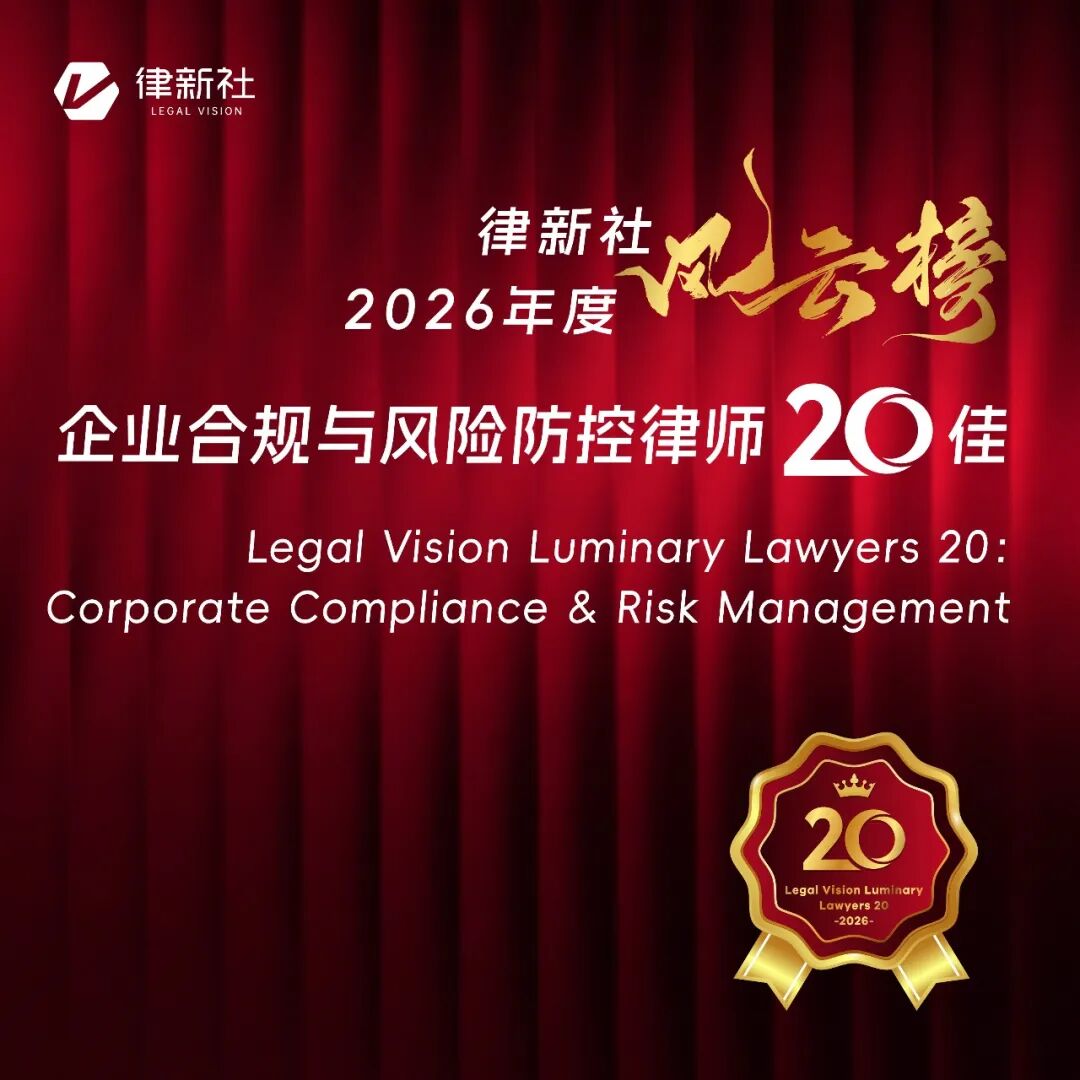
On August 24, 2026, Lvxin News officially released the "2026 Annual Power List: Top 20 Lawyers in Corporate Compliance and Risk Prevention," with 20 lawyers including Cai Yong, Jia Shen, and Jin Hongyi making the list. Behind the rankings lies a profound transformation in the legal services market for corporate compliance and risk prevention: extending from traditional contract review and labor employment to emerging fields such as data governance, cross-border operations, and supply chain security. For enterprises at large, this is not merely a display of industry honor, but also a warning on compliance risks—against the backdrop of tightening regulatory oversight, how can companies identify and resolve compliance risks? What professional support can lawyers provide? This article, drawing on the rankings and lawyer practice, offers an analysis from a legal perspective.
Corporate Compliance from "Optional" to "Mandatory": Regulatory Trends and Legal Basis
In recent years, corporate compliance reform has continued to deepen. The Measures for the Compliance Management of Central Enterprises, effective from October 2022, explicitly require central enterprises to establish compliance management systems and embed compliance review into their operational and management processes. Meanwhile, legislation in areas such as data security, personal information protection, and export controls has been enacted intensively: the Data Security Law and the Personal Information Protection Law took effect in 2021, and the Export Control Law came into force in 2020. Together, these laws and regulations constitute hard constraints on corporate compliance.
The practice areas of several lawyers on the list confirm this trend: Lawyer Cai Yong focuses on highly regulated industries such as internet digital technology and heavy chemical engineering, Lawyer Jia Shen participated in the first batch of pilot compliance system projects of the Beijing State-owned Assets Supervision and Administration Commission, and Lawyer Jin Xiaoyu's clients cover emerging industries such as biotechnology, semiconductors, and blockchain. This shows that corporate compliance is no longer limited to traditional legal risks, but has expanded to diverse scenarios such as data governance, cross-border operations, and supply chain security.
For enterprises, compliance building is not merely a passive response to regulatory requirements, but an active strategy to enhance market competitiveness. The ISO 37301 compliance management system standard provides enterprises with an international compliance framework, and Lawyer Jia Shen specializes in helping enterprises obtain certification under this standard. Compliance is not a cost, but an investment—it can reduce the risk of administrative penalties, protect goodwill, and strengthen investor confidence.
Criminal Compliance Risks: The "Red Line" That Businesses Cannot Afford to Overlook
Multiple lawyers on the list have criminal justice backgrounds. For example, lawyer Cai Yong has over twenty years of frontline judicial case-handling experience, and lawyer Jin Hongyi specializes in cross-over matters between criminal and civil cases. This reflects the close connection between corporate compliance and criminal risk prevention. In practice, common criminal risks for enterprises include commercial bribery, contract fraud, illegal business operations, infringement of citizens' personal information, and tax evasion.
The case handled by Attorney Jin Hongyi, in which an entrepreneur from a private equity fund was accused of contract fraud, is a typical example: by tracing the flow of over one hundred million yuan in funds, investment decision-making conduct, and connections of criminal intent, the court was ultimately persuaded to find that the client did not constitute the crime of contract fraud. This case illustrates that the key to preventing and controlling criminal risk lies in clarifying the boundary between business risk and criminal liability. Lawyers can determine whether conduct is criminally unlawful by examining the true transaction background, fund flows, and business operational logic.
Lawyer Cai Yong emphasized "taking judicial accountability standards as the starting point," which means corporate compliance must not be reduced to mere formality but should substantively prevent criminal risks. He promotes the establishment of mechanisms such as compliance pre-veto, checks and balances on job responsibilities, full-process risk assessment, and dynamic inspection and accountability — precisely to solve the dilemma of "complete institutional systems but ineffective substantive risk control." Enterprises should recognize that a compliance system that exists only on paper not only fails to prevent risks but may instead become "evidence" for criminal accountability.
Compliance risks extend into emerging areas: data, cross-border transactions, and supply chains.
The list shows that corporate compliance risks are extending into areas such as data governance, cross-border operations, and supply chain management. Lawyer Jin Xiaoyu's clients span biotech, semiconductors, blockchain, and other sectors; Lawyer Liu Ting specializes in compliance for cross-border investment in Central Asia; Lawyer Jia Shen focuses on compliance for enterprises expanding overseas. These areas are characterized by overlapping regulations, rapidly changing policies, and difficult cross-border coordination.
In terms of data compliance, the Personal Information Protection Law requires enterprises to establish a system of persons responsible for personal information protection and conduct personal information protection impact assessments. For platform enterprises that process large amounts of personal information, compliance obligations are particularly onerous. Lawyers can assist enterprises in conducting data compliance audits, establishing a data classification and grading management system, formulating privacy policies, and responding to regulatory inspections.
In cross-border operations, enterprises face multiple compliance requirements, including export controls, economic sanctions, and cross-border data transfers. Attorney Liu Ting provides compliance services for infrastructure projects in Kazakhstan, covering ODI filing, overseas data compliance, and other matters. Lawyers can help enterprises identify legal risks in target countries, design transaction structures, and ensure compliance in cross-border business operations.
Supply chain compliance also deserves attention. In recent years, extraterritorial legislation such as the U.S. Uyghur Forced Labor Prevention Act has imposed higher requirements on supply chain due diligence. Companies need to conduct compliance reviews of suppliers to avoid sanctions or reputational damage caused by supply chain issues. Lawyers can assist companies in establishing supply chain compliance systems, conducting due diligence, and developing contingency plans.
Legal Practice: Full-Cycle Services from Compliance Review to Crisis Response
The service models of lawyers on the ranking list show that corporate compliance and risk prevention have formed a full-cycle service chain: compliance review → system building → specialized governance → crisis response. Lawyer Liang Jiaying proposed an integrated service of "compliance review, system building, specialized risk governance, and compliance crisis resolution"; Lawyer Jin Xiaoyu developed a legal service product integrating "compliance with criminal, administrative, and civil matters"; Lawyer Liu Yao excels at achieving critical reversals in complex litigation.
Compliance review is the starting point. Lawyers identify compliance risk points by examining corporate policies and regulations, business processes, and contract documents. The review report should include a risk list, remediation recommendations, and priority rankings. System building, on the other hand, embeds compliance requirements into the corporate organizational structure, job responsibilities, and operational procedures. Attorney Jia Shen's approach of transforming legal norms into actionable systems, checklists, processes, and IT-based screening mechanisms is a typical practice in this phase.
Crisis response is an important reflection of a lawyer's value. When enterprises face administrative penalties, criminal investigations, or public opinion crises, lawyers can provide response strategies, assist enterprises in communicating with regulators, and strive for lighter penalties or non-prosecution. In a corporate loan fraud case, Lawyer Jin Hongyi facilitated the procuratorate's decision not to approve arrest, demonstrating the professional role of lawyers in criminal crises. Enterprises should establish a routine communication mechanism with lawyers so as to respond quickly when crises occur.
Conclusion: Compliance is the cornerstone of an enterprise's steady and long-term development.
The release of the Lvxin She rankings not only affirms outstanding lawyers but also reaffirms the value of corporate compliance. Against the backdrop of comprehensive law-based governance, enterprises can only achieve steady and long-term development by integrating compliance into the very fabric of their operations. For entrepreneurs and managers, compliance is not a constraint but a protection—it can isolate risks between individuals and enterprises, ensuring sustainable corporate development.
Guangdong Zhiming Law Firm, as a professional legal service institution, has accumulated extensive experience in the field of corporate compliance and risk prevention. We recommend that enterprises conduct regular compliance reviews, establish substantively effective compliance systems, and focus on emerging risk areas such as data, cross-border operations, and supply chains. When risks arise, seek professional legal assistance promptly to minimize losses. On the road to compliance, lawyers walk alongside you.