Corporate and Commercial Lawyer Zhu Shaowei on the Intersection of Criminal and Civil Law: From Losing a Lawsuit to Turning It Around — How Procedural Breakthroughs Revived a Ten-Billion-Yuan Project
As a company grows from 100 million to 500 million in annual revenue and then prepares for an IPO, every step up requires a complete overhaul of its governance structure. Yet in reality, many bosses pour all their energy into business expansion while their legal framework remains stuck at the "buddies in business together" stage of a makeshift operation. Only when the core team turns against each other, investors fall out, or regulators come knocking do they realize they cannot even hold onto the company seal.
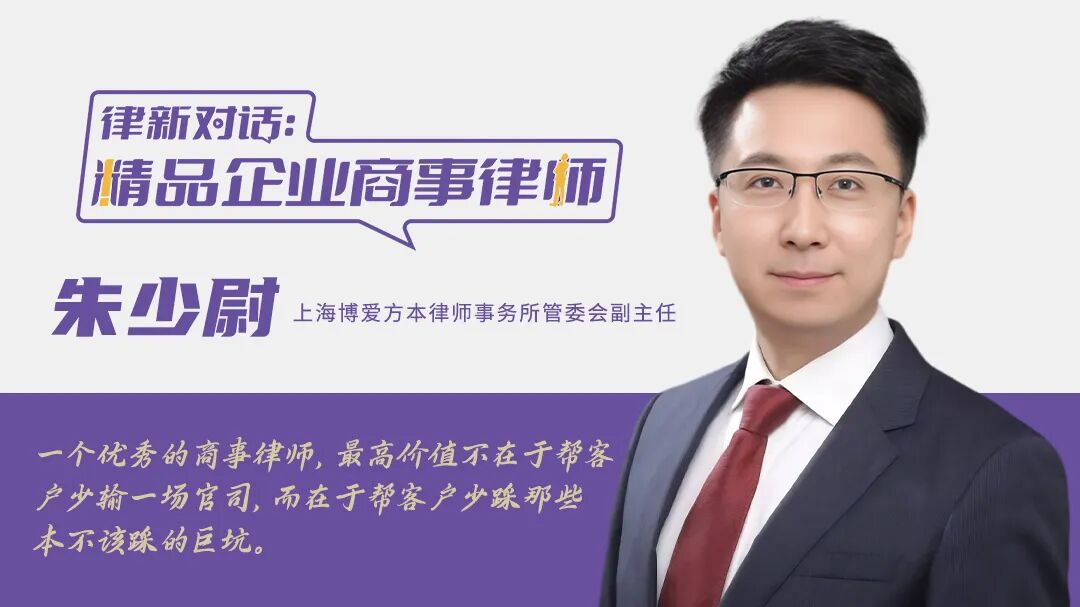
Zhu Shaowei, Attorney and Deputy Director of the Management Committee at Shanghai Bo'ai Fangben Law Firm, has an eighteen-year legal career spanning an intermediate court, a municipal government legislative affairs office, and the legal profession, with deep expertise in corporate investment and financing, mergers and acquisitions and restructuring, and major commercial dispute resolution. The over RMB 20 billion high-quality steel cord project in Huai'an for Zenith Steel and a six-year private equity fund control dispute that he handled reveal a harsh truth: more terrifying than losing a lawsuit is a severe mismatch between a company's expansion and its governance capacity. This article, from the perspective of legal practice, breaks down the legal risks in commercial disputes and the paths to breaking through.
I. Company Resolution Litigation: Why Procedural Issues Have Substantive Significance
Many company founders believe that as long as they hold a majority of equity, the company is theirs. However, when handling post-investment disputes involving private equity funds, Lawyer Zhu Shaowei discovered that the original actual controller, precisely through a lawsuit over company resolutions, exploited procedural defects to freeze the other party's control over the company's seals and accounts.
Article 22 of the Company Law of the People's Republic of China provides that if the convening procedures or voting methods of a shareholders' meeting, shareholders' assembly, or board of directors violate laws, administrative regulations, or the company's articles of association, or if the content of a resolution violates the company's articles of association, shareholders may, within sixty days from the date the resolution is made, petition the people's court to revoke it. This seemingly inconspicuous procedural provision often becomes the first battleground in the fight for corporate control in practice.
Lawyer Zhu Shaowei pointed out that his experience in the system's courts taught him: many cases are not lost on substantive legal merits, but on key procedural junctures. Flexibly using behavioral preservation to freeze the effect of a resolution, or engaging in the contest through precise jurisdictional objections, or responding by seizing on the nature, formation, and validity of legal relationships, can often achieve twice the result with half the effort.
For an ordinary company, this means that a properly drafted shareholders' meeting notice, a lawful voting procedure, and a complete set of meeting minutes may all become a "lifeline" in a future battle for control. Conversely, a procedural oversight could leave a major shareholder holding 70% of the shares at a disadvantage in litigation.
II. Intersection of Criminal and Civil Matters: When Civil Disputes Meet Criminal Case Filing, How to Achieve "1+1>2"
In the private equity fund case handled by Attorney Zhu Shaowei, the business empire built by the original actual controller was extremely complex, with intricate and tangled capital flows. The disputes spanned multiple dimensions—civil, criminal, and administrative—and were spread across many jurisdictions. Before he took over, the client had already suffered defeat after defeat; had any single procedural juncture failed to yield the desired outcome, the client might well have collapsed on the road to vindication before ever reaching the finish line.
The team established a comprehensive strategy of "procedural breakthrough + criminal deterrence." On one hand, we reconstructed the substantive rights basis of the civil and commercial dispute, thoroughly defeating the opposing party's false litigation. On the other hand, regarding the former actual controller's malicious transfer of assets and refusal to enforce the judgment, we pushed for the public security organ to file a case for investigation and pursue criminal liability.
Article 313 of the Criminal Law of the People's Republic of China provides that whoever, being capable of executing a judgment or ruling of a people's court, refuses to execute it, if the circumstances are serious, shall be sentenced to fixed-term imprisonment of not more than three years, criminal detention, or a fine; if the circumstances are especially serious, shall be sentenced to fixed-term imprisonment of not less than three years but not more than seven years, and shall also be fined. This charge is often overlooked in commercial disputes, yet it is a powerful weapon for narrowing the space for the opposing party to resist.
Lawyer Zhu Shaowei emphasizes that when handling complex commercial disputes, one cannot focus solely on a single "legal playbook." Civil proceedings resolve the attribution of rights, criminal proceedings deter malicious conduct, and administrative proceedings coordinate regulatory resources. Only when all three point toward the same goal can a "1+1>2" effect be achieved.
Enterprises must be reminded that the use of a criminal-civil intersection strategy must be built on a solid evidentiary foundation. Establishing false litigation, malicious transfer of assets, and similar conduct requires complete fund flow records, contract texts, and communication records as support. If an enterprise establishes a standardized archive management system in its daily operations, it will serve as the most powerful evidentiary weapon at critical moments.
III. Embedded Legal Services: How Can Long-Cycle Industrial Projects Avoid "Legal Lag"
The Zhongtian Iron and Steel Huai'an premium steel cord project has a total investment of over 20 billion yuan, with a long cycle, many participants, and complex interwoven interests. Lawyer Zhu Shaowei's team adopted an "embedded service" model. When the project was still just an office in its early stages, the lawyers were already stationed on site, accompanying it as it gradually built a complete corporate governance structure from a patch of empty land.
The traditional legal counsel model often follows a "client asks, lawyer answers" approach. However, in long-cycle major industrial projects, risks grow dynamically with project progress and are mostly systemic, making one-off consultations fundamentally inadequate. Article 509 of the Civil Code of the People's Republic of China stipulates that parties shall fully perform their obligations as agreed and, in accordance with the principle of good faith, perform obligations such as notification, assistance, and confidentiality based on the nature, purpose, and trade practices of the contract. But in projects worth tens of billions, the interconnections among thousands of contracts, the alignment of performance milestones, and responses to policy changes are far beyond what legal provisions can directly answer.
Lawyer Zhu Shaowei refers to this model as a "resident lawyer + front, middle, and back office collaboration" mechanism. Lawyers must not only understand the law, but also grasp their clients' strategic objectives, industry logic, and capital operations. They must find the optimal balance between compliance and efficiency, and build a communication bridge between government regulation and business demands.
For enterprises in their expansion phase, this lesson is highly instructive: legal counsel should not be a "firefighter" who only shows up when there is a fire, but rather an "architect" who gets involved in transaction structure design and risk contingency planning before the company decides to acquire land, build factories, raise financing, or undergo shareholding reform.
IV. Typical Signals of Corporate Governance Mismatch and Lawyers' Recommendations
Drawing on eighteen years of legal practice, Attorney Zhu Shaowei has observed that a mismatch between corporate governance and expansion capacity typically manifests through the following signals: a highly concentrated equity structure lacking checks and balances; core team incentives resting solely on verbal promises; high-risk clauses such as repurchase and valuation adjustment mechanisms buried in external financing agreements; arbitrary fund transfers between affiliated companies without compliance review; and chaotic management of seals and licenses due to the absence of a tiered authorization system.
These problems will not surface when a company is developing smoothly, but once shareholder disputes, investor exits, or regulatory inspections occur, they may erupt all at once. Lawyer Zhu Shaowei recommends that companies bring in commercial lawyers at three key points: first, when the founding team is establishing the equity structure, to clarify exit mechanisms and decision-making rules; second, before the first external financing, to complete a corporate governance compliance check; and third, when diversifying business or expanding across regions, to establish standardized processes for contract management and seals and licenses.
Moving from "judging right and wrong" to "solving problems" is the core value that distinguishes commercial lawyers from traditional litigators. Truly high-end legal services mean standing side by side with entrepreneurs and building solutions within complex systems. Guangdong Zhiming Law Firm has long been deeply engaged in the field of corporate and commercial legal services, accumulating extensive practical experience in corporate investment and financing, mergers and acquisitions and restructuring, and the resolution of criminal-civil intersecting disputes. It can provide enterprises nationwide with full-chain legal support, from equity structure design and compliance system development to the integrated handling of major commercial disputes.