

Can the investment agreement stipulate the repayment of principal upon maturity and sue for private lending
The reason for filing this case is a private lending dispute, not an investment contract dispute.
Judgment on September 10, 2026: The defendant shall return the principal to the plaintiff, with interest calculated from January 1, 2021 at the one-year loan market quoted interest rate until the actual repayment date.
Whether the cause of action can be determined in this way depends on whether there is a clear refund clause in the agreement.
1、 Basic information of the case
| project | Content |
|---|---|
| Case reason | Disputes over private lending |
| Accepting court | Futian District People's Court, Shenzhen |
| Filing Date | March 2, 2026 |
| Trial Procedure | Ordinary procedure, sole judge, open court hearing |
| Judgment time | September 10th, 2026 |
| Judgment Result | Return the principal; Interest will be calculated based on one-year LPR from January 1, 2021 until the actual repayment date; Please dismiss the remaining claims |
| The judgment takes effect | After the first instance judgment, neither party appealed, and the judgment in this case has come into effect |
| agent | Plaintiff (represented by our lawyer) |
| Lead Lawyer | Shen JinlongDirector of our institution |
The name, ID number number, case number and amount of money of the parties to the case, as well as the original of the judgment have been blackened, and will not be repeated here. After the first instance judgment was served, neither party filed an appeal within the statutory appeal period, and the judgment has become effective.
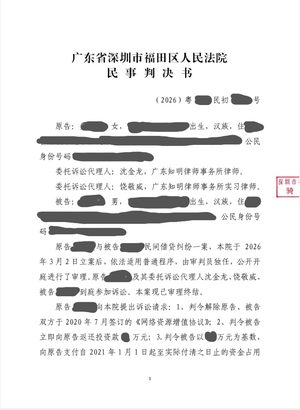
2、 The phrase 'if the transfer is not successful by the deadline, the principal will be refunded' in the agreement is the key point
In July 2020, the defendant introduced to the plaintiff the "food industry portal", "anti-counterfeiting traceability portal" and other Internet resources held by the defendant, and said that the market for such resources was active and the transfer price was rising steadily. The defendant invites the plaintiff to invest funds to jointly enhance the value of the platform, and to share the profits after the successful transfer.
On July 20, 2020, both parties signed the "Network Resource Value added Agreement" in Shenzhen. There are two sentences in the agreement that determine all subsequent choices in this case.
One sentence is that the plaintiff has invested funds to participate in the registration and value enhancement of resources related to the defendant's platform.
Another sentence is that the cooperation period ends on December 31, 2020. If the transfer is not successful by the deadline, the defendant shall fully refund the principal to the plaintiff.
The payment was made in two installments, one on July 2, 2020 and one on July 20, 2020. The defendant confirmed receipt during the trial.
The deadline has expired, and the platform has not successfully transferred or refunded the principal. Starting from December 26, 2020, the plaintiff has been continuously urging through WeChat until August 2025. In the chat records, the defendant repeatedly admitted the existence of the debt, and the reasons have changed several times.
The structure of this money is: uncertain returns, and the principal must be repaid. This decision determines all subsequent choices.
3、 Reporting a case can be attempted, but the litigation path cannot be pinned on the outcome of filing the case
The common reaction to such cases is to report them. The project introduction is complete, there is no follow-up after payment, and people keep dragging it out, which looks like contract fraud from the appearance.
Assess it as suspected contract fraud, based on the fact that it is not included in the project name and cannot be implemented in this agreement. The only outcome that the agreement aims to achieve is to transfer the platform resources and share the transfer benefits between both parties. The deadline is set for December 31, 2020, and if the transfer is not successful by the deadline, the principal will be refunded. The deadline has passed and the transfer has not occurred.
Investment losses and the failure of contract objectives are two different things. The former is due to the market not giving opportunities, and the principal may be folded in; The latter is the result of the agreement that has never occurred. Whether the party receiving the payment knew at the time of signing that the outcome was unlikely to occur is another layer of judgment and a question that criminal evaluation needs to answer.
The feasibility of filing a case depends on two things: whether it objectively meets the standards for criminal filing, and whether the evidence can be presented in the form required for criminal filing. From a civil perspective, having a written agreement, a genuine platform and introduction, and normal communication over a year after the money is received, are all manifestations of 'investment failure'.
You can try reporting the case first. But when deciding on the litigation path, one cannot bet all chips on a procedure whose outcome is not controlled by the parties involved. Whether to file a criminal case or not, the initiative lies with the investigating authorities; Where to file a civil lawsuit, on what grounds to file a lawsuit, and what to request, the initiative lies with the parties involved.
Our judgment when acting as an agent is to first use civil procedures to fix the matter of 'this money needs to be repaid', and keep the criminal line as the second set of plans for the trial.
4、 Among the three paths, only borrowing can bypass the concept of 'sharing risks'
This step is the most important choice in this case. There are three paths in front of us.
Firstly, disputes over investment contracts.The name of the agreement is investment, and filing a lawsuit according to the investment contract is the easiest way. There is an unavoidable part of this path: the essence of investment is to share risks and profits. Once the cause of action is determined as investment, the defendant only needs to claim that "the investment was originally profitable and profitable, and the plaintiff was willing to invest", and the issue immediately shifts to whether the defendant breached the contract or committed fraud, both of which are difficult to prove in civil court.
The defendant's defense in court is precisely this: the funds involved in the case belong to an investment relationship, not a loan.
Secondly, revoke the agreement on the grounds of fraud and demand its return.The threshold is on the proof of 'fraud'. To prove that the defendant knew at the time of signing the contract that the platform could not be transferred and that they did not have the ability to fulfill the contract. When we acted as an agent, we did not have any internal materials from the other party at the time, only the fact that we did not repay the money afterwards. Not repaying the money afterwards does not prove that one was cheating when signing the contract.
Thirdly, private lending.This path may seem counterintuitive, but it holds true. The basis is the sentence in the agreement, 'If the transfer is not successful by the deadline, the defendant shall refund the principal.'. The plaintiff's money has a definite exit channel, and whether the principal can be retrieved does not depend on the success or failure of the project, but only on whether the deadline expires.
This arrangement, which is called an investment but actually a loan, has a basis for being treated as a loan relationship in judicial practice. There are three practical benefits to choosing it.
The evidence structure is simple. Borrowing only requires two things to be proven: the money has been paid and it has been agreed to be repaid. Bank statements, original agreements, and WeChat collection records are all available.
Request clarification. The principal plus interest shall be calculated based on LPR from the day after the expiration of the term, which is a standard algorithm and does not require separate verification of the amount of loss.
Not giving the other party the space to 'share risks'. There is no such thing as self financing in a lending relationship.
On March 2, 2026, the People's Court of Futian District, Shenzhen, filed a civil loan dispute case, applied ordinary procedures, and held a public hearing with only one judge.
There is a detail that can illustrate the relationship between the claim and the cause of action: the claim states' return of investment funds', and the cause of action is private lending. The two are not contradictory. What needs to be returned is the money originally invested, using the name in the agreement. The basis of the claim is the principal that should be returned at the end of the term, regardless of its name.
5、 Prepare two sets before the court: either repay the money or transfer it
The reason for choosing a loan is obvious, and the risk is clear: the other party will definitely argue that 'this is an investment'. So two sets of plans were agreed upon before the court hearing.
Firstly, adhere to the loan relationship. Use the refund terms in the agreement, two transfer records, and multiple debt recognition records in WeChat to nail 'money to be repaid'.
Secondly, if the other party insists on the investment relationship and refuses to bear the principal, and points out in court that they received funds under the guise of investment and agreed to return the principal at maturity but failed to fulfill it, whether there are criminal issues in this situation needs to be judged by the investigating authorities. Accordingly, we request the court to transfer the criminal clues to the public security organs.
The task of the latter plan is simple: to present an objective contradiction in court. This money is either a loan in civil terms and must be repaid upon maturity; Either it's investment, sharing risks. If treated as an investment, there is still room for evaluation in criminal law regarding the matter of "agreed capital preservation exit and non performance upon maturity".
No matter which one the defendant chooses, they cannot both claim to share risks and keep the capital preservation agreement unfulfilled.
6、 The defendant admitted the principal but not the interest, and the second plan was immediately put into use
The defendant's defense is consistent with the prediction: this is an investment relationship, not a loan. The defendant acknowledges the return of the principal; The defendant does not agree with the interest, stating that it is acceptable if the interest is calculated from the date of the trial.
This sentence needs to be broken down: recognizing the principal and not recognizing the interest is equivalent to admitting that 'money needs to be repaid', while denying only 'starting from January 1, 2021'. And the starting point for interest is precisely the day after the expiration of the term.
After the defendant explicitly denied the loan relationship and refused to bear the interest after the expiration of the term, Lawyer Shen Jinlong of our firm filed a lawsuit with the court: in this case, funds were collected under the guise of investment, and the agreement was made to return the principal upon maturity but not fulfilled. Accordingly, the court is requested to transfer the criminal clues to the public security organs.
The defendant confirmed in court that the principal should be returned. The verdict recorded this sentence.
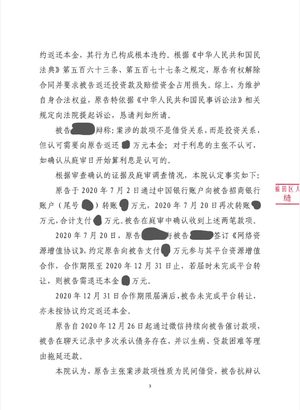
7、 The court did not determine the nature of the payment, only found that the refund conditions had been met
The court did not directly determine whether the money was a loan or an investment.
The judgment states: "Regardless of the nature of the funds involved in the case, legitimate creditor's rights are protected by law
The court is taking a different path. The agreement stipulates that if the transfer is not completed after the expiration of the cooperation period, the principal will be refunded. If the deadline has expired, the refund conditions will be met; The defendant also confirmed in court that the principal should be returned, so they directly supported the return of the principal. In terms of interest, the court found that the defendant's failure to return the funds as agreed did indeed cause a loss in the occupation of funds, and supported the calculation of one-year LPR from the day after the expiration of the deadline, which is January 1, 2021, until the actual repayment date.
This handling method indicates that the court does not need to first determine the nature of the payment, but can also make a judgment. The value of the cause of action is to bring the trial into the realm of "whether money should be returned" and constantly focus on "who bears the investment risk".
The scope of civil trial determines that another layer will not appear in the judgment. The court judges whether the lawsuit request can be established: whether the refund conditions are met, whether the principal should be repaid, and how to calculate the interest. Whether there was any fabrication at the time of signing, where the money went, and whether the platform has the possibility of transfer, these are criminal evaluations, civil judgments are not reviewed, and are not included in the judgment items.
So the judgment only includes the sentence 'legitimate creditor's rights are protected by law', and there is no indication of whether it is suspected of contract fraud. The reason for leaving blank space is that civil procedures do not handle this aspect. Not being recognized does not mean that recognition does not constitute.
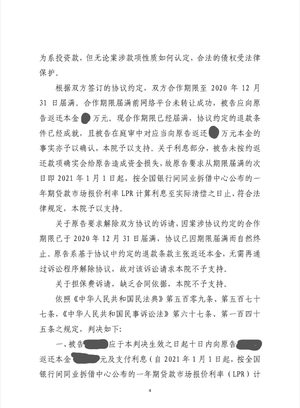
8、 Two claims were rejected, indicating that the design of the claims also has boundaries
Two claims in this case have been rejected.
One option is to terminate the agreement. The court believes that the agreement has naturally terminated due to the expiration of the term, and the plaintiff claims to return the principal based on the refund clause, without the need to terminate it through litigation.
The other item is the guarantee fee, which the court believes lacks contractual basis.
These two items were rejected, which does not affect the outcome, but indicates that the design of the claim is redundant. Terminating an expired agreement has no practical significance; The guarantee fee is not specified in the agreement, and even if it is written, it cannot be supported. The more appeals, the better. Writing more parts will only make the trial spend time on unimportant things.
9、 If one of the three conditions is missing, this path will not hold
It must be made clear that the path of this case depends on three conditions, and if one is missing, it needs to be redesigned.
There are clear provisions for capital preservation or repurchase in the agreement. The core evidence of this case is the phrase 'if the transfer is not successful by the deadline, the principal will be refunded'. If the agreement states profit sharing, risk sharing, or no exit arrangement at all, the basis for filing a loan case does not exist, and the court may directly handle it as an investment relationship.
Money is paid to individuals and there is no equity or share registration. If the payment is made to the company and the equity registration is completed, the nature is closer to equity investment. Exit requires capital reduction or equity transfer, and cannot be treated as a loan.
The plaintiff did not participate in the operation and did not share the profits. Once there is a record of dividends or participation in decision-making, the recognition of "shared risk" is difficult to overturn.
The other two situations will also render this plan ineffective. For civil cases that have already been reported and filed, the trial usually needs to be suspended, with the punishment first and the civil case later. If the defendant has no assets available for execution under their name, no matter how clearly the judgment is written, they will still not receive money during the execution phase.
10、 Frequently Asked Questions
Can I directly report the investment funds to the police if they are not refunded upon maturity?
You can report it. But whether it can be filed depends on whether it objectively meets the criminal filing standards and whether the evidence can be presented in the form required for criminal filing. Having a written agreement, a real project, and normal communication after the money is received can make people tend to view it as a civil dispute. The conflict between reporting a case and filing a civil lawsuit lies in which side to focus the main energy on.
How will the court determine that an investment is actually a loan?
The court will examine whether the agreement includes capital preservation or repurchase arrangements, whether there is a definite exit channel for the principal, and whether investors participate in the operation and share the profits. The handling method of this case is: if the transfer is not completed upon the expiration of the agreed deadline, the principal will be refunded. If the deadline has expired and the refund conditions have been met, the principal will be refunded accordingly, without first determining the nature of the payment.
Can I still request to transfer the case to the public security after filing a civil lawsuit?
Can be proposed. In the trial, one party insists on the investment relationship and refuses to bear the principal, while the agreement also stipulates a capital preservation exit. This contradiction will constitute the evaluation space for criminal clues. The proxy lawyer may propose to the court to transfer the criminal clues to the public security organs, and the court shall handle them according to its authority. The decision on whether to transfer lies with the court, not with the parties involved.
Why is there no recognition of contract fraud in civil judgments?
The civil trial only considers whether the lawsuit request can be established: whether the refund conditions are met, whether the principal should be repaid, and how to calculate the interest. Whether there is fabrication at the time of signing, the destination of funds, and whether the platform has the possibility of transfer are within the scope of criminal evaluation, and civil judgments will not be reviewed or included in the judgment items. The fact that the judgment did not determine that it constituted contract fraud does not mean that it was not determined.
There is no refund clause in the agreement, can we still sue based on the loan?
The foundation will be weak. Without capital preservation or repurchase arrangements, whether the principal can be recovered depends on the success or failure of the project, and the court is more likely to handle it based on investment relationships. In this case, we need to go back to the contract itself and see if the defendant made any false statements or fundamental breaches during the signing and performance process. From the perspective of breach or fraud, we need to find another basis for the right of claim.
The case described in this article is limited to the facts determined in the effective civil judgment of this case. The information of the parties involved has been desensitized, and the images of the judgment have been compressed to the smallest recognizable size for verification purposes only.
The distinction between contract disputes and criminal fraud, as well as the sequence of civil and criminal procedures, can be found in our institutionCriminal civilian intersectionBusiness page; For those who need to undergo criminal prosecution assessment, please refer toCriminal ComplaintBusiness page.
This article is authored by the lawyer in charge of this case and the director of our firmShen Jinlong Lawyercompose.

