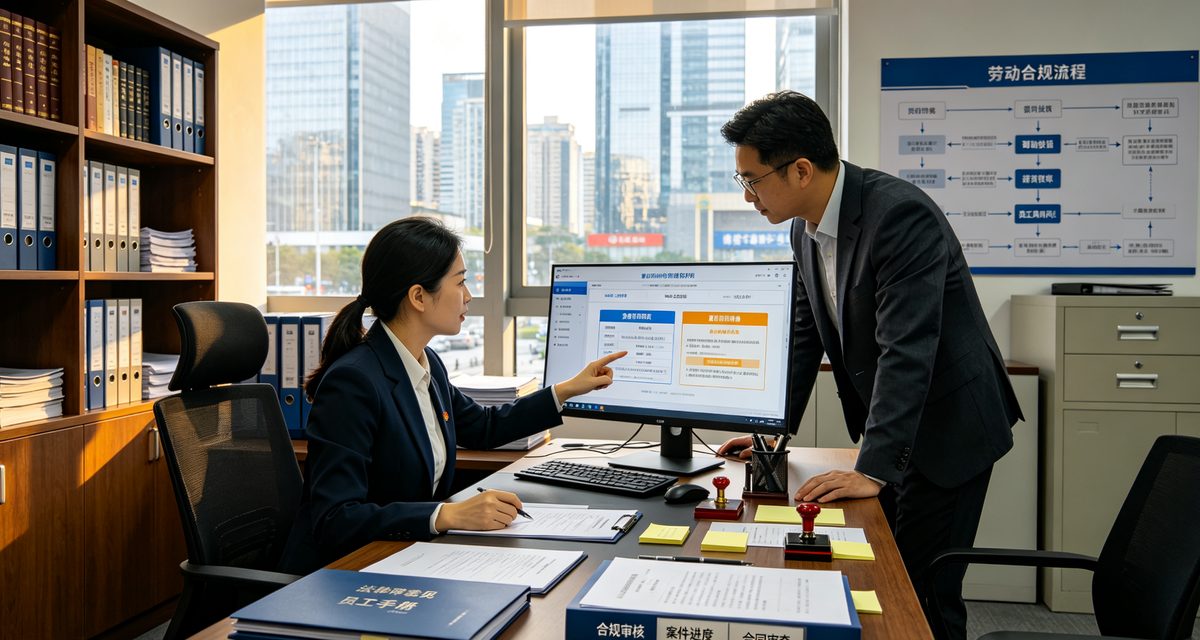
From being owed wages to finally getting paid, here is the 90-day record of Xiao Li, a worker in Shenzhen, fighting for his rights.
Last week, a client came to me and said he was a project manager at a decoration company in Bao'an District. His surname was Li, he had been in the industry for eight years, and he led a construction crew of over twenty people. Last year, he completed a curtain wall project for an industrial park in Longhua worth over 30 million yuan, but the client withheld the final payment of over 6 million yuan, citing "incomplete acceptance documents" as the reason. Li had fronted all the material costs and workers' wages, maxed out his credit cards, and mortgaged his house. Workers were camped outside the company every day demanding their pay. He spent over half a year running back and forth—the client's side passed him from the project manager to the engineering department, then from engineering to legal, and eventually stopped answering his calls altogether. Li asked, "Lawyer Wang, have I been taken for a ride? Can I still get this money back?"

After I finished reviewing the stack of contracts and supplemental agreements he brought, my heart skipped a beat—this wasn't just a case of "incomplete acceptance documents." The contract clearly stated in black and white that "95% of the total settlement price shall be paid after the completion acceptance of the project," but the supplemental agreement added an extra clause: "The final settlement shall be subject to the audit results, with the audit period not exceeding 24 months." It was precisely on this clause that Party A relied to drag the payment obligation into an "indefinite" delay. Xiao Li's case is exactly the most typical trap in Shenzhen construction contract disputes—every supplemental agreement you sign could be a buried landmine.
Three pitfalls in engineering contracts — falling into even one is enough to cause you serious trouble.
The first pitfall: turning the audit clause into a stalling tactic.Many contractors think that when the client is willing to sign a supplementary agreement, it's a sign of respect and good faith. In reality, many clients slip vague clauses like "subject to audit" or "subject to settlement review" into these agreements, but neither specify when the audit will start nor set a deadline for its completion. Once the project is finished, the client goes silent, the audit drags on for a year or two, and your money gets legally tied up. Xiao Li's contract was exactly like this—the audit firm designated by the client quoted an outrageously high price, making it clear they had no intention of letting you finish the process.
The second pitfall: the acceptance process "passing the buck."The project is completed, but Party A refuses to organize the acceptance inspection, or after the inspection, gives no written opinion, only verbally saying "make rectifications first" and then goes silent. Many contractors don't realize that the final acceptance inspection is a legal obligation of Party A, not a "favor you're asking for." If Party A delays the acceptance, you can issue a written demand for it. If they still fail to conduct the inspection after the demand, the law deems it "unauthorized use," and the payment conditions are still met. However, the prerequisite is—you must have evidence of the written demand; otherwise, it's difficult for the court to accept your claim.
The third pitfall: vague wording in contract terms.For example, the phrase "final settlement shall be subject to the audit results" — does it mean "the audit report serves as the sole basis" or "the audit results are for reference only"? In recent years, the tendency of the Shenzhen Intermediate Court's precedents is that if the audit results are clearly unreasonable, or the auditing entity lacks the requisite qualifications, the court may commission a new appraisal. However, if you fail to specify in the contract the "period for objecting to audit results" or the "conditions for initiating a re-appraisal," you will be left defenseless in court.
Over these 90 days, how did we gradually get the money back, Xiao Li?
First, "secure the evidence" before talking about "burning bridges."The first thing we did was not send a legal letter, but guide Xiao Li to organize all the emails, WeChat chat records, and meeting minutes from the past two years, focusing on finding any fragments where the client acknowledged the project quantity and quality. And we actually found it—the client's engineering department manager had sent a voice message in the WeChat group: "Xiao Li, the work you've done is fine, it's just that the process is a bit slow." That voice message later became key evidence proving that "the project had been delivered and put into use."
Second step: bypass the "audit trap" and directly assert "unauthorized use."We reviewed the surveillance records from the project site and found that Party A had moved in for office use as early as six months ago, and had even held several large-scale events. Under Article 14 of the Interpretation (I) of the Supreme People's Court on Several Issues Concerning the Application of Law in the Trial of Disputes over Construction Project Construction Contracts, if the employer uses an unaccepted construction project without authorization, it shall be deemed as acceptance qualified. Using this as a breakthrough, we directly filed a lawsuit demanding payment of the project款项 and overdue interest, without further disputing the audit process with Party A.
Third step, apply for property preservation to force the other party back to the negotiating table.At the same time as filing the lawsuit, we applied to freeze two of Party A's bank accounts in Shenzhen. This move proved highly effective — Party A had tens of millions in liquid funds sitting in those accounts, and once they were frozen, Party A immediately called to discuss a settlement. In the end, both parties reached a mediation agreement under the court's auspices, with Party A paying the full amount owed in three installments. From filing the case to receiving the first payment, it took a total of 87 days.

Xiao Li's case is a typical tragedy caused by "unclear contracts and improper procedures." However, more common engineering contract disputes often involve multi-level subcontracting, affiliation relationships, or sometimes no written contract at all. In such situations, relying solely on the contractor to negotiate directly with the client is basically like talking to a brick wall.
A professional lawyer's "scalpel" and "firewall"
At Guangdong Zhiming Law Firm, we have handled too many similar construction payment disputes. Director Lawyer Shen Jinlong often says, "The decisive factor in contract disputes lies not in the litigation itself, but in the signing of the contract." Lawyer Shen holds a master's degree in economics from Fudan University, has served as a senior executive at a large state-owned enterprise, and possesses 31 years of qualifications as an economist. He excels at uncovering legal loopholes through business logic. For instance, regarding the "pay-when-paid clause" in construction contracts (where the contractor only pays the subcontractor after receiving payment from the upstream party), the standards for recognizing such clauses are inconsistent across arbitration and court rulings in Shenzhen. Lawyer Shen will help you design "exception clauses" to prevent the client from using upstream disputes as an excuse to default on payments.
Lawyer Li Wei from Zhiming Law Firm has over 20 years of experience handling economic contract disputes and corporate legal matters. He once handled a case where an electronics factory in Shenzhen was defrauded of over three million yuan in payment by an intermediary, and even the legal representative's name was incorrectly written in the contract. Instead of rushing to file a lawsuit, Lawyer Li first investigated the counterparty company's registered capital and shareholders' capital contributions. He discovered that the shareholders had engaged in capital withdrawal, so he directly added the shareholders as co-defendants. In the end, he recovered the full amount owed from the shareholders' personal accounts through enforcement.
If you are caught up in engineering payments, goods payments, or other economic disputes, don't tough it out on your own. Start by calling Shenzhen's free legal consultation hotline. 0755-25986969Talk to a lawyer about your contract and evidence. Zhiming Law Firm is located in Room 1802, Building A, Xintian Century Business Center, Futian District. We've been established for 26 years and welcome you to come in for a face-to-face chat anytime. Our独创 "Zhiming Art Litigation Method" focuses on finding the most ingenious breakthrough within the framework of rules—not by rigidly clinging to legal provisions, but by solving legal issues with a business mindset.
Regarding engineering contracts and economic disputes, you may also want to ask:
1. The first party keeps saying "no money"—is it useful to sue?
Useful. Before filing the lawsuit, apply for property preservation first to freeze the other party's bank accounts, real estate, and vehicles. Many clients who claim to have "no money" suddenly come up with funds once their accounts are frozen. Even if they truly have no money, you can apply to have them listed as a dishonest judgment debtor, restricting their high-consumption activities and forcing them to come forward to resolve the issue.
2. If there is no formal contract signed, only WeChat chat records, can the lawsuit be won?
Yes. In recent years, Shenzhen courts have recognized WeChat chat records and emails as forms of written contracts. However, it should be noted that the chat records must be complete and coherent, and able to prove that both parties reached an agreement on the project content, price, and payment schedule. It is best to also provide supporting evidence such as transfer records, delivery notes, and acceptance forms.
3. If the engineering contract stipulates "payment after invoicing," and I have not issued the invoice, can Party A refuse to pay?
No. Issuing an invoice is an ancillary obligation, while paying the project payment is a primary obligation. Party A cannot refuse to pay merely because you have not issued the invoice. However, if Party A suffers losses as a result (such as being unable to claim tax deductions), they may seek compensation from you. In practice, it is generally advisable to first file a lawsuit demanding payment while simultaneously indicating your willingness to issue the invoice retroactively.
4. What is the relationship between shareholder information rights litigation in Shenzhen and engineering payment disputes?
If you are not a contractor but a company shareholder, and you discover that the company has a large amount of receivables for construction projects that have not been pursued for a long time, you can file a shareholder's right-to-know lawsuit to inspect accounting books, original vouchers, and even demand that the company initiate legal proceedings against the debtor. This falls within the scope of shareholder derivative litigation. Lawyers in Bao'an District, Shenzhen, often need to apply both the Company Law and the Contract Law when handling such cases.
5. If you win the lawsuit but the opposing company has been deregistered, can you still recover the money?
It depends on whether there was lawful liquidation at the time of deregistration. If the shareholders promised at deregistration that "all company debts have been settled," but there are actually unresolved debts remaining, you can sue the shareholders to demand they bear compensation liability. Another approach: check whether the other party has any external investments or accounts receivable, and apply for subrogation enforcement.
When it comes to contract disputes, the worst thing you can do is panic and rush into reckless actions. Remember: your contract is your weapon, and evidence is your ammunition. Before signing any contract, spending a few hundred dollars to have a lawyer review it is far more cost-effective than spending tens of thousands of dollars on litigation later. If you're already entangled in a contract dispute, don't hesitate—pick up the phone and call. 0755-25986969Let a lawyer from Zhiming Law Firm analyze it for you—at the very least, you need to know whether the cards in your hand are actually playable.
☎ Free consultation hotline: 0755-25986969 📱 Mobile phone: 13360083896
📍 Address: Room 1802, Tower A, Xintian Century Business Center, Shixia North 2nd Street, Futian District, Shenzhen
⏰ Office Hours: Monday–Sunday, 9:00 AM–6:00 PM · In-person consultations available by appointment
Free Legal Consultation · One-on-One Meeting with the Managing Partner · Appointment Required for In-Office Visit