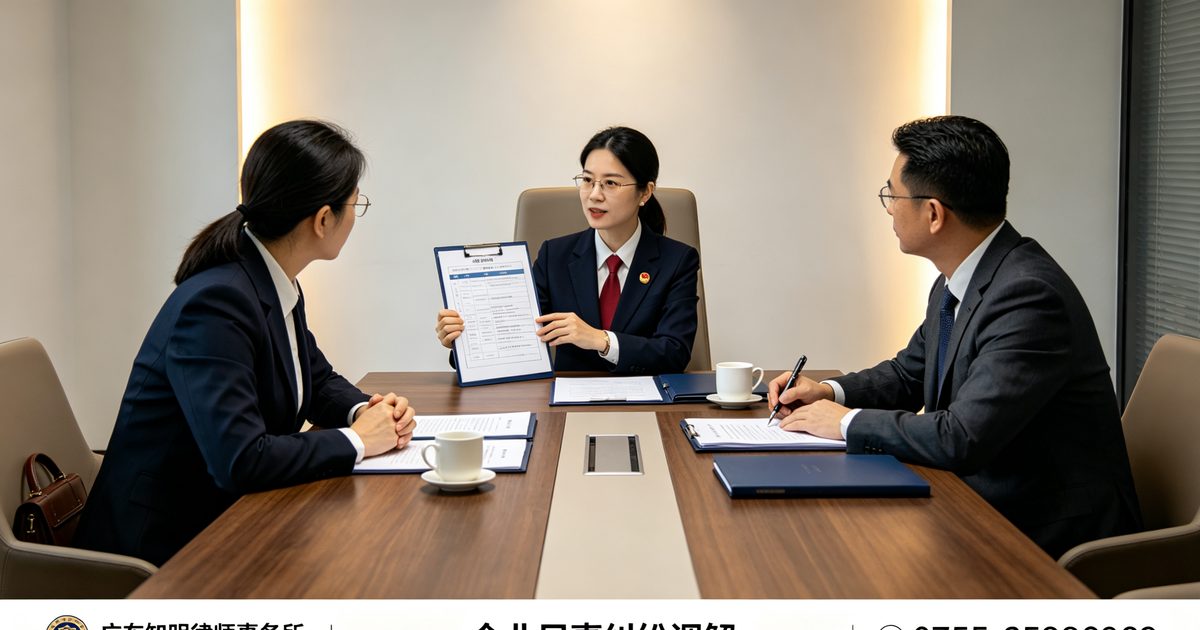
Shenzhen companies frequently face equity disputes? Looking for the right law firm in Shenzhen—check this trade secret protection and compliance guide first.
Let me start with a real case—
In 2024, a tech company in Nanshan, Shenzhen that made smart hardware came to us — the founder, Mr. Wang, was on the verge of a breakdown. His co-founder and CTO had jumped ship to a competitor with the core source code and client list, and then poached two of his sales managers. What made it worse was that because the company's equity structure had been set up too casually at the time of its founding, the CTO had never signed a non-compete agreement, and even the clause on "ownership of trade secrets" had not been clearly defined.
President Wang trembled with rage: "Lawyer Shen, our company's valuation has exceeded a hundred million, and now all our core assets have been taken away. What am I supposed to do?"
In the end, with the intervention of Senior Partner Shen Jinlong's legal team, this case employed a coordinated strategy of "trade secret protection + equity buyback + non-compete accountability," recovering nearly ten million in losses for Mr. Wang. But to be honest, if Mr. Wang had implemented compliance precautions in the early days of his startup, the situation would never have escalated to this point.
Today, using this case as an example, I'll thoroughly explain the most common equity and trade secret legal pitfalls that Shenzhen companies tend to fall into.
I. Risk Warning: The Three Most Common "Hidden Bombs" for Shenzhen Companies
1. The "Time Bomb" of Equity Structure
Many Shenzhen bosses started their businesses relying on a sense of "brotherhood" and a verbal agreement. Equity ratios were decided on a whim, shareholder roles were based on mutual understanding, and profit distribution depended on mood. And what happened? As the company grew, conflicts emerged: some contributed capital but not effort, others contributed effort but not capital, and some wanted to exit but no one was willing to buy them out. What's more, if a shareholder left with technical know-how or client resources, the company could collapse overnight.
We have handled too many such cases. Some companies have even been listed as operating abnormally by the Administration for Industry and Commerce due to equity disputes, causing all their financing to fall through.
2. The "Leaky Bucket Effect" of Trade Secrets
Shenzhen is a city of technology, but the protection of trade secrets in many tech companies is truly like a colander. There are no confidentiality agreements, no non-compete clauses, no management procedures for classified documents, and not even any declassification measures taken when employees leave. Do you think it's all settled once employees sign a "Confidentiality Agreement"? If that agreement doesn't even clearly specify the scope of confidentiality, the duration of confidentiality, or the liability for breach, it's very difficult to enforce legally.
What's even more frightening is that some companies "write" their trade secrets in WeChat groups or store them on personal cloud drives, so when a dispute arises, they can't even preserve the evidence.
3. The "Gray Areas" of Corporate Compliance
Many business owners in Shenzhen think that "compliance" is something only big companies need to worry about, and that for their small operations, a casual approach will do. However, data from the Shenzhen Market Supervision Administration for 2024 shows that the number of small and medium-sized enterprises penalized for invoice issues, labor law violations, and lack of data compliance increased by 40% compared to last year. Once labeled a "dishonest enterprise," bidding, financing, and partnerships are all affected.
2. Solution: Shen Jinlong Team's "Four-Step Compliance Protection Network"
In response to the above pain points, the team led by Director Lawyer Shen Jinlong of Guangdong Zhiming Law Firm, combining 22 years of practice experience and a 31-year background as an economist, has developed a "Four-Step Protective Net" solution specifically tailored for small and medium-sized enterprises in Shenzhen:
Step 1: Dynamic Design of Equity Structure
Don't determine equity solely by capital contribution ratio. Instead, incorporate factors such as human capital, technology contributions, and resource input to design a dynamic equity adjustment mechanism. For example, set up a "vesting" period where employees only earn full equity after working for four years; also, include a "repurchase clause" allowing the company to buy back shares at an agreed price when a shareholder leaves. This protects the founders' control while avoiding the deadlock of "shares remaining after the person is gone."
Step Two: The "Triple Lock" System for Trade Secrets
First lock: Sign the Confidentiality Agreement and Non-Compete Agreement, clearly defining the scope of confidentiality (source code, client lists, pricing strategies, procurement channels, etc.), the non-compete period (up to 2 years), and the amount of liquidated damages (recommended to be no less than 3-5 times the employee's annual income). Second lock: Establish access control for confidential areas, encryption for confidential computers, and a tiered management system for confidential documents. Third lock: Conduct a mandatory "debriefing interview" for departing employees, and have the legal department issue a "Departure Confidentiality Reminder Letter."
Step 3: Compliance Review and Risk Checklist
Spend half a day each year having a professional legal team conduct a "legal check-up" for the company. From five dimensions—equity structure, labor contracts, intellectual property, tax planning, and data security—produce a "Corporate Legal Risk Checklist" and rectify each item one by one. Many business owners see this as an expense, but in reality, it saves money—the cost of one check-up may be only a tenth of what future litigation would cost.
Step 4: Routine Preservation of the Evidence Chain
Every company should establish an "evidence log" system. Emails, WeChat chat records, and contract signing processes related to important decisions should be archived promptly. In particular, content involving core technology discussions and customer price negotiations must be documented without fail. Should a dispute arise, this evidence will serve as your "ammunition" in court.
III. Why Choose Zhiming Law Firm? — The Confidence of 10,000+ Cases
Guangdong Zhiming Law Firm was established in 2000 and is one of the earliest partnership law firms in Futian District, Shenzhen. Over the past 26 years, Director Lawyer Shen Jinlong has led the team to handle over 10,000 cases in total, with particular expertise in the "systematic handling of difficult and complex cases."
Last year, we handled a typical cross-disciplinary case involving "trade secrets + equity": a cross-border e-commerce company in Shenzhen, where three core operations staff left with backend data and supply chain resources to start their own business. By gathering 46 pieces of evidence, including backend logs, WeChat chat records, and logistics documents, we built a complete evidence chain. In the end, the court ruled that it constituted trade secret infringement, ordered compensation of 3.8 million yuan, and prohibited the three former employees from engaging in similar business for two years.
The hardest part of this case wasn't actually the application of the law, but the preservation of evidence. Since much of the data was stored in the cloud, we had to use blockchain-based evidence storage technology to ensure the evidence couldn't be tampered with. This is also what sets Shen Jinlong's team apart from ordinary lawyers—he understands technology, business, and management, and can turn legal solutions into actionable business strategies.
4. Four Frequently Asked Questions (FAQ) That Shenzhen Bosses Care About Most
Q1: Which law firm in Shenzhen is the strongest? How can you assess their professional competence?
Don't look at the scale—look at the "fit." For equity disputes, ask the lawyer whether they've handled similar cases, what their win rate is, and whether you can see the judgments. For trade secret protection, ask whether the lawyer understands the technical background and has experience in evidence preservation. It's advisable to first call the free consultation hotline (0755-25986969) to have a chat, make a preliminary assessment of their expertise, and then decide whether to retain them.
Q2: How do Shenzhen trade secret protection lawyers charge?
In the market, fees are generally charged by the hour (500–3,000 RMB/hour) or as a percentage of the subject amount. Zhiming Law Firm has launched an "Annual Corporate Legal Advisor Card" service for small and medium-sized enterprises, which includes the establishment of trade secret systems, contract review, and legal consultation. The annual fee is over 60% cheaper than hiring in-house legal counsel separately. For specific plans, please contact us by phone.
Q3: Is free legal consultation in Shenzhen reliable?
Reliable free consultation is a "gateway for client acquisition," not something to be handled casually. Zhiming Law Firm offers a 30-minute free in-person consultation, conducted by licensed attorneys, not interns. During these 30 minutes, the lawyer will help you sort out the facts of your case, assess risks, and provide preliminary advice. However, please note that the free consultation does not include issuing legal opinions or representing cases.
Q4: The company hasn't had any issues yet, do we still need to do compliance?
Waiting until problems arise to hire a lawyer is like waiting for a house fire to install a fire hydrant. Shenzhen's business environment is becoming increasingly standardized, and many major clients and investment institutions now conduct "legal due diligence." If your company doesn't even have basic confidentiality agreements and shareholding entrustment agreements in place, you won't pass due diligence at all. Compliance isn't a cost—it's an investment.
One last thing: preventing corporate risks is always more important than seeking remedies after the fact. If you are starting a business in Shenzhen, or your company is facing issues with equity or trade secrets, why not drop by Zhiming Law Firm? Our address is Room 1802, Tower A, Xintian Century Business Center, Shixia North Second Street, Futian District, Shenzhen. Have a chat with our lead attorney Shen Jinlong—perhaps one afternoon with him could help you avoid a pitfall worth tens of millions.
Phone: 0755-25986969 (24-hour hotline)
☎ Free consultation hotline: 0755-25986969 📱 Mobile phone: 13360083896
📍 Address: Room 1802, Building A, Xintian Century Business Center, Shixia North Second Street, Futian District, Shenzhen
⏰ Office hours: Monday to Sunday 9:00-18:00 · Reservation available at the office
Free legal consultation · Director one-on-one · Appointment at the office