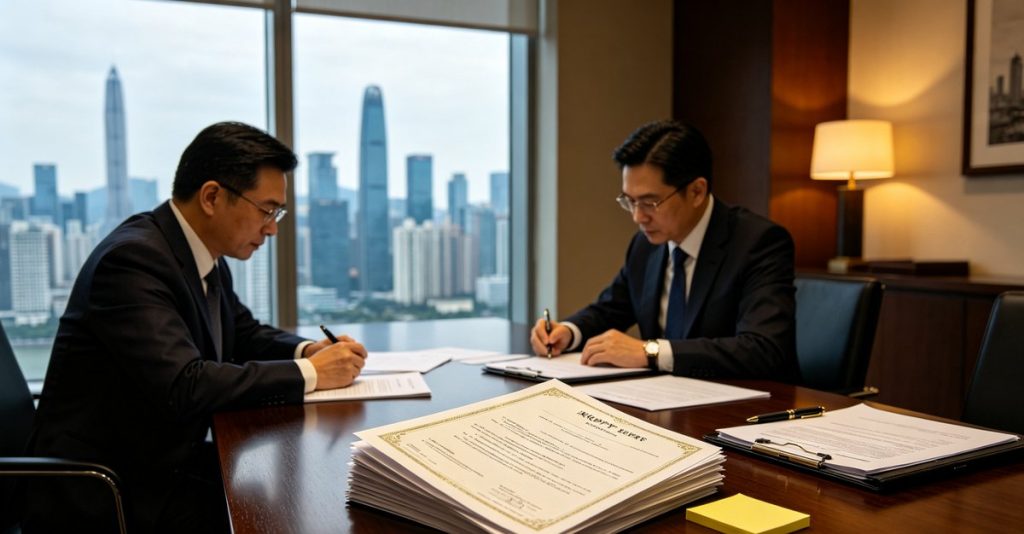
A Shenzhen-based company’s dissolution lawsuit is halfway through when a shareholder absconds—how do you clean up this mess? Lawyers advise first examining these three points.
Let us begin with a real-life case.
Lao Zhou and Lao Chen, childhood friends from Guangming District, Shenzhen, co-founded a precision mold manufacturing company that primarily supplies major consumer electronics manufacturers. Business was strong for the past two years, generating solid profits—several million RMB remained in the company’s bank account. However, this year, a key client significantly reduced its orders, causing an abrupt cash flow crunch. The two partners became embroiled in a heated dispute over whether to accept low-margin orders merely to keep production running. In anger, Lao Chen filed a petition with the court seeking judicial dissolution of the company, citing “serious difficulties in the company’s management and operations” and arguing that the company’s continued existence would cause “major losses to shareholders’ interests.”
The lawsuit had barely been filed when Mr. Chen vanished—ignoring phone calls, failing to respond to WeChat messages, and moving out of Shenzhen altogether. Court summonses and mediation notices sent to the company’s registered address were refused by the front-desk staff and returned to the court. Left to shoulder the entire company alone, Mr. Zhou discovered that the corporate bank account had been frozen; suppliers arrived daily demanding payment; and employee salaries were on the verge of going unpaid. Even more critically, before leaving, Mr. Chen had copied the company’s core client drawings and proprietary product formulas—intellectual assets Mr. Zhou had spent five years cultivating to secure exclusive orders.
When Lao Zhou came to us, he was completely bewildered: “Lawyer, is this company finished? Can I sue him instead? And can this dissolution lawsuit still be withdrawn?”
This case is virtually the “standard script” for shareholder disputes among small- and medium-sized limited liability companies in Shenzhen. Many people assume that a company dissolution dispute simply means “shareholders have fallen out, and the court orders dissolution.” In reality, however, such disputes trigger serious, high-stakes legal issues—including trade secret leakage, resolution of corporate deadlock, and isolation of external liabilities—each one a potential legal “deep-water bomb.” Today, we’ll use Lao Zhou’s case as a starting point to thoroughly examine the legal risks inherent in company dissolution disputes in Shenzhen—and explain precisely how to respond if you find yourself facing such a situation.
**Risk Analysis: Corporate Dissolution Disputes Are Far More Complex Than Merely “Breaking Up”**
Many parties equate “company dissolution disputes” with “divorce proceedings,” believing that once a judgment is rendered, the matter is conclusively resolved—this is a serious misconception. Based on our experience handling cases in Shenzhen, initiating this procedure triggers a three-dimensional cascade collapse.
**First Risk: The “Loss-of-Control Window Period” for Trade Secrets**
This is the most critical issue in Lao Zhou’s case. Once a company dissolution dispute enters litigation, shareholders are essentially at war with one another. The party in control of technical documentation or customer lists often adopts the mindset: “The company is doomed anyway—why not seize these resources for myself?” Under the Anti-Unfair Competition Law, trade secrets must satisfy three statutory elements: secrecy, commercial value, and reasonable confidentiality measures. Yet during internal corporate conflicts, confidentiality systems frequently become meaningless—employees share email passwords, design servers lack tiered access controls, and customer contact information resides openly on every salesperson’s mobile phone. If one shareholder maliciously copies such materials, subsequent enforcement becomes extremely difficult. Even if you sue for trade secret misappropriation, you must prove that the defendant acquired the information “improperly”—yet he can easily counter that his actions were “necessary to perform his job duties.” Even more troubling, if he sells the technical drawings to a competitor, the resulting damages may exceed the company’s entire enterprise value.
**Second Risk: Operational Paralysis under Corporate Deadlock**
A court’s acceptance of a dissolution lawsuit does not mean the company immediately ceases operations. However, during the litigation period, banks and business counterparties will swiftly activate their risk-control systems. Once “involvement in dissolution disputes” appears on the company’s public industrial and commercial registration information, banks typically freeze its credit lines outright, and major clients often suspend orders on grounds of “questionable performance capability.” This is precisely what happened to Mr. Zhou’s company: its bank accounts were frozen—even paying electricity bills became problematic. Such a “deadlock” itself further deteriorates the company’s financial condition, creating a vicious cycle. Moreover, once corporate assets are lost or dissipated, little remains to distribute—whether through liquidation or settlement—leaving virtually no residual value for stakeholders.
**Third Risk: “Unlimited Joint and Several Liability” of Shareholders**
Many Shenzhen business owners assume that, as a limited liability company, their liability is capped at the amount they contributed as shareholders. However, during corporate dissolution disputes, if shareholders hastily dispose of assets, transfer contracts, or engage in unreasonable related-party transactions while the company is clearly insolvent, this may trigger the “piercing the corporate veil” provision under Article 20 of the PRC Company Law—rendering shareholders jointly and severally liable for the company’s debts. For instance, if Lao Zhou, seeking to retain clients, privately enters into a procurement contract with a supplier in his personal capacity, such debt may, under law, become his personal liability.
**Solution: How Shareholders Can “Defuse the Bomb” in Dissolution Disputes**
Returning to Lao Zhou’s case: Upon our involvement, the first step we took was not to rush into filing a defense, but rather to carry out three key actions.
Step 1: Secure the evidence chain for trade secrets to reclaim your “technological assets.”
We promptly filed an application for evidence preservation. In Shenzhen, courts tend to grant strong support for urgent preservation applications involving trade secrets. We submitted to the presiding judge server log records showing that Mr. Chen had repeatedly logged into the server and downloaded large-volume files during the week prior to his resignation, as well as screenshots of his WeChat chat records with competitors in the same industry. Through this preservation measure, we secured critical evidence and deterred any further dissemination by him. Concurrently, we advised the company’s HR and IT departments to immediately reset passwords for all core systems, implement tiered access permissions, and proactively contact existing clients on a one-to-one basis to clarify that the company’s operations remain fully normal—emphasizing that the current situation involves only a shareholder dispute—to prevent client attrition.
Step Two: Assess whether the “dissolution conditions” have been met and identify potential negotiation leverage.
The Shenzhen court’s judgment in this corporate dissolution dispute was primarily based on Article 182 of the PRC Company Law and Article 1 of the Supreme People’s Court’s Interpretation (II) on Several Issues Concerning the Application of the PRC Company Law. The central legal inquiry is whether the company’s management and operations have encountered “serious difficulties.” Courts generally refrain from ordering dissolution where, although the shareholders’ meeting mechanism has broken down, day-to-day operations continue to be effectively managed by professional managers and the company’s core business remains uninterrupted.
We compiled and submitted evidence—including the company’s bank statements, signed contracts, and tax payment records for the past six months—to demonstrate that the company continues to generate stable profits. The underlying dispute stems solely from irreconcilable personal conflicts among shareholders—not from any operational or financial distress. Following submission of this evidence, the court adopted a markedly more proactive approach toward mediation.
Step Three: Design a “Shareholding Exit” Scheme as an Alternative to “Company Dissolution.”
Dissolving the company is the most drastic and costly resolution available. Instead, we proposed to Mr. Lao Zhou an alternative solution: “equity transfer plus share repurchase by the company.” Specifically, Mr. Lao Zhou—or a third-party investor introduced by him—would acquire Mr. Lao Chen’s equity stake at a price based on the company’s net asset valuation. This approach satisfied Mr. Lao Chen’s desire to exit while preserving the company’s legal status as an operating entity. Crucially, we linked this proposal to our claim for misappropriation of trade secrets: should Mr. Lao Chen refuse to settle, we would formally file a lawsuit for trade secret infringement and apply for pre-judgment asset preservation. After carefully weighing the risks and benefits, Mr. Lao Chen agreed to the equity transfer agreement. As a result, the company remained intact, its business orders were preserved, Mr. Lao Chen received the transfer payment, and both parties reconciled amicably following the court’s issuance of a mediation order.
**Zhiming Law Firm’s Advantages: Why Are We Uniquely Equipped to Handle These “Messy Cases”?**
Guangdong Zhiming Law Firm is not a law firm renowned for its marketing prowess. Established in 2000, we have been deeply rooted in Futian District for twenty-six years. Our ability to handle complex, cross-cutting cases—such as Mr. Lao Zhou’s involving corporate dissolution disputes, trade secret misappropriation, and personal liability of shareholders—stems from the extensive experience and accumulated expertise of Managing Partner Attorney Shen Jinlong and his team.
Managing Partner Shen Jinlong possesses a dual professional background: he is both a seasoned lawyer with 22 years of practice experience and a certified economist with 31 years of expertise, having also served as a senior executive in a large state-owned enterprise. This unique combination enables him not only to analyze corporate disputes through the lens of legal provisions but also to decipher underlying capital flows reflected in financial statements and to grasp the core commercial interests at stake in negotiations. In the “Lao Zhou” case, the opposing shareholder initially adopted an extremely rigid stance; however, during negotiations, Attorney Shen directly presented a detailed analysis of several potential tax irregularities within the opposing party’s company, as well as the criminal liability risks associated with alleged trade secret infringement—under China’s Criminal Law, conviction for trade secret infringement carries a maximum penalty of ten years’ imprisonment. This immediately weakened the opposing party’s psychological resistance. Such systematic, holistic handling of complex and challenging cases constitutes Zhiming Law Firm’s core competitive advantage.
We have handled over 10,000 cases to date, with a substantial proportion involving corporate equity disputes, corporate dissolution, and trade secret litigation. We possess in-depth familiarity with the adjudication approaches and mediation preferences of local courts in Shenzhen’s Guangming, Bao’an, and Longgang Districts—areas densely populated by manufacturing enterprises. In such disputes, our recommendation is clear: engage legal counsel immediately upon learning that the opposing party has initiated legal proceedings—do not wait until bank accounts are frozen or mass employee resignations occur before taking remedial action.
FAQ: Key Questions Regarding Company Dissolution Disputes in Shenzhen
**Q: I have received a court summons for a dissolution dispute, but the facts alleged by the opposing party are false. Can I file a counterclaim?**
A: A dissolution dispute is, in nature, an action for modification and generally does not permit a counterclaim. However, you do not need to file a counterclaim. Instead, during the response period, you may simply submit evidence demonstrating that the company’s operations have not encountered “serious difficulties”—for example, audited financial reports showing consecutive years of profitability, material contracts still being performed, or records evidencing regular convening of shareholders’ meetings. If the opposing party has filed the lawsuit in bad faith, thereby causing harm to the company’s interests, you may separately initiate a claim for damages.
**Q: During the period of a company dissolution lawsuit, may I, as the legal representative, normally enter into contracts with third parties?**
A: Yes, but the risk is extremely high. It is strongly recommended that, during litigation, all major contracts—those exceeding a certain monetary threshold or involving the disposal of core assets—be reviewed and approved by legal counsel. Additionally, you should, to the greatest extent possible, require the counterparty to issue a written confirmation letter acknowledging awareness of the shareholder dispute and expressly affirming its voluntary commitment to continue performance under the contract. Otherwise, if the company is ultimately dissolved, the liquidation committee may determine that such transaction harmed creditors’ interests and hold you personally liable for compensation.
Q: How quickly does the Guangming District People’s Court in Shenzhen handle such cases?
A: Under the summary procedure, a case is typically resolved within three months; under the ordinary procedure, the timeframe is six months. However, if the case involves expert appraisal of trade secrets, auditing, or valuation, the timeline may be extended. In Shenzhen, courts actively encourage mediation. If both parties express willingness to settle, they may apply for pre-trial mediation—a process significantly faster than litigation and generally easier to enforce. In most cases we handle, disputes are ultimately resolved during the mediation stage. This is precisely why we advise our clients to maintain an open mindset and pursue an “exit mechanism” rather than adopting a “mutually destructive” approach.
**Q: Does Zhiming Law Firm charge for consultations?**
A: We offer an initial consultation, typically priced at RMB 600 per hour. If you subsequently retain us formally, this consultation fee may be credited toward our legal representation fees. We place greater emphasis on the intrinsic value and complexity of the case itself, rather than using free consultations as a “lead-generation” tactic. Truly valuable legal strategies can only be developed after thorough analysis of all evidence and a deep understanding of the underlying commercial context—not through brief telephone discussions.
Finally, while Shenzhen boasts a vibrant startup ecosystem, legal awareness regarding corporate governance often lags behind the pace of commercial expansion. Dissolution disputes are not an endpoint—they represent the culmination of an underlying corporate governance crisis. If you’re facing a situation similar to Lao Zhou’s, don’t panic. Act promptly to preserve evidence and safeguard your trade secrets, then contact us for a consultation. After all, with 26 years of experience, our established law firm has handled more complex, challenging cases than you’ve likely ever heard of. Our contact information is provided below—feel free to reach out anytime.
Guangdong Zhiming Law Firm
Room 1802, Tower A, Xintian Century Business Center, Shisha North 2nd Street, Futian District, Shenzhen
Consultation Hotline: 0755-25986969
(Personal information of the parties involved in this article has been anonymized, and case details have been adapted for illustrative purposes; please do not attempt to identify any real individuals or cases.)
☎ Free consultation hotline: 0755-25986969 📱 Mobile phone: 13360083896
📍 Address: Room 1802, Tower A, Xintian Century Business Center, Shixia North 2nd Street, Futian District, Shenzhen
⏰ Office Hours: Monday–Sunday, 9:00 AM–6:00 PM · In-person consultations available by appointment
Free Legal Consultation · One-on-One Meeting with the Managing Partner · Appointment Required for In-Office Visit