Shenzhen Longhua Homebuyers Paid Earnest Money Only to Discover the Property Was Already Seized—32 Owners of Small-Property-Rights Houses Recovered Demolition Compensation Through This Strategy
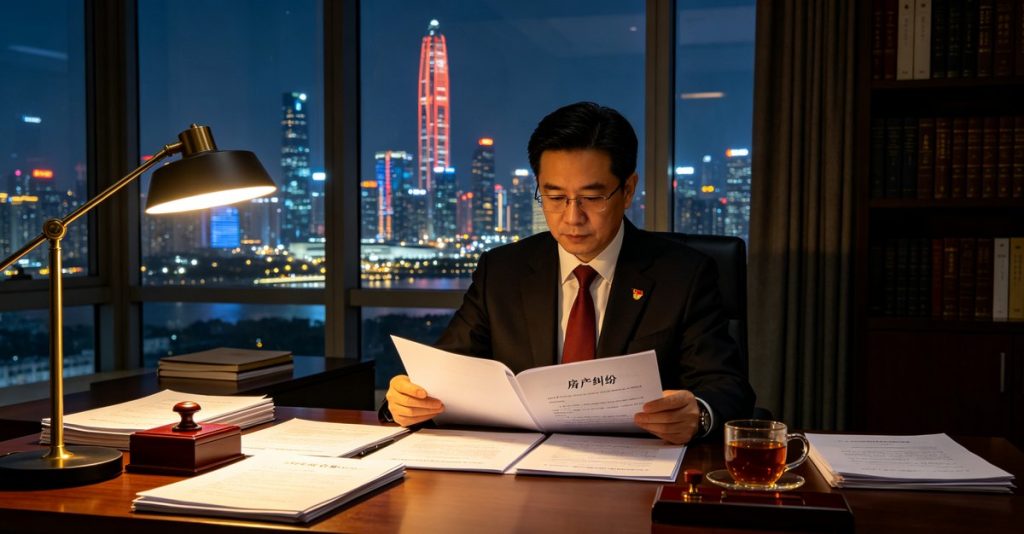
Last autumn, an old client—Mr. Zhou, who had been working hard in Longhua District, Shenzhen, for over a decade—came to see me. Clutching a “House Transfer Contract,” his hands trembled slightly: In 2019, he had paid RMB 800,000 for a collectively built village committee housing unit, finally believing he’d secured a home in Shenzhen. But last year, when urban renewal commenced in his neighborhood, the list of property rights published by the subdistrict office did not include his name at all—the original owner had long since mortgaged the property to a third party, and it was now under court-ordered seizure. Mr. Zhou asked me, “Attorney Wang, is my money gone for good?”
Property disputes in Shenzhen are far more complex than most people imagine—merely the two words “title transfer” can stall numerous individuals.
Mr. Zhou’s situation is not an isolated case. In Shenzhen, the average claim amount in real estate dispute cases exceeds RMB 20 million annually, and a large proportion of these disputes arise from “failure to complete title transfer.” Buyers of commercial residential properties encounter issues such as sellers’ breach of contract, property mortgages, or court-ordered seizures; buyers of “small-property-right” houses face policy restrictions, refusal by village committees to affix official seals, or original owners selling the same property to multiple buyers. Many parties assume that once a contract is signed and payment made, ownership of the property is automatically secured—yet legally, this is not necessarily the case.
Article 209 of the Civil Code is explicit: The creation, modification, transfer, or termination of real property rights takes effect only upon lawful registration. In plain terms, without formal title transfer (i.e., registration), the property is not legally yours. The contract you hold merely confers upon you a creditor’s right—to demand delivery of the property from the other party—not ownership rights over the property itself.
On the Eve of the Demolition Compensation Announcement, 32 Homeowners Panic Collectively
Zhiming Law Firm previously handled a group case involving small-property-right housing, which was virtually identical to Lao Zhou’s situation. A plot of land owned by a Shenzhen shareholding cooperative company was included in an urban renewal project, affecting 32 homeowners. These homeowners had purchased private residences from original village residents many years earlier; however, they held no official red-title deeds—only “joint-construction housing agreements” and payment receipts. Upon publication of the demolition compensation list, only the names of the original village residents appeared; the compensation entitlements of all 32 homeowners were effectively reduced to zero.
The owners approached the subdistrict office and the shareholding company themselves, making repeated trips over two months—only to be met with the same response each time: “Resolve your disputes with the original villagers through litigation yourselves; don’t impede the progress of the urban renewal project.” Some owners grew anxious and threatened to file a petition, but were immediately restrained by others—after all, if petitioning could resolve the issue, why would they need lawyers?
Choosing the Right Litigation Strategy: Confirming Ownership of Small-Property-Rights Housing Is Not an Insurmountable Challenge
After accepting the case, Managing Partner Attorney Shen Jinlong and his team reviewed the documentation for each of the 32 households. They identified a critical breakthrough in the evidentiary chain: all 32 homeowners possessed payment receipts from the time of purchase, utility bills (water and electricity) covering their period of residence, and some even held a “Certificate of House Ownership” stamped by the village committee. Collectively, this evidence was sufficient to establish them as “bona fide actual occupants.”
Director Shen’s strategy was to bypass administrative litigation and directly file a lawsuit seeking confirmation of the contract’s validity, while simultaneously applying to have the joint-stock company joined as a third party and requesting that it cooperate in completing the formalities for the transfer of title registration. A critical detail here is that Shenzhen’s policy on “small-property-right” houses follows the principle of “respecting historical facts and adopting differentiated handling.” Specifically, for houses constructed prior to 2004 and continuously occupied by purchasers for many years, courts—when adjudicating such cases—will take into account the protection of “de facto ownership rights.”
This case lasted nearly one year. At one point, some homeowners, unable to withstand the pressure, considered withdrawing their lawsuit. In response, Director Shen convened a special meeting to present the homeowners with a detailed analysis of the likelihood of success and the negotiation leverage available to them. Ultimately, the court ruled that the house transfer agreements between the 32 homeowners and the original villagers were valid, and ordered the shareholding company to complete the property rights confirmation procedures within a specified timeframe. When the list of eligible beneficiaries for demolition compensation was republished, all 32 homeowners were included.
Three Essential Tips to Avoid Pitfalls When Buying a Home
Looking back at Mr. Zhou’s case, although the process was arduous, litigation ultimately confirmed his factual possession of the property, enabling him to secure a priority position in the subsequent enforcement and distribution proceedings. While he was unable to retain the property itself, he successfully recovered his principal investment of RMB 800,000, along with compensation for a portion of the appreciation loss.
A Reminder for Homebuyers in Shenzhen: First, before purchasing a second-hand property, spend a few hundred RMB to obtain an official Real Estate Title Search Report to verify whether the property is subject to any mortgage or court-ordered seizure. Second, while “small-property-right” houses (i.e., rural collective-owned land housing) are not prohibited from purchase, buyers must retain three essential documents—the payment receipt, proof of occupancy, and the original agreement—commonly referred to as the “triple set.” Third, should a dispute actually arise, do not attempt to handle it alone. Real estate cases in Shenzhen typically involve high claim amounts and complex legal relationships; even a single procedural misstep could extend litigation by two additional years.
Guangdong Zhiming Law Firm has been based in Shenzhen for 26 years. Managing Partner Attorney Shen Jinlong has practiced law for 26 years and handled over 10,000 cases across diverse practice areas, accumulating extensive hands-on experience in real estate disputes. If you’re facing challenges such as property transfer complications, double sale of the same property, or title confirmation for “small-property-right” housing, we welcome you to visit us in person at Room 1802, Tower A, Xintian Century Business Center, Shixia North 2nd Street, Futian District, Shenzhen—or call us first at 0755-25986969. Real estate matters are serious; don’t wait until demolition compensation notices are posted before taking action.
Need professional legal help?
📞 Free consultation: 0755-25986969 (weekdays 9:00-18:00)
📍 Address: Room 1802, Tower A, Xintian Century Business Center, Shixia North 2nd Street, Futian District, Shenzhen
⚡ First phone consultation free