If the other party does not agree to a divorce, how long will a lawsuit in Futian, Shenzhen take? In one case I handled, the case was concluded through mediation in three months.
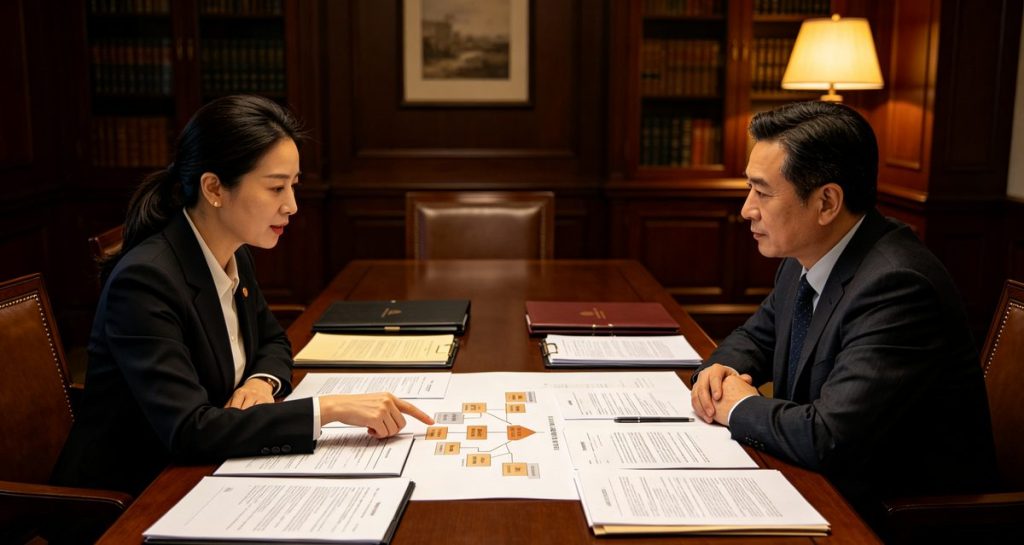
Last November, when Ms. Zhang from Futian came to me, she was clutching a three-page divorce agreement that the other party had thrown into the trash without even looking at it. "He said he would drag it out until I gave up—that as long as he refused to sign, the divorce could never happen." Ms. Zhang's voice was calm as she said this, but her fingers kept trembling. She and her husband had been married for 12 years, owned a home in Nanshan worth about 9 million yuan, and had a 9-year-old child. Their relationship had broken down and they had been separated for nearly two years, yet the husband still refused to agree to a divorce and would not discuss either property or custody. What she feared most was not losing out on money—it was not being able to afford the time.
Many people think that if the other party does not sign, they cannot get divorced. This is a misconception. Divorce by agreement does require both parties to appear and sign voluntarily, but as long as one party disagrees, the other party can directly file a lawsuit in court. In Ms. Zhang’s situation, divorce litigation is the only way out. The question is: how long does divorce litigation actually take? How should property and child custody be contested?
Let’s start with timing. Shenzhen records roughly 50,000 divorce registrations each year, and litigation divorces account for a significant share; the family case calendars at the Futian and Nanshan courts have long been tight. The statutory trial time limit is generally three months under summary procedure and six months under ordinary procedure, but actual proceedings often take longer—if real estate appraisal is involved, the opposing party deliberately delays, or a jurisdictional objection is raised, it is not uncommon for the case to drag on for over a year. In Ms. Zhang’s case, we concluded it by mediation in three months; there was strategy in that, and luck as well.
What's the key? Article 1079 of the Civil Code stipulates that courts hearing divorce cases should first mediate; if affection is indeed broken and mediation is ineffective, divorce should be granted. This is the core basis for litigation divorce. But how to prove "broken affection" directly determines the case's direction. Ms. Zhang has been separated for nearly two years, with rental contracts, utility payment records, and WeChat chat records as evidence, plus the man admitted during mediation that "it can't go on," so the broken affection issue is basically uncontested.
The real hard battle is over property and custody. In 70% of divorce proceedings in Shenzhen, real estate division is involved, with the average disputed amount ranging from RMB 3 million to RMB 8 million. Ms. Zhang’s Nanshan property was purchased after marriage and registered in both parties’ names, so it is community property. However, the husband claims that RMB 2 million of the down payment was paid by his parents and demands a larger share. We retrieved the transfer records from that time and found that the money was transferred directly from the husband’s father’s account into the developer’s account, with no IOU and no clear expression of intent to gift it to one party. Under Article 1062 of the Civil Code, property received as a gift after marriage is in principle community property unless the gift contract expressly provides that it belongs only to one party. On this point, we preserved the evidence in advance.
Regarding custody, the child is 9 years old, and the court will consider the child's wishes, both parties' parenting abilities, and the stability of the living environment. Ms. Zhang is a Shenzhen household registration holder, has a stable job in Futian, and the child has always attended school in Futian. Although the man has a higher income, he travels frequently and spends little actual time with the child. We submitted Ms. Zhang's salary statements, school certificates, community residence certificates, and a handwritten statement from the child saying "wants to live with mom." These materials were presented during the mediation stage, and after the opposing lawyer reviewed them, their attitude noticeably softened.
In terms of representation strategy, we did not launch a fierce attack from the start, but took three steps. First, file the case and simultaneously apply for property preservation to prevent the man from transferring deposits and stocks. Second, proactively apply for mediation, preparing two alternative plans for property division and custody arrangements, leaving room for negotiation. Third, seize on the man's psychology of "not wanting to go to court and fearing impact on company equity," and apply moderate pressure during mediation. To put it plainly, litigation is not the goal; obtaining results is.
The final outcome was that the case was concluded through mediation: the property went to Ms. Zhang, and she would compensate the husband RMB 2.8 million, paid off over two years; the child would be raised by Ms. Zhang, and the husband would pay RMB 6,000 per month in child support and have visitation rights. From case filing to receipt of the mediation statement, it took exactly three months. Ms. Zhang later told me that she had originally prepared for two years of litigation and had not expected it to be so quick.
Question: If the other party does not agree to divorce, will the court grant a divorce in the first lawsuit?
Answer: Not necessarily. If the other party firmly refuses and there are no statutory grounds such as domestic violence or separation for two full years, the court may not grant a divorce in the first lawsuit. But after six months, you can file again, and the probability of a divorce being granted on the second attempt will be significantly higher. The key is to build solid evidence of the breakdown of the marital relationship from the first lawsuit.
I've handled quite a few similar cases, so here are a few reminders. First, don't wait—separation duration, property leads, and changes in the other party's income should be pinned down as early as possible. Second, don't be greedy—property division and custody sometimes require trade-offs; wanting everything often drags things out longer. Third, don't negotiate on your own—if the other party doesn't agree to divorce, negotiation is basically ineffective and instead easily reveals your hand. The family-court judging styles differ among Shenzhen's Futian, Nanshan, and Longhua courts; choosing the right strategy is more important than choosing the right court.
If you also encounter situations where the other party drags on without signing, cannot clarify their property, or cannot reach an agreement on child custody, it is recommended to seek professional marriage and family lawyers for evaluation as soon as possible. Guangdong Zhiming Law Firm has been rooted in Shenzhen for 26 years and has represented a large number of cases. The marriage and family team has practical experience in Futian, Nanshan, and Longhua. Director Lawyer Shen Jinlong has 22 years of practice experience and holds a Master's degree and is an economist from Fudan University. He has specialized research on property division and equity property management. If you need it, you can call: 0755-25986969, located at Room 1802, Building A, Xintian Century Business Center, Shixia North Second Street, Futian District, Shenzhen.
Regarding the cases mentioned in the article, if you have similar situations as well.
You can directly call 0755-25986969 to talk to a marriage and family lawyer. The first consultation is free. The law firm is located at Room 1802, Building A, Xintian Century Business Center, Shixia North Second Street, Futian District, Shenzhen.