The defendant produced unfavorable evidence in court; how did the lead lawyer secure the greatest benefit for the plaintiff—a record of a private lending case successfully mediated in court, led by Lawyer Wang Shuang of Director Shen Jinlong's team
- Case reason
- Disputes over private lending
Recently, a private lending dispute case handled by Lawyer Wang Shuang from the team of Director Shen Jinlong of Guangdong Zhiming Law Firm reached a court-mediated settlement during the hearing under the auspices of a judge at a Shenzhen court. An unexpected turn occurred during the trial: the defendant presented evidence unfavorable to the plaintiff in court, putting the plaintiff at a temporary disadvantage. Lawyer Wang Shuang remained calm in the face of crisis, quickly assessed the risks, persuaded the plaintiff to accept mediation, and through precise negotiation strategies, ultimately secured the plaintiff's core interests including the full principal amount, acceleration of default, overdue interest, and cost bearing, achieving a substantive victory despite the unfavorable evidence situation.
I. Courtroom Emergency: Defendant Presents Unfavorable Evidence in Court
The plaintiff claimed that the defendant should repay a relatively large amount of loan principal and overdue interest. However, after taking on the case, Lawyer Wang Shuang discovered that the evidence in the plaintiff's possession was incomplete, with defects in key elements such as the loan agreement and delivery of funds. More troublesome was that during the trial, the defendant suddenly presented evidence unfavorable to the plaintiff, directly undermining the plaintiff's evidentiary system. If the plaintiff continued to insist on a judgment, not only might the plaintiff be unable to claim overdue interest, but even the principal might be found to lack sufficient evidence. The courtroom atmosphere suddenly became tense, and the plaintiff was put at a disadvantage.
II. Staying Calm in Crisis: Lead Lawyer Decisively Adjusts Strategy
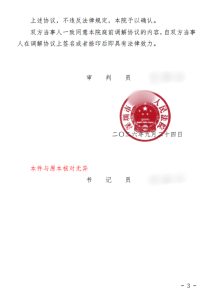
Faced with suddenly unfavorable evidence, Lawyer Wang Shuang did not panic, but quickly and calmly assessed the situation in court: the judgment outcome was uncertain, and the enforcement cycle would be long; while mediation required certain concessions, it could quickly secure the claim. After communicating with the plaintiff and analyzing the pros and cons, the plaintiff ultimately agreed to resolve the case through mediation. Lawyer Wang Shuang then adjusted the strategy: with "confirming the full principal" as the bottom line, "installment performance + acceleration of default" as protection, "overdue interest" as deterrence, and "costs borne by the defendant" as a supplement. Under the judge's auspices, both parties engaged in multiple rounds of negotiation regarding the repayment amount, performance deadline, and consequences of breach. Lawyer Wang Shuang argued forcefully, explaining to the defendant that the claim genuinely existed and that if mediation failed, the judgment outcome would be uncertain for both parties; and analyzing for the plaintiff the certainty of mediation and the convenience of enforcement. Ultimately, both parties reached a mediation agreement in court, which the court confirmed by issuing a civil mediation statement.
III. Clause Design: Securing Maximum Benefits for the Plaintiff
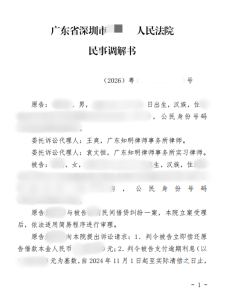
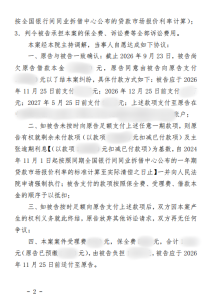
The core clauses of this mediation agreement reached in court were extremely favorable to the plaintiff:
First, confirmation of the full principal. Both parties confirmed that as of the date of mediation, the defendant still owed the plaintiff the full principal amount originally claimed, and the plaintiff agreed to settle the dispute on this basis. This means that despite defects in the evidence, the plaintiff still secured the entire principal claim through mediation.
Second, installment performance but acceleration of default. The defendant was to pay in three installments, spanning several months. If the defendant failed to pay any installment in full and on time, the plaintiff had the right to apply for compulsory enforcement of the remaining unpaid amount and overdue interest together. This clause both gave the defendant room to perform and ensured that the plaintiff could immediately initiate enforcement upon discovering a breach.
Third, clear overdue interest. Based on the remaining unpaid amount, interest was to be calculated from the agreed start date at the one-year loan market quoted rate until the date of actual repayment. The interest clause was specific and enforceable, strengthening the binding force on the defendant.
Fourth, costs borne by the defendant. The case acceptance fee and preservation fee were to be borne by the defendant, with a payment deadline agreed upon, avoiding additional losses for the plaintiff.
Fifth, termination of the dispute. If the defendant paid in full and on time, the rights and obligations of both parties would terminate, the plaintiff would waive other litigation claims, and there would be no further dispute between the parties. This provided the plaintiff with assurance of a complete resolution of the dispute.
IV. Case Insights: Mediation Is Also a Victory
The biggest insight from this case is that victory does not only come in the form of a judgment. When the defendant presents unfavorable evidence in court and the plaintiff's chain of evidence has hard flaws, in-court mediation is often the better solution. Lawyer Wang Shuang, through precise judgment of case risks, the ability to respond to unexpected courtroom situations, and firm protection of the client's interests, successfully persuaded the plaintiff to accept mediation, and through clause design transformed an "uncertain judgment" into an "enforceable claim." For the plaintiff, the full principal was confirmed, breach protection was in place, and costs were borne by the defendant, which was already the best result that could be achieved under the unfavorable evidence situation.
At the same time, this case also reminds parties that private lending should focus on evidence preservation, and key elements such as loan agreement, delivery of funds, and interest agreements must be documented. Once a dispute arises, engaging a professional lawyer early to assess risks and formulate strategies is the only way to secure maximum benefits in an unfavorable situation.
The professional judgment, on-the-spot adaptability, and client-interest-first practice philosophy demonstrated by Lawyer Wang Shuang of Shen Jinlong's team in this case are worthy of recognition. Although the in-court mediation settlement did not bear the word "victory" in a judgment, it won the plaintiff tangible protection of rights and interests.
(The party information and amounts in this article have been anonymized)
Guangdong Zhiming Law Firm, Shen Jinlong Team, Lawyer Wang Shuang