

Tencent fined! Exclusive copyrights revoked, market monopoly prohibited.
Compiled from: People's Daily, Red Star News
Case review
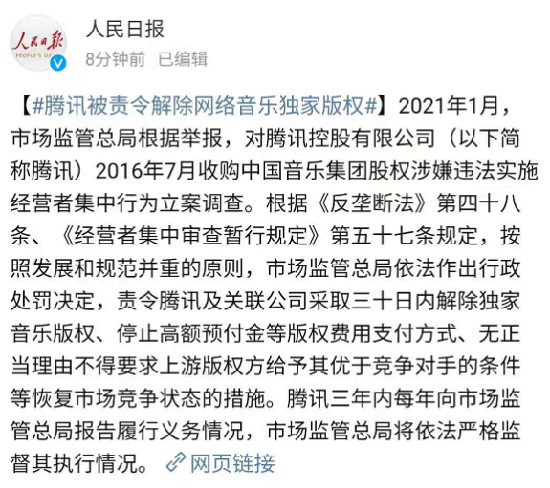
In January 2021, based on a tip-off, the State Administration for Market Regulation launched an investigation into Tencent Holdings Limited (hereinafter referred to as Tencent) for suspected illegal implementation of concentration of undertakings in its acquisition of equity interests in China Music Group in July 2016.
The State Administration for Market Regulation, in accordance with the Anti-Monopoly Law, ascertained the facts of the illegal concentration in this transaction and fully assessed factors such as the market share, control, concentration level of the operators involved in the relevant market, and the impact of the concentration on market entry and consumers. At the same time, it extensively solicited opinions from relevant government departments, industry associations, experts and scholars, and industry competitors, and repeatedly listened to Tencent's statements.
The investigation indicates that the relevant market in this case is the online music streaming platform market within China. Licensed music copyrights are the core assets and key resources for the operation of online music streaming platforms. In 2016, Tencent and China Music Group held approximately 30% and 40% of the relevant market shares, respectively. Through its merger with a major competitor in the market, Tencent obtained a relatively high market share, and the post-concentration entity controlled over 80% of exclusive music library resources. It may have the ability to induce upstream copyright holders to enter into more exclusive copyright agreements with it, or to require more favorable trading terms than those offered to its competitors. It may also have the ability to raise barriers to market entry through copyright payment models such as paying high advance fees, thereby having or likely having the effect of eliminating or restricting competition in the relevant market.
In response, the State Administration for Market Regulation made an administrative penalty decision, ordering Tencent and its affiliated companies to take measures to restore market competition, including lifting exclusive music copyrights within thirty days, ceasing payment methods such as high advance payments for copyright fees, and not requiring upstream copyright holders to give them terms more favorable than those given to competitors without justifiable reasons. Tencent must report its compliance status to the State Administration for Market Regulation annually for three years, and the State Administration for Market Regulation will strictly supervise its implementation in accordance with the law.
Relevant legal provisions
Anti-Monopoly Law Article 48
If an undertaking implements a concentration in violation of the provisions of this Law, the anti-monopoly enforcement authority under the State Council shall order it to cease implementing the concentration, to dispose of its shares or assets within a specified period, to transfer its business within a specified period, and to take other necessary measures to restore the state of affairs before the concentration, and may impose a fine of not more than 500,000 yuan.
Interim Provisions on the Review of Concentrations of Undertakings Article 57
If an operator implements a concentration in violation of the Anti-Monopoly Law, it shall be punished in accordance with Article 48 of the Anti-Monopoly Law.
[1] The author's perspective
This case is the first case since the implementation of China's Anti-Monopoly Law where necessary measures were taken against an illegal concentration of operators to restore market competition. Adhering to the principle of balancing development and regulation, ordering Tencent to lift exclusive copyright and other measures will reshape the order of competition in the relevant market, lower market entry barriers, and provide competitors with fair access to upstream copyright resources. This will help shift the focus of competition from using capital advantages to seize copyright resources back to the rational track of innovating service levels and improving user experience; facilitate the calculation of copyright fees in a reasonable manner aligned with international standards, reducing downstream operating costs; foster the emergence of new market entrants and create a fairer competitive environment for existing enterprises; safeguard consumer choice; and ultimately benefit consumers, promoting the standardized, innovative, and healthy development of the online music industry.



