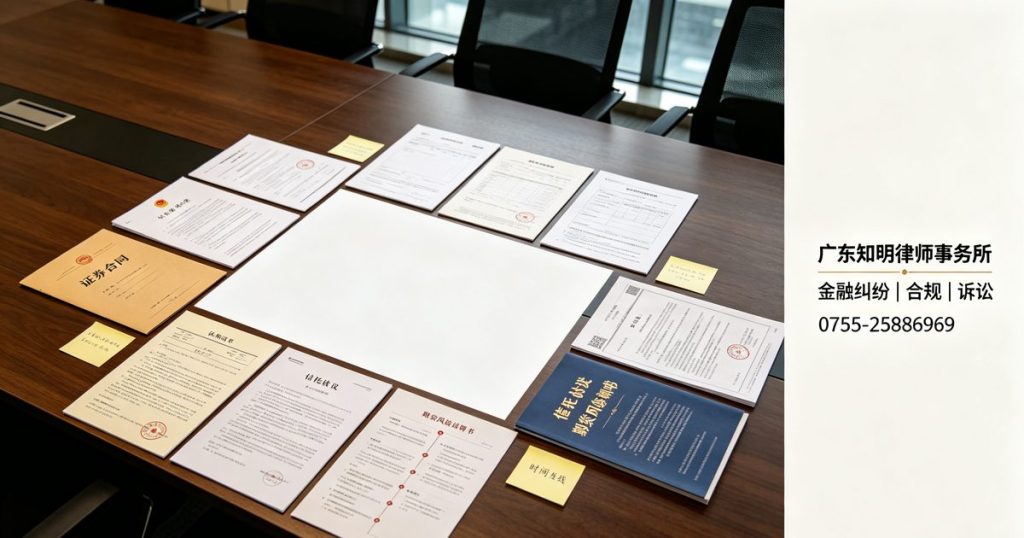
Which law firm in Shenzhen is the best? After being burned by a contract, what you need isn't luck—it's this practical playbook.
A client came to me last week, and the moment they sat down, they slammed the table and said, "Attorney Shen, I signed a supply contract with someone, shipped the goods, but the payment never came through, and the other party blocked me! I looked into it, and that company is just a shell. Have I been scammed?"
I asked him to produce the contract and the transfer records. After a quick glance, I already knew what was going on. In my over twenty years practicing at Zhiming Law Firm, I've seen scenes like this no fewer than a thousand times. He wasn't the first to fall into a "contract trap," and he certainly won't be the last. Today, I'll cut straight to the chase—let's talk about the places in contract disputes where "you think it's a minor issue, but it's actually a major pitfall," and if you do step into one, how to use the law to recover your losses.
One, the problem is not that "you were fooled," but that "you don't know how you were fooled."
Contract disputes sound technical, but when you break them down, they're nothing more than a few categories: sales and supply, loan repayment, unfinished services, and overdue construction payments. The catch is that many people don't take the contract seriously at all when they sign it.
The first trap: what's written in the contract and what's said verbally are two completely different things.
My client—before the supply, the other party pounded their chest and swore, "We'll pay monthly, absolutely no delays." But the contract said, "Payment within 30 working days after acceptance inspection." Guess what? They dragged it out for three months and shut him down with a single line: "Acceptance hasn't been completed yet." The law relies on evidence—what's written in black and white is what matters. Verbal promises, even if recorded, carry very weak evidentiary weight.
The second pitfall: the counterparty's legal status was not properly verified.
Are you signing the contract with an individual or a company? Has the company's registered capital been actually paid in? Is it a shell company just established? Many people ignore these things and only look at the company seal. As a result, the seal turns out to be a fake one, and the company is a shell company. Even if you win the lawsuit, you still can't collect the money — it's like winning in vain.
The third pitfall: the chain of evidence is broken.
I often ask my clients: "Do you have delivery notes? Did the other party sign for them? Have you sent any account statements?" Many people look bewildered: "I told him on WeChat." WeChat records are certainly useful, but if the conversation lacks clear quantities, unit prices, and total amounts, it's difficult for the judge to make a determination. What's worse, some people lose all their chat records when they switch phones — and then there's truly no time left to cry about it.
The fourth pitfall: In loan disputes, cash delivery cannot be clearly explained.
Loan disputes are more typical. Just last week, there was a consultation where someone borrowed 200,000 from a relative, paid in cash, without even a written IOU. Now the relative refuses to acknowledge the debt, and he is so angry his blood pressure is through the roof. Legally, for large-sum loans, transfer records alone are not enough; it's best to have an IOU, payment demand records, and a statement of fund usage. Otherwise, if the other party says "that was you repaying me," you're at a disadvantage.
II. How to solve it? It's not about "going to court," but "how to fight to win."
Many people get a headache at the mere mention of litigation, thinking it is time-consuming, laborious, and costly. But look at it from another angle: if you fail to recover that money, your loss is 100%; if you bring in a lawyer, even at a cost of 10%, as long as you recover the funds, you come out ahead.
Step one: Conduct an "evidence check-up" first—don't rush to file a lawsuit.
I often tell clients that litigation is the last resort, not the first response. First, do these three things:
- Preservation of evidenceChat record screenshots, transfer vouchers, and original contracts—all compiled into a bound volume. If WeChat is involved, it is best to go to the notary office for evidence preservation to prevent the other party from deleting the records.
- Issue a demand letter.Send a written demand letter to the other party via EMS, specifying the amount owed and the repayment deadline. This both pressures the other party and lays the groundwork for future litigation—proving that you have "demanded payment."
- Investigate the opposing party's property clues.Does he have a house? A car? Savings? If you know in advance that the other party is transferring property, you can apply for pre-litigation property preservation and freeze the account first.
Step Two: Identify the correct defendant—don't sue the wrong person.
In a sales contract dispute, if the other party is a company, both the company and its legal representative should be listed as co-defendants; if it is an individual, it should be determined whether the debt is a joint marital debt. In a loan dispute, if the borrowed funds were used for household expenses, the spouse may be added as a co-defendant. If this step is done incorrectly, everything that follows will be in vain.
Step Three: Litigation strategy must be "steady, accurate, and forceful."
Many litigants prefer to handle their cases themselves, simply downloading a template online and filing a lawsuit. What happens as a result? The claims for relief are drafted incorrectly, the court with jurisdiction is chosen wrongly, and the deadline for submitting evidence is missed—ultimately, the case is dismissed. Legal procedure is a "one-shot deal." If you lose at first instance and then appeal, the costs double, and the odds of winning are slim. The value of a professional lawyer lies in calculating all the variables before filing the lawsuit.
Step Four: Don't overlook the "execution" phase.
I've seen too many people win lawsuits but never get their money. A judgment is just a piece of paper — to turn it into real money, you need enforcement. A lawyer will help you apply for compulsory enforcement, investigate and freeze assets, and get the debtor placed on the dishonesty list. If the other party is a deadbeat, you can also apply for judicial detention. But these procedures simply can't be handled by non-professionals.
III. The Role of Professional Lawyers: Not to Help You "Fight," but to Help You "Settle the Books"
Speaking of this, you might ask: "Which law firm in Shenzhen is the best? Are Shenzhen law firms reliable?" That's a very practical question, but the answer doesn't come from advertisements—it comes from "who can actually solve your problem."
Guangdong Zhiming Law Firm was established in 2000 and has been rooted in Futian District for 26 years. The director, Lawyer Shen Jinlong, has 22 years of practice experience, holds a master's degree in economics from Fudan University, and previously served as a senior executive at a large state-owned enterprise. What does this background mean? It means that when he reviews contracts, he doesn't just look at legal provisions—he can also anticipate from a business logic perspective how the other party might breach the contract and how they might abscond.
For example, we handled a sales dispute where a client was owed 1.2 million yuan in unpaid货款, and the opposing company was on the verge of bankruptcy. Director Shen did not rush to file a lawsuit but first investigated the parent company's assets and discovered they had a piece of land being auctioned by the court. We immediately applied for property preservation, freezing a portion of the auction proceeds from that land. In the end, the case was resolved without a trial—the opposing party voluntarily reached a settlement, and the client recovered 1.35 million yuan, including principal and interest.
There is also Attorney Li Wei, who specializes in corporate law and economic contract disputes. He handled a loan dispute case where a client lent out 800,000 yuan, but the borrower only repaid 100,000 yuan before disappearing. Attorney Li obtained bank transaction records and discovered that the borrower had used the funds to purchase a property. He directly filed a lawsuit in court, seeking to revoke the property transfer registration. In the end, the property was auctioned, and the client received full satisfaction of the claim.
This is what a professional lawyer does—not reciting legal provisions, but helping you find "the path the opposing party fears most."

4. Frequently Asked Questions (FAQ)
1. How much does it cost to file a lawsuit for a contract dispute? Can I sue first and pay later?
Litigation fees are charged proportionally based on the claim amount; for example, a case worth 100,000 yuan costs approximately 2,300 yuan, borne by the losing party. Attorney fees can be arranged on a contingency basis, meaning "handle the case first, collect fees after payment is recovered." ZhiMing Law Firm can operate this way for some cases, depending on the nature of the case.
2. The other party is a shell company. Is it still worth suing?
That makes sense. You can add the shareholder as a co-defendant. If the shareholder hasn't actually contributed their capital, they bear joint and several liability personally. We've handled quite a few cases like this — we pierced the "shell" company, and the shareholders, eager to avoid prison, paid up without a fuss.
3. No contract, only WeChat chats—can you still win the lawsuit?
Yes, but the evidentiary requirements are high. The chat records must be complete, clearly identify both parties, and contain specific transaction details. It is best to also provide transfer records, delivery notes, and logistics information. With these, the win rate remains very high.
4. Is the process of hiring a lawyer for litigation in Shenzhen complicated?
It's not complicated, but don't do it carelessly on your own. The process is: consult a lawyer → sign a representation contract → organize evidence → file the case → court hearing → judgment → enforcement. A professional lawyer will guide you through the entire process; you just need to cooperate and provide the materials.
5. The other party has no money—does that mean winning is pointless?
Not necessarily. If he has no money, he can be added to the list of judgment defaulters and have high-consumption restrictions imposed. Once he has money in the future, enforcement can be resumed at any time. Moreover, many people who claim to have "no money" are actually transferring assets — if the lawyer uncovers that, it's a whole different path.

One final word from the heart: In contract disputes, what you should fear most is not the other party being unreasonable, but losing your own composure. The law operates on logic—as long as your evidence is solid and your strategy is clear, you have a strong chance of getting back what is rightfully yours. If you're troubled by a contract issue, don't carry the burden alone. Drop by Zhiming Law Firm—we can sit down, talk over tea, and see which path your evidence can take you down.
Guangdong Zhiming Law Firm
Address: Room 1802, Building A, Xintian Century Business Center, Shixia North Second Street, Futian District, Shenzhen
Phone: 0755-25986969
Managing Partner: Shen Jinlong (Practicing attorney for 22 years, Master of Economics from Fudan University)
☎ Free consultation hotline: 0755-25986969 📱 Mobile phone: 13360083896
📍 Address: Room 1802, Building A, Xintian Century Business Center, Shixia North Second Street, Futian District, Shenzhen
⏰ Office hours: Monday to Sunday 9:00-18:00 · Reservation available at the office
Free legal consultation · Director one-on-one · Appointment at the office