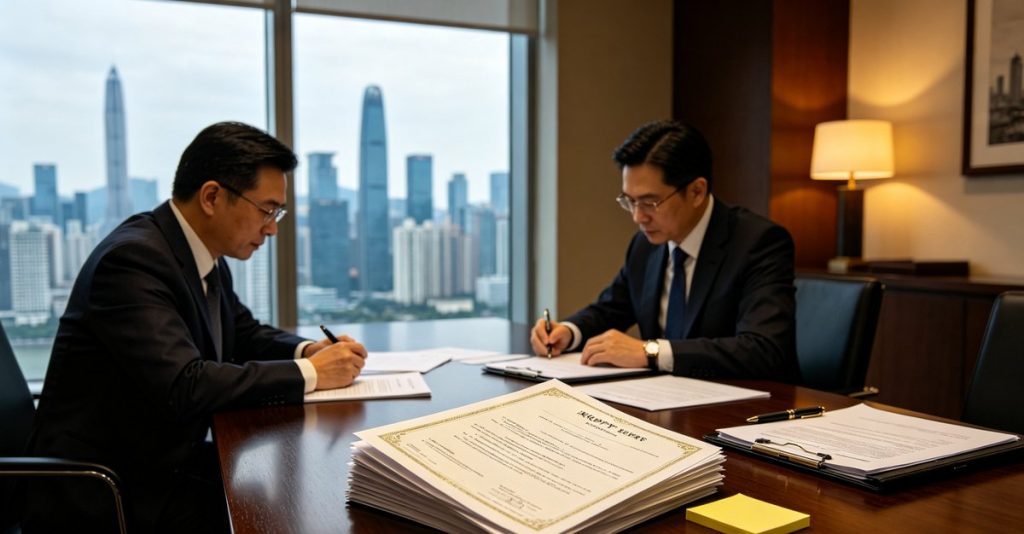
Recommended Reading on Shenzhen Equity Rights Confirmation Disputes: Corporate Equity Legal Risk Prevention Insights from a Nominee Shareholding Dispute | Shen Jinlong Team, Futian Office
Let us begin with a real-life case.
In the summer of 2019, at a startup in Shenzhen Nanshan Science and Technology Park, the founder, General Manager Zhang, was so anxious that blisters formed at the corners of his mouth. In his early entrepreneurial days, due to his sensitive identity, he had his cousin hold 30% of the company's equity on his behalf. Now that the company was seeking financing, the investors required a clear equity structure during due diligence. Zhang went to discuss the equity transfer with his cousin, but his cousin hemmed and hawed, and ultimately turned hostile: "How much of the company's dividends have I received over the years? The equity is registered under my name—what makes you think it's yours?"
Only then did President Zhang realize the severity of the problem. He dug out the transfer records from back then and the bank statements of dividend transactions, only to find the accounts were in complete disarray. Even the capital contribution for that 30% equity stake had been transferred from his personal account, without any note saying "investment funds." What's more troublesome was that the shareholding agreement was being withheld by his cousin under the pretext of "safekeeping" and was not returned. On his phone, there were only a few recordings of past discussions about the company, vague and ambiguous.
Later, General Manager Zhang approached the Shen Jinlong team at Guangdong Zhiming Law Firm. Over three months, the team of lawyers systematically reviewed Zhang's bank transaction records, shareholder meeting sign-in sheets, and email correspondence regarding his involvement in major corporate decisions. They even unearthed a confidentiality agreement that Zhang signed in 2015 in the capacity of "Founder Advisor" during the company's Series A financing round—a document that became key evidence proving he actually exercised shareholder rights. In the end, the court ruled that a nominee shareholding relationship existed between the parties, awarded the equity to Zhang, and ordered his cousin to cooperate in completing the business registration change within a specified timeframe.
Although Mr. Zhang ultimately won, the process was fraught with peril. This year-long lawsuit nearly caused the company to miss its optimal financing window. And Shenzhen entrepreneurs like Mr. Zhang, stepping on equity "minefields," are by no means few in number.
I. The "Hidden Minefield" of Equity Structure: Core Risks in Equity Ownership Confirmation Disputes
As a law firm deeply rooted in Shenzhen corporate legal services, Director Shen Jinlong of Guangdong Zhiming Law Firm has handled a large number of difficult and complex cases involving equity confirmation during his 26-year legal career. We have summarized the most common "pitfalls" that Shenzhen business owners tend to step into:
Pitfall One: The "Naked" Nominee Shareholding RelationshipIn the absence of a written shareholding agreement, or where the agreement terms are vague, many arrangements are verbal agreements between relatives and friends, without even remarks on the transfer records. Once a dispute arises, the nature of the contributed funds becomes difficult to determine—is it a loan, a gift, or an investment? The court's reasoning is based on the principle that "without written evidence, a shareholding trust relationship will not be readily recognized."
Minefield 2: Separation of Registered and Beneficial Ownership of EquityBusiness registration reflects one structure, but actual control lies with another. The shareholders have not signed a concerted action agreement, or the agreement on rights and interests between the nominee shareholder and the registered shareholder is incomplete, resulting in dividends, capital increases, and the exercise of voting rights all being in a state of "distortion."
Minefield 3: Broken Chain of EvidenceDuring the company's operations, the actual investor failed to retain evidence of participating in decision-making or receiving dividends. The most common statement in court is: "You claim to be the actual shareholder, but how do you prove that you have exercised shareholder rights?"
Pitfall Four: Lack of Exit MechanismMany companies never thought about dissolution when they were founded. How should equity be bought back? How is the price calculated? When one party wants to exit, they make exorbitant demands, and it eventually ends up in court, causing severe internal friction within the company.
II. Solution: A Systematic Guide to "De-mining" Equity Compliance
As a practical team that has long studied corporate equity legal risks, Lawyer Shen Jinlong suggests that everyone conduct prevention and control from the following four dimensions:
First, the shareholding agreement must be "in black and white with all details properly addressed."Do not use a template downloaded at random from the internet. The standard practice is to specify in the agreement the actual ownership of the capital contribution, the manner in which shareholder rights are exercised, the dividend mechanism, and liability for breach of contract, as well as to include an obligation to cooperate with the name-visible transfer of ownership once the conditions are fulfilled. The most reliable approach is to have a lawyer custom-draft the agreement based on the relationship between the parties and the stage of the company.
Second, evidence management must "leave a paper trail."Each capital contribution is made via bank transfer with the remark "investment funds"; every dividend payment leaves a transaction record; each shareholders' meeting vote is documented in written minutes signed by the actual contributors. These seemingly trivial actions become the most compelling evidence in a courtroom.
Third, the company's articles of association should be forward-looking and prepared for contingencies.Include the equity nominee holding and restoration process, equity transfer, exit mechanisms, and valuation methods in the articles of association or shareholder agreement, with particular emphasis on clearly stipulating the procedure for converting an undisclosed shareholder into a registered shareholder. This will minimize future disputes to the greatest extent possible.
Fourth, promptly consult a lawyer at the first signs of a dispute.If you detect signs that the nominee shareholder is not cooperating, such as unauthorized pledging of equity or refusing to deliver dividends, be sure to initiate legal proceedings immediately. Early intervention allows more room for evidence collection; if you wait until the other party transfers the equity to a bona fide third party, that is when the real trouble begins.
III. Advantages of Zhi Ming Law Firm: Handling Complex Equity Cases with Systematic Thinking
Speaking of this, some readers may ask: why not directly approach the Commerce Bureau or the Arbitration Commission? The reason is simple: equity confirmation disputes often involve cross-cutting issues across multiple legal domains, including company law, the contract chapter of the Civil Code, and marriage, family, and inheritance law. Moreover, Shenzhen courts maintain very strict standards regarding the form of evidence and the standard of proof. In such cases, a "professional and systematic approach" becomes particularly important.
Guangdong Zhiming Law Firm was established in 2000 and is a long-established firm in Futian District with 26 years of history. The chief lawyer, Shen Jinlong, holds a master's degree in economics from Fudan University, has 22 years of experience as a practicing attorney, and also possesses 31 years of economist qualifications. In his early years, he served as a senior executive at a large state-owned enterprise. This interdisciplinary background combining "economics + law + business management" provides a unique advantage in handling equity disputes — the lawyer can not only analyze the legal basis of claims from a legal perspective but also comprehend the company's business model and financial data, thereby weaving scattered evidence into a logically rigorous business narrative.
Here is another real case handled by Shen Jinlong's team.
A Shenzhen-based chain restaurant brand had three founding shareholders. In 2021, conflicts arose among the three due to incompatible business philosophies. One minority shareholder actually contributed 25% of the capital, but his registered shareholding was only 10%—back then, out of a sense of brotherhood loyalty, he agreed to have the majority shareholder hold the shares on his behalf. Now the majority shareholder plans to bring in outside capital at an extremely low price to dilute him, and the conflict between the parties has intensified.
The difficulty of this case lies in the fact that the minority shareholder could not produce a complete shareholding agreement, and most dividends were paid in cash without bank records. After the Shen Jinlong team intervened, they reconstructed the company's store procurement data, supply chain transaction flows, and store profit distribution statements over the past five years, and combined them with financial entry vouchers to prove that the minority shareholder's actual dividend participation ratio was 25% rather than 10%. During the court hearing, the team also applied for a judicial audit, ultimately helping the minority shareholder confirm the corresponding equity and complete the business registration change. This case later became a typical case handled by the Futian District Court regarding "equity confirmation without a written shareholding agreement."
We often say that the best outcome for an equity confirmation dispute is "not needing to go to court"—it can be avoided through upfront agreement design and evidence management. But if a dispute truly arises, then it becomes necessary to systematically organize all the complex factors in court, forming a complete chain of evidence and a system of claims. This is exactly what the Shen Jinlong team at Zhiming Law Firm excels at.
IV. Frequently Asked Questions (FAQ) Regarding Equity Confirmation Disputes in Shenzhen
Question 1: Is a shareholding entrustment agreement legally valid?
Answer: In principle, it is valid, but subject to specific industry restrictions (such as foreign-investment-restricted industries and financial industries), the validity of the agreement may be subject to special circumstances. If the purpose of the nominee shareholding is to circumvent mandatory legal provisions, the agreement shall be invalid. It is recommended to have a professional lawyer review the matter first.
Question 2: I am an undisclosed shareholder. How can I transfer the equity back to my own name?
Answer: There are two paths. First, the negotiation path: the registered shareholder cooperates by signing the shareholding entrustment termination agreement and the documents for industrial and commercial registration changes. Second, the litigation path: file a lawsuit based on a "shareholder qualification confirmation dispute." The key is to prove that you are the "actual contributor" and that you "actually exercised shareholder rights."
Question 3: What should I do if other shareholders of the company do not agree to my becoming a registered shareholder?
Answer: According to Judicial Interpretation (III) of the Company Law, the consent of more than half of the other shareholders is required. However, if you can prove that more than half of the other shareholders knew that you were actually exercising shareholder rights and did not raise any objection, the court may deem such consent to have been given.
Question 4: What should be done if it is discovered that the equity has been pledged without authorization by the nominee shareholder?
Answer: Immediately file a lawsuit to confirm the ownership of the equity, and seek a declaration that the pledge is invalid. At the same time, consider applying for property preservation to freeze the equity and other assets under the nominee's name.
Question 5: How long do equity confirmation dispute cases in Shenzhen generally take? What is the approximate lawyer's fee?
Answer: For simple cases, the first-instance trial typically takes about 3-6 months, but may be extended to over a year if audits or appraisals are involved. Attorney fees are calculated based on the amount in dispute and the complexity of the case, and usually include preliminary due diligence, evidence organization, and full-service court appearances. It is recommended that you bring your materials to the firm for an in-person consultation to obtain an accurate quote.
Zhiming Law Firm is located at Room 1802, Tower A, Xintian Century Business Center, Shixia North Second Street, Futian District, Shenzhen. If you are facing disputes over nominee shareholding, shareholder qualification confirmation, or company control, please call 0755-25986969 to schedule an in-person consultation with the Shen Jinlong team.
Equity issues cannot wait; the earlier you address them, the more proactive you can be.

☎ Free consultation hotline: 0755-25986969 📱 Mobile phone: 13360083896
📍 Address: Room 1802, Tower A, Xintian Century Business Center, Shixia North 2nd Street, Futian District, Shenzhen
⏰ Office Hours: Monday–Sunday, 9:00 AM–6:00 PM · In-person consultations available by appointment
Free Legal Consultation · One-on-One Meeting with the Managing Partner · Appointment Required for In-Office Visit