What legal risks should the construction contractor and the project owner be alert to after the completion of large equipment hoisting for the Shenzhen hospital project?
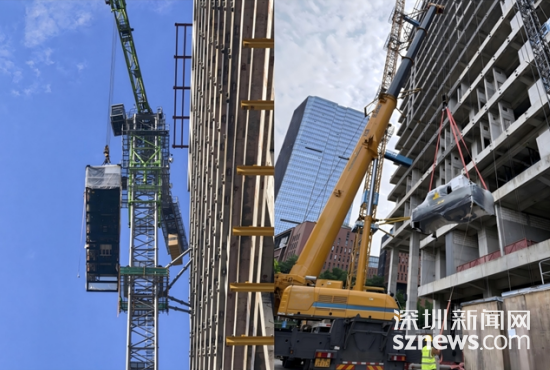
On September 22, the Phase III installation project of Fuwai Hospital Shenzhen Hospital, Chinese Academy of Medical Sciences, undertaken by China Construction Eighth Engineering Division, successfully completed the hoisting of core HVAC equipment, including magnetic levitation chillers, water manifolds, and air-cooled heat pumps. This batch of equipment is large and heavy, and the hoisting precision and safety management standards are far higher than those for ordinary civil buildings. The project team prepared special plans in advance and organized technical briefings and hazard inspections, ultimately completing all stages of hoisting, positioning, and securing. In terms of project progress, this is undoubtedly a significant milestone.
However, viewed from a legal perspective, behind every milestone in a large-scale medical building construction project lurks legal risk that cannot be ignored. Completion of hoisting means that MEP pipeline installation and system commissioning are about to commence in full, and this stage is precisely a high-incidence period for construction disputes. Whether the owner or the contractor, if they fail to attach sufficient importance to contract clauses, safety responsibilities, and evidence management, a seemingly smooth project milestone may also become the trigger for future litigation.
Safety Responsibility Behind Lifting Operations: Who Bears Liability When an Accident Occurs?
Hoisting of large equipment is a divisional and subdivisional work with relatively high risk as explicitly stipulated in Article 26 of the Regulations on the Administration of Work Safety in Construction Projects. The construction unit shall, in the construction organization design, prepare safety technical measures and a temporary electricity use plan for the construction site, and for divisional and subdivisional works with relatively high risk that reach a certain scale, prepare a special construction plan and attach safety verification and calculation results; the plan shall be implemented after being signed by the technical director of the construction unit and the chief supervising engineer.
This means that a hoisting plan is not a mere formality, but legal evidence of liability. If equipment damage or casualties are caused by defects in the plan or inadequate execution, the construction contractor will face administrative penalties, civil compensation, and even criminal liability. Under Article 134 of the Criminal Law, whoever violates relevant safety management regulations in production or operations, thereby causing a major casualty accident or other serious consequences, commits the crime of major liability accident.
In practice, many construction companies treat special construction plans as materials to be used during bidding and shelved during construction, sign technical disclosure records after the fact, and keep hazard inspection ledgers as a mere formality. Once an accident occurs, these missing records will become evidence extremely unfavorable to the contractor. When handling construction safety accident cases, Shenzhen lawyers have found that courts and emergency management departments scrutinize three links with extreme strictness: whether a special construction plan was prepared, whether technical disclosure was actually conducted, and whether the plan was actually implemented. If written evidence for any one of these links is missing, it is difficult for the contractor to be exempted from liability.
For the construction owner, it also cannot rest easy simply because the general contractor is responsible for safety. Article 1193 of the Civil Code provides that where a contractor causes damage to a third party or to itself in the course of completing the work, the client shall not bear tort liability, but if the client is at fault in commissioning, instructions, or selection, it shall bear corresponding liability. If the construction owner gives manifestly unreasonable instructions regarding equipment selection or site-entry scheduling, it may also be found to be at fault.
Equipment Procurement and Installation Contracts: Where Are the Invisible "Minefields"?
HVAC equipment for the hospital’s Phase III project, especially high-value equipment such as magnetic levitation chillers, typically involves complex procurement and installation contracts. Such contracts often simultaneously encompass multiple legal relationships, including equipment sale, transportation, installation, commissioning, and acceptance; once the terms are unclear, disputes are highly likely to arise.
The most common problems are concentrated in three areas. First, the provisions on equipment quality standards and acceptance conditions are vague. For example, the contract only states that the equipment complies with relevant national standards, but does not specify the specific standard number, testing methods, or acceptance procedures. After the equipment arrives, the owner believes the noise exceeds the limit, while the contractor believes it meets factory standards, and each side insists on its own position. Second, payment milestones are disconnected from project progress. Large equipment usually adopts an installment payment model of advance payment + payment on arrival + payment on installation + payment on commissioning + warranty deposit, but if the contract does not link each payment milestone to specific deliverables, the contractor may claim payment early, while the owner may refuse payment on the grounds that commissioning has not been completed. Third, the start date of the warranty period is unclear. Does it start from the arrival of the equipment, from passing completion acceptance, or from the hospital's actual use of the equipment? Different start dates may cause the warranty period to differ by several months or even more than a year.
From the perspective of judicial practice, when adjudicating disputes over construction project equipment procurement contracts, Shenzhen courts tend to respect the contractual terms, but will also examine whether any terms are obviously unfair. If the contract is a standard form document provided by the project owner and contains terms that significantly increase the contractor's liability, the contractor may, pursuant to Article 496 of the Civil Code, claim that such terms do not form part of the contract. However, the precondition is that the contractor can prove that it fulfilled its duty to give reasonable notice at the time of contracting.
Lawyers advise that, whether the owner or the contractor, during the performance of an equipment procurement and installation contract, complete written communication records should be kept. Unpacking inspection records when equipment arrives on site, acceptance forms for concealed works during installation, and parameter records during the commissioning stage are all key evidence for resolving disputes in the future. Oral communications, WeChat voice messages, and casual on-site photos often have insufficient probative value in litigation.
Settlement of Project Payments and Construction Delays: How to Avoid Not Getting Paid After Finishing the Work?
Hospital projects are government-invested projects or projects in which state-owned funds are predominant. The settlement of construction payments often involves financial review, auditing, and other stages and is relatively time-consuming. If the contractor lacks a clear expectation of the settlement process, it can easily fall into cash-flow strain.
Since the Regulations on Guaranteeing Payments to Small and Medium-sized Enterprises came into force in 2020, they have imposed strict rules on the payment periods for state organs, public institutions, and large enterprises after purchasing goods, works, and services from small and medium-sized enterprises, requiring payment within 30 days from the date of delivery of the goods, works, or services; where the contract provides otherwise, the maximum payment period shall not exceed 60 days. In practice, however, payment conditions often remain unfulfilled for a prolonged period because construction contractors' acceptance documents are incomplete, change orders have not been confirmed, and other such reasons.
Construction delays are also a frequent source of disputes in hospital projects. Healthcare buildings are functionally complex, and design changes are frequent, so contractors often suspend work while waiting for design drawings, waiting for equipment to arrive on site, or waiting for the owner to confirm materials. If the contractor fails to submit an application for an extension of time within the period stipulated in the contract and obtain written confirmation from the owner or the construction supervisor, it will be very difficult to claim an extension of time after the fact.
When handling such disputes, Shenzhen lawyers usually advise contractors to establish a construction period certification ledger early in the project, record every work stoppage or idling not caused by the contractor itself, and promptly send written letters to the owner and the supervisor. The letters should include the cause of the stoppage, the start and end times, the scope of impact, and the intention to claim. Even if the owner refuses to sign for receipt, service by postal express mail with the receipt retained can still form a valid chain of evidence in litigation.
Special Compliance Requirements for Medical Buildings: It's Not Just About Construction
The Phase III Project of Fuwai Hospital Shenzhen Hospital differs from ordinary commercial buildings in that, during its construction and delivery for use, it must also meet compliance requirements in multiple fields, including healthcare, environmental protection, fire protection, and special equipment.
Taking HVAC systems as an example, the air-conditioning systems in hospital areas such as operating rooms, ICUs, and catheterization rooms must comply with national standards such as the Architectural Technical Code for Hospital Clean Operating Department, which impose strict requirements on air cleanliness, air changes per hour, and temperature and humidity control. If the contractor fails to perform the installation in accordance with the specifications, resulting in a subsequent failure to pass acceptance inspection, it will not only face rework losses but may also face compensation claims from the project owner.
In addition, there are also statutory requirements for the use registration and periodic inspection of special equipment such as magnetic levitation chillers. Under the Special Equipment Safety Law, a user unit of special equipment shall, before putting the special equipment into use or within 30 days after putting it into use, apply to the department responsible for the safety supervision and administration of special equipment for use registration. If a hospital, as a user unit, fails to complete registration in a timely manner, it will face administrative penalties.
From a broader perspective, compliance management for healthcare building projects spans the entire process of project initiation, design, construction, acceptance, and delivery. If the owner and the contractor focus only on schedule and quality during the construction phase while neglecting environmental acceptance, fire safety acceptance, special equipment registration, and other steps, the project is likely to be unable to be put into use on schedule, which can in turn trigger knock-on effects on patients' access to medical care and hospital operations.
For enterprises participating in such projects, engaging professional lawyers to assist with contract review, compliance system development, and dispute resolution is not an additional cost but a fundamental investment in risk control. Guangdong Zhiming Law Firm has long served Shenzhen’s construction engineering and healthcare sectors and has accumulated extensive practical experience in engineering contract review, safety incident response, and disputes over construction payment settlement. Whether for the developer or the contractor, bringing in professional legal support at key milestones in project advancement can often avoid relatively large losses at a relatively small cost.
The construction of large-scale medical projects tests not only construction technology but also the systematic capacity for legal risk management. The completion of hoisting is merely the beginning; the subsequent pipeline installation, system commissioning, acceptance, and delivery must each be advanced prudently within the legal framework.