The Full Story of the "Sea Palace" Administrative Litigation Case
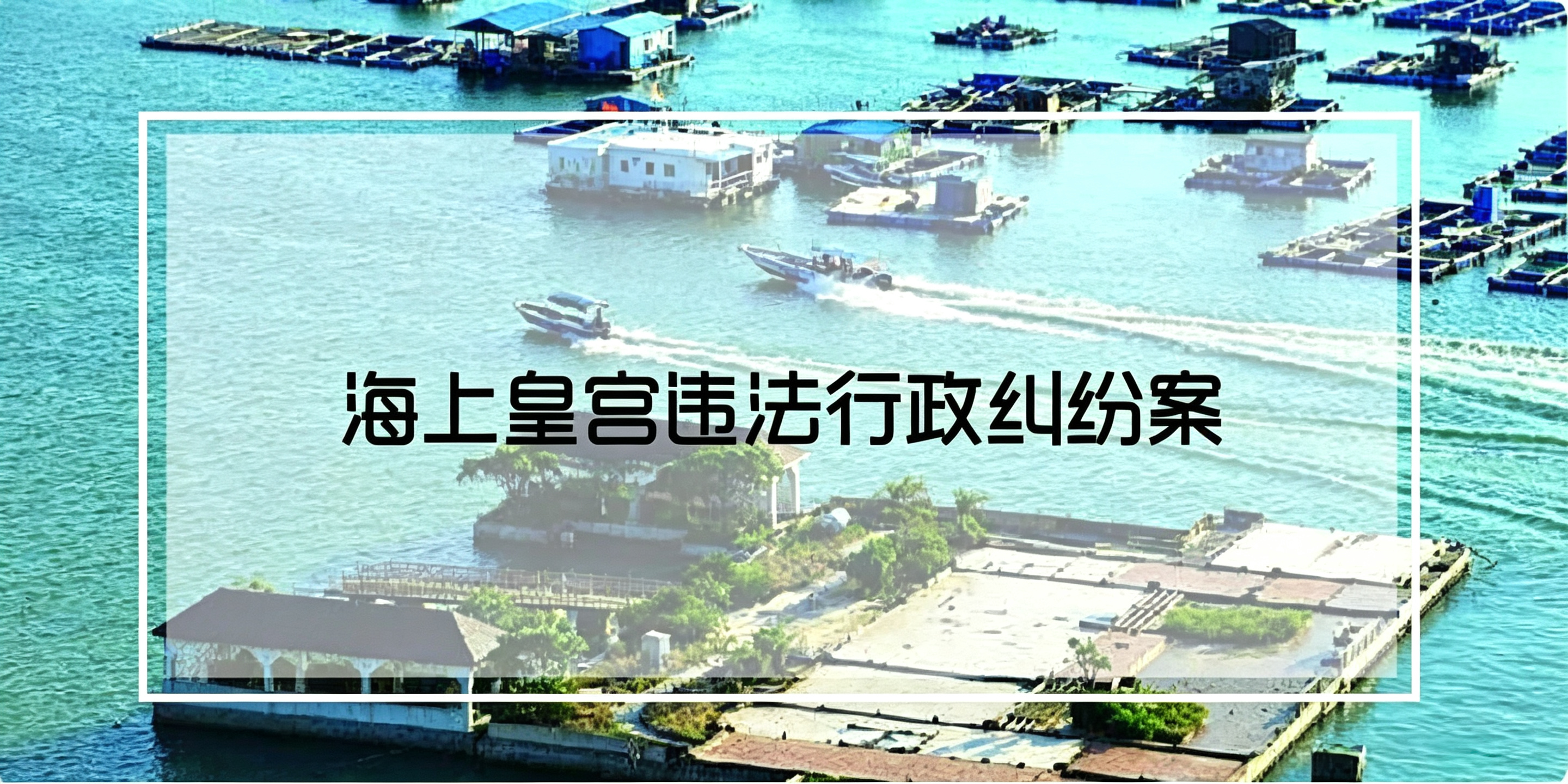
"Sea Palace" Main Floating Island (2010)
I. Case Background
The Nanao Dongshan Bay in Longgang District, Shenzhen has long been an aquaculture area for local fishermen, where generations of fishermen have built fish rafts and quarters on this peaceful bay for production and living purposes. Around 2011, the nationally sensational "Sea Palace" in Shenzhen referred to the floating island that drifted on Dongshan Bay.

"Sea Palace" Original State (2009)

The main structure of the "Sea Palace" in its original state
As early as 2003, entrepreneur Guo, building on traditional fish rafts, began constructing a relatively large offshore floating island (later dubbed the "Sea Palace" by the media). Since the offshore floating island was a novel concept, no agency was willing to issue a sea area use right certificate for it at the time. By January 2008, the former Longgang District Agriculture, Forestry and Fishery Bureau (hereinafter referred to as the Ocean Bureau) imposed a fine of 711,000 yuan on the "Sea Palace" and ordered it to restore the sea area to its original state within a specified period. However, due to the active efforts of the "Sea Palace" side, Li Zhujiang, then Director of the Guangdong Provincial Ocean and Fishery Bureau, issued an instruction in the spirit of encouraging innovation, designating the Longgang Brigade to withdraw the case. Nevertheless, out of deference to the former Longgang District Ocean Bureau, the "Sea Palace" side still chose to pay the fine.

The development agreement between the "Sea Palace" party and the Nan'ao party.
On January 13, 2010, some media in Shenzhen published reports concerning the floating island's "illegal" use of sea areas, and named the floating island the "Sea Palace," which immediately drew national attention. For a time, journalists from all sides gathered at Dongshan Bay, creating a formidable uproar as if to blast the "Sea Palace" flat. Amid the media's narrative of "collusion between officials and businessmen," the "Sea Palace" was dismantled into three major sections on May 13 and towed away from its original sea area, but it was left to drift on the surface of Dongshan Bay, awaiting rectification. Following active rectification efforts by the "Sea Palace" side, on December 26 of the same year, the then Longgang District Ocean Bureau issued an "Aquaculture Registration Certificate" and approval for recreational fishing to the rectified "Sea Palace."

The "Sea Palace" (2010), split into three major parts, was ready to undergo comprehensive rectification by the former Longgang District Ocean Bureau.

Rectification plan for converting the "Maritime Palace" floating island into aquaculture and fishing raft facilities


The former Longgang District Ocean Bureau's approval reply to "Sea Palace" regarding the aquaculture and angling certification

The aquaculture license issued by the former Longgang District Oceanic Administration to the "Sea Palace" party

The "Sea Palace" after comprehensive rectification, along with the newly added aquaculture fish rafts around it.
Just as the "Sea Palace" was preparing to open the floating island to the public, renewed involvement by certain media outlets forced the Shenzhen Municipal Oceanic Administration and Longgang District to issue a joint notice on March 2, 2011, declaring that the "Sea Palace" had illegally occupied sea areas and ordering the former Longgang District Oceanic Administration to revoke the "Aquaculture Registration Certificate" it had issued to the "Sea Palace." On April 8, without following the legally required administrative procedures, the Longgang District Oceanic Administration began organizing personnel to forcibly demolish the superstructure of the "Sea Palace."

Decision of the Former Longgang District Oceanic Administration on Revoking the "Sea Palace" Aquaculture License

A scene of the former Longgang District Ocean Bureau organizing forces to forcibly demolish the "Sea Palace"
I'm ready to help translate your Chinese legal content into professional English for the Shenzhen Zhiming Law Firm website. Please provide the Chinese text you'd like me to translate.
The "Sea Palace" During Forced Demolition

A news report by Southern Daily on the forced demolition of the "Sea Palace."
As early as March 28 prior to this, the "Sea Palace" side had already filed a lawsuit against the former Longgang District Ocean Bureau for its administrative penalty of going back on its word and violating legal procedures. On April 20, the Longgang District Court decided to accept the administrative litigation request filed by the "Sea Palace" side in accordance with the law. The former Longgang District Ocean Bureau also stopped the relevant demolition work after completely dismantling the main structures in the atrium of the floating island. Subsequently, the plaintiff, the "Sea Palace" side, entrusted the Zhiming lawyer team of Guangdong Zhiming Law Firm to represent the case.

On June 21, the scene at the first hearing of the "Sea Palace" administrative lawsuit case.
II. Heated Courtroom Debate
The case was first heard on June 21, 2011, in the Fourth Trial Court of Longgang District People's Court. During the hearing, lawyers from Zhiming primarily presented the following points in their defense statement:
1. After obtaining the "Aquaculture Registration Certificate," the plaintiff's aquaculture (fishing) activities in the designated sea area are entirely lawful. First, the fishery administrative department of the people's government at or above the county level is the legally authoritative organ responsible for issuing aquaculture licensing documents, and once such a licensing document is obtained, one naturally possesses the lawful right to use the relevant designated sea (water) area for aquaculture, with no legal provision requiring the separate acquisition of an independent "sea area use right certificate" as a prerequisite. The so-called assertion by the Longgang District Economic Development Promotion Bureau (i.e., the former Longgang District Ocean Bureau) that "the plaintiff has not lawfully obtained the sea area use right" is purely illegal and unfounded. Second, over the past thirty years, the fishery administrative departments of Longgang District, in their actual supervision and administration of marine aquaculture within their jurisdiction, have likewise only issued aquaculture registration certificates, without imposing the acquisition of a sea area use certificate as a prerequisite.
2. It is unreasonable to mischaracterize the luxury fishing raft as an "illegal structure," and the private desire of resentment toward the wealthy and jealousy should not receive legal support. It is true that the plaintiff's fishing raft is luxurious, but this does not negate its essential nature and function as a fishing raft, nor does it deprive it of its aquaculture and fishing functions. Secondly, the fact that the plaintiff's aquaculture and fishing raft often receives guests for visits and viewing is not illegal, and there is no provision in Chinese law that prohibits guests from visiting and viewing anyone's fishing raft. Finally, no illegal activities such as gambling, prostitution, or drug use have occurred on the plaintiff's luxury fishing raft; only gatherings for viewing and socializing have taken place. Without a "law" classifying its nature, the "Sea Palace" should not be deemed an "illegal structure."
3. The revocation of the aquaculture registration certificate and the approval for fishing permits constitutes "unlawful administration," not "self-correction." The Longgang District Economic Development Promotion Bureau first approved the plaintiff's operation of the rectified fish rafts for aquaculture and recreational fishing, and issued the "Aquaculture Registration Certificate" in December 2010, permitting the plaintiff to operate legally. However, just three months later, due to negative media coverage, it openly violated statutory procedures by revoking the approval for the plaintiff's lawfully obtained aquaculture and fishing permits and forcibly reclaiming the "Aquaculture Registration Certificate," seriously contravening the provisions of China's "Administrative Licensing Law" and depriving the plaintiff of their rights to defense and statement. This can only be regarded as a new act of unlawful administration. Even if the intention was to "self-correct prior licensing errors," it cannot re-violate the nation's statutory procedural regulations by enforcing the law unlawfully and committing new errors.
4. The forced demolition is in fact a new illegal administrative penalty, rather than the restoration of the old penalty measure. Although the Longgang District Economic Development Promotion Bureau argued that its forced demolition of the "Sea Palace" was a lawful compulsory measure taken pursuant to the old administrative penalty decision, this clearly contradicts the facts and violates legal provisions. In reality, the old administrative penalty had already been ruled by the People's Court of Longgang District as concluded in enforcement. Therefore, the Longgang District Economic Development Promotion Bureau did not apply for judicial enforcement to resume the "forced demolition"; rather, it arbitrarily carried out the demolition on its own, without any legal basis.
(For details of the representation statement in the "Sea Palace Case," please refer to the article "Zhiming Lawyers' Representation Statement in the Sea Palace Illegal Administrative Dispute Lawsuit" on this website)
Subsequently, the attorney representing the Longgang District Economic Development Promotion Bureau was not to be outdone and likewise raised sharp rebuttals. The lawyers on both sides engaged in a fierce debate over many detailed issues in the case, leaving the reporters present almost holding their breath. In the end, through unremitting efforts, the Zhiming lawyers successfully found strong support for the survival of the "Sea Palace" in both legal principles and common sense. They not only won over the judge, but also the journalists covering the scene, gradually turning the tide of public opinion in the case in a favorable direction.

After the first court session, Attorney Zhiming gave a news interview to the "Today's Focus" program of Guangdong Television.

Shenzhen Commercial Daily's news report on the court hearing of the administrative lawsuit regarding the "Sea Palace"
After a two-day adjournment, the parties held a second court session at the court on June 24. Before the hearing, Attorney Zhiming turned defense into offense, demanding that the Longgang District Economic Promotion Bureau provide administrative compensation for the losses suffered by the plaintiff as a result of the forced demolition, totaling 50 million yuan. This time, Attorney Zhiming once again demonstrated his superb courtroom advocacy skills, seamlessly integrating reason, common sense, and legal principles, while creatively unleashing his extraordinary talent in the art of litigation. He not only perfectly defended but even expanded the gains achieved in the first hearing.

Lawyer Zhiming and Mr. Guo, the owner of the "Sea Palace," at the second court hearing on June 24th.

After the second court session, Attorney Zhiming accepted a news interview with Xinhua News Agency.
3. Post-Trial Maneuvering
The arguments in the courtroom had just concluded, and the contest outside the courtroom began as well. Given the unfavorable situation faced by the Longgang District Economic Development Promotion Bureau in this litigation, the municipal and district courts specially dispatched a vice president of the municipal intermediate court to meet with Zhiming Lawyers in late 2011, engaging in an in-depth discussion on whether there was any possibility of settlement in the "Sea Palace" case. Although both sides had reached a consensus on certain issues in the case, Zhiming Lawyers clearly sensed that the government side still preferred to adopt a "stalling" tactic rather than make any concessions. Although Zhiming Lawyers also deeply understood the court's dilemma in this case, they consistently maintained that since the current situation was caused by the repeated errors of the former Longgang District Oceanic Bureau, there was no reason for the plaintiff to suffer a silent loss. With no alternative, the court could only set the case aside and delay issuing a judgment.
The turning point came in May 2012. He Yongzhi, former Director of the Shenzhen Ocean Bureau, was transferred to serve as Director of the Administrative Committee of Dapeng New District. To align with the development of Dapeng New District, after careful deliberation among municipal leaders, it was decided to adjust the strategic positioning of the district, shifting its goal to building a "world-class coastal eco-tourism resort," while the waters of Dongshan Bay in Nan'ao were re-planned as a high-end tourism area.
Thus, under the enlightened leadership and candid treatment of the new director of the management committee, and through court coordination, the Longgang District Economic Development Promotion Bureau and the "Sea Palace" side reached a settlement in May 2012 — setting aside the dispute and maintaining the status quo, allowing the "Sea Palace" to continue floating on Dongshan Bay, and seeking new development in light of the Dapeng New Area's strategic positioning once the negative impact of the matter had subsided. At the same time, the "Sea Palace" side was required to remain silent and low-key to avoid attracting renewed public criticism. Accordingly, the "Sea Palace" side formally withdrew its lawsuit in late May and abandoned its compensation claim of 50 million yuan for the partial demolition of the floating island. At this point, the administrative litigation case of the Sea Palace was temporarily brought to a close, thanks to the vigorous advocacy of the Zhiming lawyers.


Original copy of the ruling on the plaintiff's withdrawal of the lawsuit in the "Sea Palace" case
Nowadays, the main body of the "Maritime Palace" floating island still drifts in Dongshan Bay, but thanks to its earlier fame, this once-abandoned floating island has gradually attracted numerous visitors who come to "sightsee and visit," making it a must-see attraction for many tourists. Fishermen near Dongshan Bay have capitalized on this opportunity, building various seafood raft restaurants around the "Maritime Palace" floating island, while the catering and tourism businesses of villagers on the shore have also flourished as a result, collectively forming a unique industrial chain on the waters of Dongshan Bay. According to nearby villagers, most tourists visiting Nan'ao now follow a set itinerary: arriving in Nan'ao in the morning, heading directly to Dongshan Bay Pier, going out to sea to see the "Maritime Palace" and taking photos, having lunch at the nearby fishing rafts, and then heading to nearby Yangmeikeng Beach for a swim.

Tourists are climbing to a high vantage point by Dongshan Bay, gazing out at the "Maritime Palace."

An aerial view of the "Sea Palace" (2012).
IV. Post-Case Reflections
"Although it ended in a settlement due to compromise between both parties, appearing to be a win-win, it was in fact a lose-lose situation." Years later, when Lawyer Zhiming revisited this administrative litigation case that had once stirred the whole nation, he was still deeply moved.
Firstly, in this case, the government side exposed numerous problems, such as rigid legal provisions, wavering positions, rough enforcement, and extrajudicial interference, to the extent that even after the "Palace on the Sea" was demolished, public outrage remained unappeased, instead drawing even more criticism from the public and causing some damage to the government's credibility. However, the relevant leaders also demonstrated sufficient foresight and responsibility in this case. After all, when handling the entire incident, the government side accepted dissenting voices and did not absolutely and arbitrarily insist on forced demolition and wrongful judgment, in order to uphold the government's reputation and image. As a result, the "Palace on the Sea" was able to be preserved for a long time, winning a chance for its subsequent development.
At the same time, as the owner of the "Maritime Palace," Guo, despite his commanding presence in the business world, faced dire consequences when the legal risks were underestimated. In this case, Guo himself endured immense mental stress and suffered substantial financial losses. A breathtaking paradise on the sea was reduced to the barren island seen today—wealth destroyed, splendor lost, a lamentable sight. However, the artistic masterpiece he conceived in a flash of inspiration, the "Maritime Palace," holds groundbreaking significance for the nation in terms of sea-use models.
Finally, we should also recognize the positive significance of this case. On one hand, the emergence and tremendous influence of the "Sea Palace" promoted the progress and improvement of the law, facilitating the smooth promulgation of the "Interim Measures of Shenzhen Municipality for the Registration of Offshore Structures." On the other hand, the righteous advocacy of the Zhiming lawyers made government departments aware of their improper conduct in the enforcement procedures, allowing the "Sea Palace," as a novel development, to survive a desperate situation and ultimately be preserved.

The "Sea Palace" that survived the disaster (end of 2012)
V. Afterword
According to Shenzhen Evening News: In June 2014, Comrade Fu Xinjiang, then Deputy District Mayor of Longgang District and now Vice President of the Shenzhen Intermediate People's Court, delivered a speech at the Futian District event themed "Rule of Law Thinking and Law-Based Administration." Drawing on the highly publicized "Sea Palace Case" from his tenure as Deputy District Mayor of Longgang, he explained the essence of rule-of-law thinking in an accessible manner: "The government must abide by the law and administer in accordance with the law!" At the same time, Comrade Fu Xinjiang, drawing on his own governance experience, urged leading officials at all levels present at the meeting to "constantly remind themselves to resolve issues through legal means."
From this, it is evident that the "Maritime Palace Case" is far more than just an administrative litigation case. The legal insights it offers and its role in advancing the construction of a rule-of-law society in China are immeasurable.

A tourist rented a jet ski from nearby villagers to observe the "Sea Palace" up close.

A floating island building designed by a foreign engineer.