Guo's "Sea Palace" Dream Comes True — The Ultimate Revelation of the "Sea Palace" Case (Part 7)
Part One: "Rich Tycoon" Guo XX and His "Sea Palace"
6. Dream Come True
Having solved the technical challenges and found a flexible way to address the legal identity issue, Guo began to roll up his sleeves and pull out all the stops, making grand plans in the beautiful Dongshan Bay. The massive investment of manpower, material resources, and capital goes without saying. More importantly, Guo devoted himself wholeheartedly to his dream, often forgetting to eat and sleep, pouring his heart and soul into the design and construction of the floating island, continuously infusing it with his artistic inspiration. For what he aimed to create was not merely a technological marvel but also a work of art. One detail alone suffices to demonstrate the effort Guo invested: in order to incorporate the characteristics of a traditional Chinese courtyard into the floating marine structure and create the effect of a green home at sea, Guo experimented with planting over a hundred different species before finally selecting a dozen or so ideal ornamental plants capable of withstanding sea winds for the floating island.
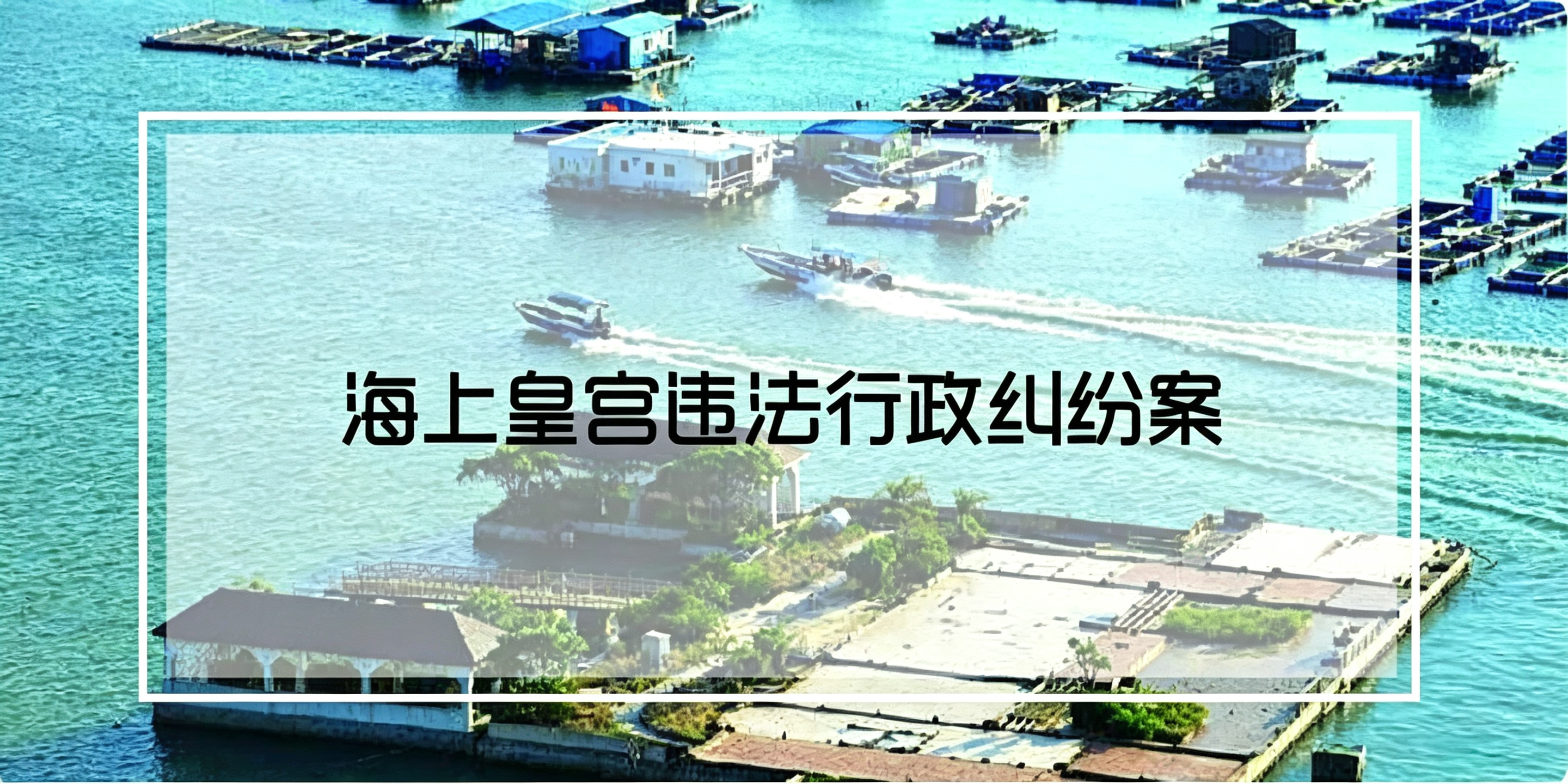
Hard work pays off, and Guo's years of relentless effort have yielded results that can only be described as flawless: technologically, the floating island excels in typhoon resistance and corrosion resistance; artistically, the island and its superstructure showcase symmetry and balance in architectural aesthetics, complemented by the use of lightweight materials and Balinese-style decor, endowing this offshore floating structure with unprecedented visual appeal (Figures 18-23).


Looking back now at the floating island structure that Guo had painstakingly designed and built over many years, objectively speaking, as a new creation, it was too perfect and too luxurious. But perfection was not Guo's fault; it was a natural expression of the artistic temperament and sentiment that Guo carried, which had already been unmistakably revealed in the decorative design of the entrance to the first influential commercial real estate project Guo invested in—the Taiyuan Street Fashion Underground Street in Shenyang! Nor was luxury Guo's crime. The extravagance in the decorative design was tied to Guo's original business plan targeting the high-end tourism industry, and this positioning itself was in line with economic laws. After all, in the development of modern market economies, any product or service is a luxury at its inception. For instance, the flush toilet that every household now has was a luxury even in the advanced Western countries over a hundred years ago, and the mobile phones that everyone now carries—one or even several per person—were just the "big brother" phones in the hands of the wealthy only a decade or so ago! Producers and providers of innovative goods and services must charge high prices to compensate for the enormous costs and risks they bear in innovation, and the high profits then attract imitation and competition, driving continuous technological improvement, quality enhancement, and price reduction of innovative products and services, eventually turning them into ordinary consumer goods, benefiting society as a whole. Unfortunately, due to the severe wealth disparity, social injustice, and polarization brought about by corruption and monopoly, a strong atmosphere of resentment against the rich pervades current Chinese society. In the eyes of those who resent the wealthy, perfection may itself be a mistake, and luxury could even be a sin!
After years of arduous exploration and investments totaling over a hundred million yuan, the offshore floating island architecture was finally completed, nearly perfect and arguably luxurious. However, Guo did not rush to officially open it to the public to recoup his investment and generate profits. If we were to speculate with a petty mind about a gentleman's intentions, perhaps Guo's actions at the time stemmed from a "selfish motive." The offshore floating island was a technological marvel and artistic masterpiece forged from years of his hard work, representing the perfect intersection of his artistic sensibilities and entrepreneurial spirit. It was also a spiritual haven he created for himself after achieving success as an entrepreneur, allowing him to revisit his artistic dreams. At one point, Guo even envisioned developing the offshore floating island into an exclusive venue for elites to gather and socialize, even conceiving a grand and prestigious name for it: "Jiangshan Club." However, this plan was never formally put into action. Thus, for a long time after the completion of the offshore floating island, aside from serving as a retreat from the mundane world, Guo also enjoyed bringing close friends from his circle there for brief gatherings during his leisure time—discussing ideals, chatting about life, sharing business opportunities, and exchanging creative ideas. One can imagine life on the offshore floating island: azure waters and clear skies, the ebb and flow of tides, lush greenery and blooming flowers, birds soaring and fish leaping; savoring delicacies from the sea, admiring masterpieces by renowned artists; greeting the red sun rising over the blue sea in the morning, bidding farewell to the sunset dyeing the clouds in the evening; conversing with learned scholars, free from the company of the unlettered. For someone born with an artist's soul, what more could one ask for in life? Yet, Guo was, after all, also an entrepreneur, and his approach was driven by a certain "economic rationality": since his offshore floating island project was unique both domestically and globally, and despite having weathered several storms and strong typhoons, the time was still too short. If it were fully opened to the public and a public safety incident occurred, it would be an unbearable burden for both himself and the fashion enterprise group he had founded.
Peaches and plums do not speak, yet a path forms beneath them. Even as a low-key, informal operation, Guo's floating island project exerted a strong radiating influence over Dongshan Bay. In particular, thanks to the bold creativity and unique artistic charm of the floating island, it became increasingly well-known among local residents. Through word of mouth, more and more tourists were drawn to Dongshan Bay to see the floating island, boosting local popularity. Hotels and restaurants in the area gradually saw thriving business, all of which spurred local economic development. On the other hand, the fragrance of flowers blooming within the walls wafts beyond them—Guo's high-end floating island tourism model also attracted the attention of government departments from other regions in China eager to develop marine tourism economies, and visits to study its model occurred from time to time. Moreover, when it later became embroiled in a storm of public opinion, came under siege and criticism, and faced the adverse situation of being forcibly dismantled by the Shenzhen local government, many marine tourism attractions and local governments extended olive branches to Guo's floating island, saying, "Just tow it over here and dock it!" That, however, is a story for later—let us set it aside for now.
The combination of perfection and luxury, along with its exclusive operational model, has shrouded Guo's offshore floating structure in an air of mystery for the average person. In a social climate rife with resentment toward the wealthy, this veil of mystery inevitably reflects wealth, power, and corruption in the public eye. On the other hand, Guo, as the island owner of the floating structure, has always exhibited an artistic temperament and an otherworldly, free-spirited, and unyielding demeanor, maintaining a long-standing distance from officials, the media, and the general public, making him an easy target of envy, jealousy, and resentment. All of this laid the groundwork for what followed: when sensationalist media reporters seized upon the floating structure, it was labeled a private club and branded with the infamous title "Maritime Imperial Palace." Suddenly, it gained notoriety, its "ill repute" spread far and wide, and it became the focus of public criticism, planting the seeds of its downfall.
Extended topic: A rational look at the pros and cons of "private clubs"
During the preparation and writing of this book, the new central leadership collective headed by General Secretary Xi Jinping was advocating frugality, carrying out the Party's mass line education practice activities, and cracking down on corruption with a strong hand. The entire political landscape and social atmosphere in China were taking on a renewed look. In this process, "private clubs" unfortunately became a completely negative concept, synonymous with corruption involving power-money deals. Of course, it is indeed improper and infuriating for private clubs to occupy public resources such as parks, historical sites, and even revolutionary memorial sites, and it should be strictly prohibited for government officials to frequent private clubs where power-money transactions and corruption can easily occur. However, private clubs, as a form of leisure and entertainment lifestyle for the affluent class in society, just like luxury consumption such as villas, luxury cars, famous watches, and designer bags, have their own reasons and logic for existing in a market economy. They should not be viewed as a scourge and rejected or excluded wholesale; otherwise, we risk falling back into the quagmire of the old extreme leftist ideology. In this regard, we do not need to employ any profound modern economic theories or methods to demonstrate this; our ancients have already set an example for us. Fan Zhongyan, who said, "Be the first to bear the world's worries and the last to enjoy its pleasures," although living in the Song Dynasty a thousand years ago, can still serve as a model for all government officials today who uphold the concept of governance for the people, not only for his ideological realm but, more importantly, for his pragmatic style of respecting the laws of the market economy. In Shen Kuo's *Dream Pool Essays*, Chapter on Official Affairs I, there is such a record:
In the second year of the Huangyou reign, a great famine struck Wu, and the dead lay strewn across the roads. At that time, Fan Wenzheng governed western Zhejiang and distributed grain from the granaries. He also recruited the people to provide food supplies, devising a comprehensive plan. The people of Wu delighted in boat racing and were fond of Buddhist activities. Xiweng allowed the people to hold boat races, and the prefect himself went out daily to feast by the lake. From spring to summer, the residents emptied the streets to join in the festivities. He also summoned the heads of the various Buddhist temples and instructed them, saying: "In times of famine, labor is extremely cheap, so you may undertake large-scale construction projects." Consequently, the temples began extensive building work, and new granaries and official residences were also erected, employing a thousand laborers daily. The supervisory officials impeached Hangzhou for neglecting famine relief, indulging in excessive leisure, and wasting public and private resources on construction, harming the people's strength. Wenzheng then personally explained that the feasting, outings, and construction were all intended to circulate surplus wealth and benefit the poor. Those engaged in trade, catering, crafts, and manual labor who depended on public and private support numbered tens of thousands daily. No famine relief measure was greater than this. That year, only Hangzhou among the two Zhe circuits remained peaceful without people fleeing, all thanks to his benevolence. In times of famine, distributing grain from the state granaries and recruiting the people for public works to generate benefits later became established policy. Having relieved hunger and thereby achieved public welfare, this was the virtuous legacy of the ancient sage kings.
This passage describes a great famine that occurred in Wuzhong (present-day Jiangsu and Zhejiang region) in the second year of Emperor Renzong's Huangyou reign (1050 AD) during the Northern Song Dynasty, when the bodies of those who starved to death lay scattered across the roads. At that time, Fan Zhongyan served as the governor of Zhexi. He distributed grain from the national granaries and raised money and goods from the private sector to relieve the victims, and his famine relief measures were quite comprehensive. The people of Wuzhong were fond of boat racing and loved to engage in Buddhist activities, so Fan Zhongyan encouraged the populace to hold more events, and the governor himself went out daily to feast and wander by West Lake. From spring to summer, the city's residents went out in large numbers, enjoying themselves to the fullest. Fan Zhongyan also summoned the abbots of various monasteries and instructed them, saying: "During famine years, labor costs are at their lowest, so this is an opportune time to undertake large-scale construction projects." As a result, construction projects in all the monasteries flourished. He also ordered the government to renovate granaries and official residences, employing thousands of laborers each day. The supervisory officials impeached him for not showing concern for famine relief, for indulging in pleasure without restraint, and for the construction of buildings by both the government and private parties, which they claimed wasted the people's resources. Fan Zhongyan then drafted a memorial himself, explaining that the reason for the feasting and construction was to mobilize surplus wealth to aid the poor. Those engaged in trade, the food and beverage industry, as well as craftsmen and laborers, who depended on the government and private households for their livelihood, numbered perhaps tens of thousands daily. No famine relief measure was better than this. That year, among the disaster-stricken areas of the Liangzhe circuit, only Hangzhou remained peaceful, with no refugees, all thanks to the benevolence of Lord Fan Wenzheng. In famine years, opening the granaries of the Court of Agricultural Supervision to relieve the people and raising private funds to promote local benefits has in recent years been established as law. This measure both relieves famine and, taking advantage of the lean year, promotes benefits for the people—this is the achievement of the former kings.
The most common approach for governments in disaster relief—and one that aligns with conventional thinking—is for officials to tighten their belts and distribute as much relief aid to victims as possible (providing free relief supplies). However, ancient Chinese officials already understood that in times of famine, the best course was to implement an "expansionary fiscal policy"—launching large-scale construction projects and infrastructure development. This would stimulate consumption, boost employment, and increase income, achieving two goals at once: addressing the livelihoods of disaster victims while improving infrastructure. If one fails to grasp this principle, then in a year of severe disaster, Fan Zhongyan—the local magistrate responsible for the region—would not have led by example in frugality but instead taken the lead in sightseeing and building grand halls and offices. Even today, he would be drowned in a flood of online criticism, and those self-righteous "men of virtue" who believe they occupy the moral high ground would add: "He got what he deserved, and his punishment was too lenient!" Yet this kind of pseudo-morality, which defies the laws of market economics, is not only incompatible with modern economic theory but also falls a hundred thousand miles short of the insight and standards of people a thousand years ago.
(To be continued)