

Shenzhen Real Estate Administrative Litigation – Demolition Relocation Compensation Disputes
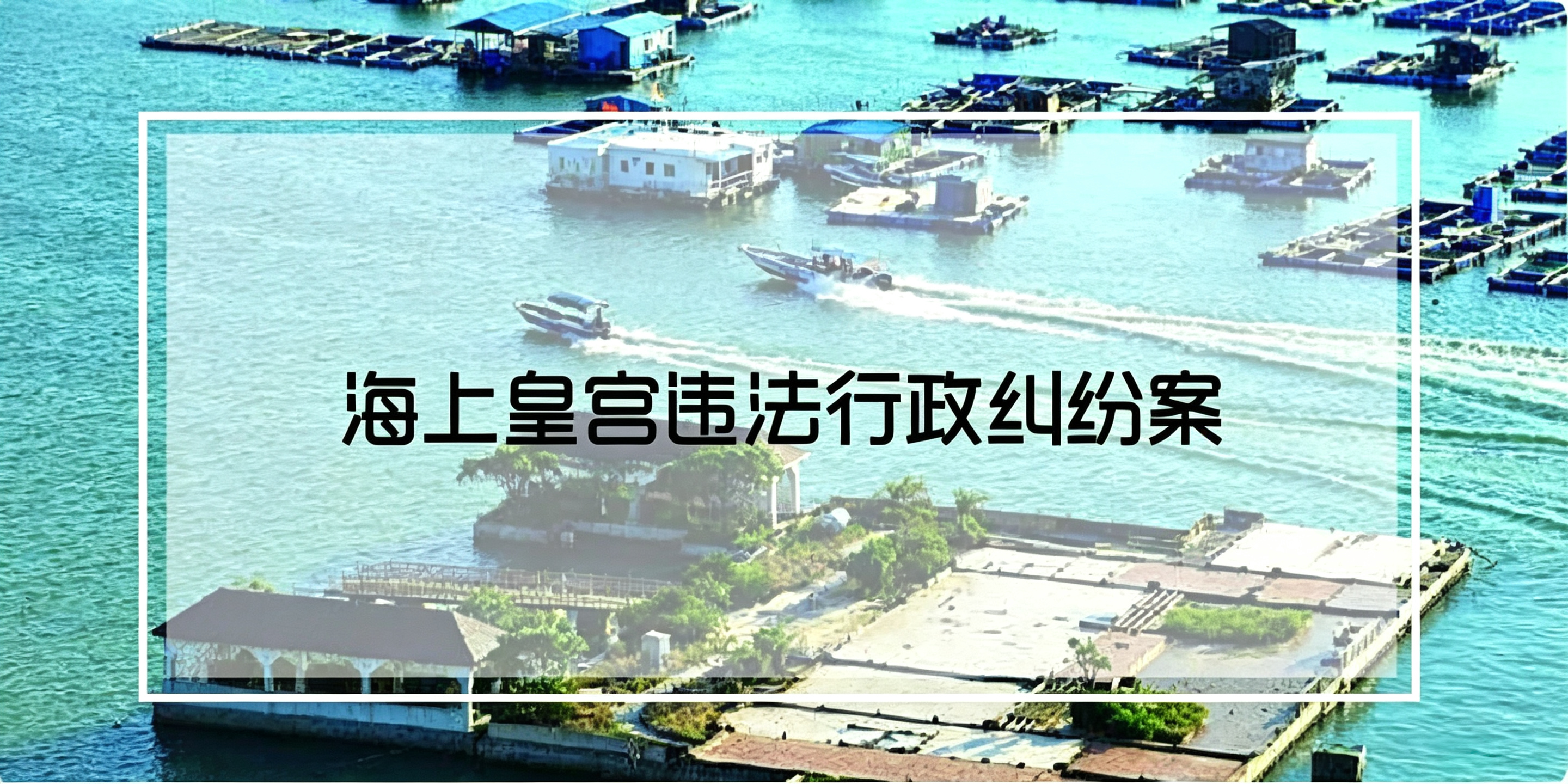

This article is dedicated to commemorating the 25th anniversary of the promulgation of the Administrative Litigation Law and its first major revision! Part One: "Tycoon" Guo Moumou and His "Sea Palace" 4. Technical Difficulties From offshore fish rafts to offshore floating islands, the splendid plan to expand maritime living space and commercial space was so tempting, but the reality Guo Moumou faced was discouraging: there was no successful precedent anywhere in the world for floating islands. Japan, a country with formidable technical and financial strength but very limited territory, was one of the earliest explorers of floating islands, having invested substantial funds in an attempt to build a floating island-style airport. The Netherlands, known as the "low country," also put great effort into the "floating island" issue to increase its land area. However, these early explorations and efforts all failed, one reason being the constraint of habitual human thinking—engineers all chose the "shipbuilding" technical approach to construct floating islands, i.e., building them on shore from steel plates and then launching them into the sea. But this way, floating islands could not be built very large, because if too big, they could not be launched; moreover, steel plates posed an extremely high risk of corrosion after several years in seawater, so the lifespan of floating islands was short. Guo Moumou brought out the skills he had developed from his early art education and later from architectural decoration, turning his dream of maritime living space into vivid renderings, and then sought advice from experts at the ocean research institute, hoping to find a feasible technical solution. But after studying his drawings, most experts believed it could not be done, because a structure of such volume, built on shore and then placed in the sea, was simply impossible to achieve. The habitual thinking that had plagued Japanese engineers struck again! Later, it was an engineer who understood marine principles who provided Guo Moumou with a simple yet highly creative solution: connect 100 stainless steel pontoons in the sea, secure them, and build a house on top! Guo Moumou's mind was suddenly enlightened, and he deployed the killer skill of successful entrepreneurs—vigorous and resolute execution—and immediately set to work. "But unexpectedly, before the foundation part was even finished, a small wave came and snapped the connecting parts between the pontoons." Successful entrepreneurs are never people who give up easily! Guo Moumou was undaunted. After carefully studying the video of the waves snapping the pontoons, he gained preliminary marine experience, and combined with land-based civil engineering principles, he poured concrete on the original foundation and stuffed foam into the steel frames, preliminarily solving the solidity and stability problems of the foundation. Then he added the superstructure, and the first experimental offshore building was completed. Applying a little of his artistry and architectural decoration expertise, the "home at sea" of Guo Moumou's dreams appeared spectacularly between the blue sky and clear waters of Dongshan Bay. It was the joy of success, the pleasure of creation, and perhaps also the excitement of unfolding grand commercial ambitions at sea—we can somewhat imagine how Guo Moumou felt at that time. But the good times did not last. The offshore building, which he thought was very solid, encountered Shenzhen's strongest typhoon in years a year later and was instantly snapped into two pieces! Everything started from scratch again! After several setbacks and repeated trial and error, Guo Moumou was not at all disheartened at this point; on the contrary, he was full of confidence and had a well-thought-out plan, because he had already figured out the secret to building floating maritime structures. Since steel is easily corroded in seawater, while concrete is never corroded in seawater, Guo Moumou changed the foundation base slab to polyester, sealed foam inside with concrete, and made "hollow concrete." This allowed it to float, while also being heavy enough to effectively keep the floating island's foundation stable. More importantly, it was sturdy and corrosion-resistant, required no maintenance on shore, and would not corrode for over a hundred years. To increase the building's foundation area, the "hollow concrete" units were connected with rebar, allowing unlimited extension like fish rafts, and the cost was also very low, giving it the economic viability necessary for large-scale promotion. Guo Moumou once proudly said, "The experts could not figure out no matter how they tried how I achieved it. When I explained the principle to them, they were thrilled and said the reasoning was actually so simple. This shows that the more widely a project can be applied, the simpler its underlying principle is." Figure 14: This is the description and schematic diagram of the abstract portion of the patent application Guo Moumou submitted on April 2, 2011, with patent application number CN201110084209. (Source: Screenshot of the database search results from the State Patent Office) (To be continued)

