

Love at First Sight with the "Sea Palace" — The Ultimate Revelation of the "Sea Palace" Case (Part 18)
4. Love at first sight
Let us turn back and continue with the story of Guo Moumou and his "Sea Palace" dispute case.
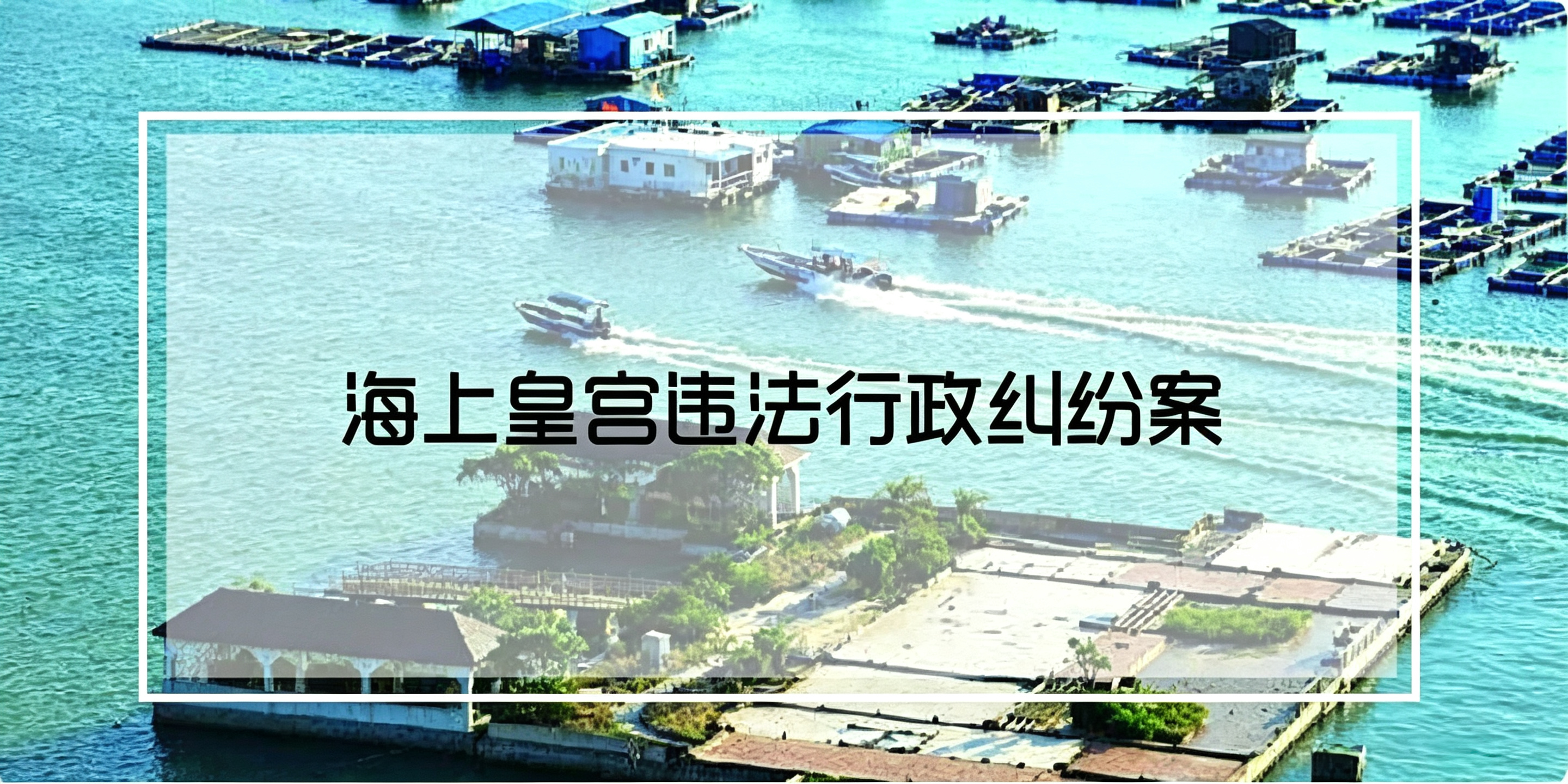
The entire "Maritime Palace" incident did not come to an end with the forced demolition of the "Maritime Palace" as government departments had expected, nor was it simply "a matter of tearing it down and being done with it." On the one hand, the forced demolition operation launched on April 8, 2011 only managed to destroy the main parts of the upper structures of the floating island. As for the foundation of the floating island, which is structurally complex and extremely sturdy, the government departments still could not come up with a thoroughly sound solution, and the forced demolition operation came to a standstill. On the other hand, Guo, who in a fit of anger decided to resort to legal means to seek redress for himself and for the "Maritime Palace," simply went all the way. On March 24, April 12, and May 4, he successively filed three administrative complaints with the Longgang District People's Court (Figures 77, 78, 79), and the claims raised in the lawsuits corresponded respectively to the Notice on the Revocation of the Reply Concerning the Application for Marine Aquaculture, Fishing, and Other Certificates issued by the Longgang District Oceanic Bureau to Maritime Elite Entertainment Co., Ltd. on March 1, the Decision on the Revocation of the Aquaculture Registration Certificate, and the forced demolition operation against the "Maritime Palace" carried out by the Longgang District Oceanic Bureau. Due to the institutional reform of the Longgang District Government, the Oceanic Bureau and other functional departments were merged into the Economic Promotion Bureau, so the defendant in the administrative lawsuits was uniformly listed as "Shenzhen Longgang District Economic Promotion Bureau." The Longgang District People's Court accepted the three administrative lawsuits under case numbers "(2011) Shen Long Fa Xing Chu Zi No. 45, No. 47, and No. 53" respectively.
Driven by a momentary sense of righteous indignation, he filed an administrative lawsuit against a government department, primarily as a gesture to express his stance to the public. As for the outcome of the lawsuit, Guo had no confidence in his heart and did not intend to dwell too much on the consequences. After all, he was up against the formidable backing of the Shenzhen city government. This was hardly surprising, for he was not a legal expert himself. But even if he were a legal expert, so what? As mentioned earlier, Guo had also leveraged his personal connections to consult many legal experts and prominent lawyers, and had even resorted to seeking help from anyone available, asking people to reach out to lawyer Wang Cailiang, an expert in housing demolition and relocation in the capital. However, the "Sea Palace" was not a simple matter of housing demolition compensation. Faced with this "neither-fish-nor-fowl" structure that seemed to have no legal basis, even the most brilliant experts were at their wit's end and powerless. Although many "enthusiastic" lawyers volunteered and came knocking on his door, they either failed to hit the mark or were driven by self-interest, making it difficult to win the favor and trust of Guo, who had the discerning eye of an artist.
On the other hand, filing an administrative lawsuit was also a means for Guo to negotiate with the government. Guo still hoped that the government department would ultimately show leniency and revoke its decision, refraining from imposing the ultimate punishment on the "Maritime Palace." To this end, Guo, in the name of Shenzhen Maritime Elite Entertainment Co., Ltd., submitted the "Application for Rectifying the 'Floating Island' into a 'Fishing Park'" to the Ocean Bureau of Longgang District on April 15, 2011, the "Report on the Establishment of Shenzhen 'Dongshan Maritime Leisure Fisheries and Cultural Creative Industry Park'" to the Shenzhen Municipal Ocean Bureau on May 9, the "Legislative Proposal Letter to the Shenzhen Municipal People's Congress on the Necessity and Urgency of Improving and Legislating Shenzhen's Maritime Laws and Regulations as Seen from the 'Maritime Palace' Incident" to the Legal Affairs Committee of the Shenzhen Municipal People's Congress on June 3, and the "Report on the Application for Rectifying the 'Maritime Palace' into a 'Fishing Park'" to the Guangdong Provincial People's Government, addressed to Governor Song Hai, on June 9. It can be said that for a glimmer of hope for the "Maritime Palace," Guo was appealing and petitioning everywhere, begging for mercy and pleading for leniency, burning incense and worshipping Buddha, but unfortunately, in the end, no one paid any attention. The indifference of the government departments is chilling.


As the court date set by the Longgang District Court drew nearer day by day, and no trustworthy, reliable lawyer with whom they felt confident had yet been found to represent them in the lawsuit, both Guo Moumou himself and his secretary Zhang Guangbin grew increasingly anxious. Just at that moment, as fate would have it, Zhang Guangbin happened to catch sight of Attorney Zhiming on a Shenzhen TV station program that specifically interviewed several local legal experts about the "Sea Palace" case. Attorney Zhiming's unequivocal stance and well-reasoned analysis immediately captured Zhang Guangbin's attention. After some effort, Zhang Guangbin managed to get in touch with Attorney Zhiming, and the two subsequently met for an in-depth discussion and exchange on issues related to the "Sea Palace" case.
Zhang Guangbin, overjoyed and filled with renewed confidence, returned to the company and immediately reported the situation to his boss, a certain Mr. Guo, while strongly recommending Attorney Zhiming. However, as a seasoned entrepreneur who had long achieved success and fame, Mr. Guo had met countless people in his life. Perhaps having seen too much of the world to be easily impressed, he showed little enthusiasm for his secretary's recommendation and casually asked, "Is this guy up to the task?" Seeing that his boss wasn't particularly interested, Zhang Guangbin grew a bit anxious, because deep down he sensed that Attorney Zhiming might be their only chance to win the lawsuit. He said directly, "Attorney Zhiming said that the government's enforcement shows a lack of understanding of procedure—they made the penalty decision without going through a hearing process, revoked the two certificates, issued them one moment and took them back the next, going back on their word and acting arbitrarily. With such contradictory actions, one of the two must be wrong—whether it's the earlier or the later mistake, if the government commits administrative wrongdoing, they must bear responsibility!"
Upon hearing this, Guo XX was somewhat tempted. "Have him come see me directly tomorrow."
The boss's attitude put Zhang Guangbin in a difficult spot. His original intention was for the boss to personally approach Lawyer Zhiming, as a sign of respect. Because despite their brief acquaintance, his intuition told him that Lawyer Zhiming's unique insights might be the winning trump card for their lawsuit, and Lawyer Zhiming should be the best candidate to turn the tide and bring the "Sea Palace" back to life. At the same time, he vaguely sensed that Lawyer Zhiming was a legal prodigy, and such extraordinary talents often had distinctive personalities, frequently being unruly and defiant. If he inadvertently offended the senior lawyer, it could backfire. On second thought, the experts his boss had been seeking nationwide were all renowned industry figures, and compared to them, Lawyer Zhiming's national fame might still be somewhat lacking. To be on the safe side, Zhang Guangbin gave his boss Lawyer Zhiming's contact information, hoping the boss would condescend to reach out. Then, he called Lawyer Zhiming himself, tactfully expressing his concerns. Unexpectedly, after hearing his worries, Lawyer Zhiming laughed heartily over the phone and said, "A lawyer's duty is to uphold justice, speak out boldly, and safeguard judicial fairness and impartiality. Whether you ultimately hire me or not, I will still say what needs to be said. The government certainly has procedural errors in its administrative actions—that is an indisputable fact!" In reality, what Zhang Guangbin didn't know was that Lawyer Zhiming had recently come under pressure for publishing views unfavorable to the government in the Southern Daily regarding the "Sea Palace" case, and was currently locked in a dispute with the Legal Affairs Office of the Shenzhen Municipal Government.
Feeling the chivalrous righteousness of Attorney Zhiming, Zhang Guangbin's concerns immediately vanished. He promptly took the initiative to invite Attorney Zhiming to come the next day for a face-to-face meeting with the boss, and Attorney Zhiming readily agreed.
The next day, Attorney Zhiming arrived as scheduled at Guo's office on the 23rd floor of Shenzhen China International Trading Plaza, where Fashion Group was located. With nearly three decades of practice focused on litigation, having handled thousands of complex cases, Attorney Zhiming had mastered and synthesized various litigation techniques into a cohesive litigation artistry. To this end, he established the "Zhiming Litigation Art Research Center" within his own law firm and created the "Zhiming Attorney Litigation Art Website." It is no exaggeration to say that today marked the first meeting between "corporate artist" Guo and "litigation artist" Attorney Zhiming. However, neither party realized any particular significance in this encounter. Despite the strong recommendation from his secretary, Guo—always impulsive, self-assured, and arrogant—remained skeptical of Attorney Zhiming's abilities. Meanwhile, Attorney Zhiming approached this first meeting with Guo with the mindset of an ordinary client consultation, treating it with due diligence.
Calling Attorney Zhiming a litigation artist is not only because his mastery of various litigation techniques has reached a level of perfection, integration, and brilliance, but also because in handling any legal dispute, he is able to discern human nature, gain insight into the human heart, and precisely grasp the psychology of all parties involved in the litigation. He then skillfully employs strategic maneuvering to secure the best outcomes for his clients. This also includes an accurate understanding of the psychology of potential clients, enabling him to deeply move them and earn their high trust through a single meeting or even just a few words. Therefore, in addition to providing a more thorough elaboration of the views he had already expressed in the media on behalf of Guo, Attorney Zhiming also specifically addressed Guo's feelings of grievance and anger over the forced demolition of the "Maritime Palace" by government authorities, saying the following:
The media and public opinion are attacking your "Maritime Palace" in a one-sided torrent, driven in part by the abnormal social mood of the day—leave that aside for now. However, over the years, you have been striving to obtain legal status for the "Maritime Palace," and government departments have been unable to act only because they lacked a clear legal basis. Yet the leaders of the three levels of government—Guangdong Province, Shenzhen Municipality, and Longgang District—have repeatedly and explicitly expressed their support for you to proceed on a trial basis. Now, swept along by irrational public opinion, and disregarding both history and reality, the government has forcibly demolished the "Maritime Palace" without distinguishing right from wrong. From the standpoint of reason and common sense, this is an act of self-preservation and a failure of responsibility—sacrificing your interests to exonerate itself. In the jargon of we legal professionals, this violates one of the fundamental principles of administrative law, namely the principle of protection of legitimate expectations. Under this principle, government departments and administrative organs must be true to their own actions, and the public's legitimate reliance on government conduct should receive reasonable protection, so as to prevent unforeseeable adverse consequences—what we in law call loss of relational interest. This is a major issue touching upon legal stability, government integrity, and the protection of citizens' fundamental rights, and it is of great importance. To put it plainly, the government leaders initially supported you and promised that, once a clear legal basis existed, they would complete the formalities retroactively. It was precisely in reliance on those government leaders' assurances that you invested enormous capital and substantial manpower and material resources to build an offshore floating island project of such scale. Now, merely out of fear of media manipulation and public pressure, the government has gone back on its word, completely disregarding its prior support and promises, and forcibly demolishing the "Maritime Palace" without any proper procedure. The government's conduct is contrary to reason, equity, and the law—this is beyond any doubt. Moreover, you are fully justified in demanding substantial compensation from the government...
This impassioned speech stirred Guo so-and-so's blood, and he couldn't help himself, exclaiming loudly: "Lawyer Zhiming, you've truly hit the nail on the head! We've always felt we were in the right, but couldn't articulate it clearly. Now hearing you speak, I feel as if I've been enlightened!"
Attorney Zhi Ming slightly calmed his tone and said, "Mr. Guo, these are just my initial impressions. After all, I haven't yet delved deeply into the relevant materials of this case or gained a thorough understanding of the details."
Guo Moumou quickly said, "Right, right. Attorney Zhiming has sharp insights and must be highly skilled. My original lawsuit against the government was just to vent my frustration, clear my name, and seek some justification. Hearing what Attorney Zhiming said, since we do have a relatively strong case, could I ask for your help? Please first take a look at the details of our case. Secretary Zhang, you must fully assist Attorney Zhiming in getting familiar with the case materials and other relevant information."
Attorney Zhi Ming understood that his unique legal expertise and chivalrous spirit had fully moved Guo, but he did not let success go to his head or remain blindly optimistic. Instead, he felt a heavy sense of responsibility weighing on him. He knew that what lay ahead would be an extremely intense, close-quarters test—a veritable "clash of titans." At this point, only about ten days remained before the court hearing.
Extended topic: Principle of Reliance Protection
The principle of legitimate expectations is one of the fundamental principles of administrative law. This principle generally refers to the idea that when a party (the administrative counterpart) takes certain actions based on trust in public authority conduct (administrative acts), the legitimate interests arising from such actions should be protected. In other words, the principle of legitimate expectations requires that administrative organs honor their commitments, and that the legitimate reliance of individuals or organizations on administrative acts should be reasonably protected, so as to shield them from unforeseeable adverse consequences. The foundation of this principle lies in legal stability, governmental integrity, and the protection of citizens' fundamental rights. That is to say, if administrative organs arbitrarily alter their previously made acts or behave inconsistently, legal order can hardly maintain stability, the government loses credibility, and citizens' fundamental rights will not receive the protection they deserve.
The principle of protection of legitimate expectations may render administrative acts that are formally illegal legally valid; therefore, the application of this principle must satisfy specific conditions: (1) the basis of reliance is a certain act of the administrative organ, including acts, omissions, and promises, regardless of whether such act is lawful; (2) the administrative counterpart has reliance on such administrative act, and this reliance is manifested through some conduct taken by the administrative counterpart; (3) the reliance of the administrative counterpart is legitimate reliance worthy of protection, rather than an act induced by the administrative organ through improper means such as malicious fraud, coercion, bribery, concealment, or false statements. If these conditions are satisfied, the protection of legitimate expectations may be realized in two ways: first, continued validity protection, that is, the administrative organ may not revoke, alter, or annul an act already taken; second, compensation protection, that is, if the administrative organ, after weighing the public interest against the reliance interests of the administrative counterpart, determines that it must revoke, alter, or annul an act already taken, it shall provide appropriate compensation for the losses of lawful rights and interests suffered by the administrative counterpart as a result.
According to research by administrative law scholars, the principle of reliance protection originated in German administrative law and has been widely accepted in civil law countries. It is similar to the "principle of legitimate expectation" in British administrative law and the "principle of estoppel" in American administrative law. In China, it is generally believed that the provisions of Article 8 of the Administrative License Law reflect the spirit of the principle of reliance protection: "The administrative license lawfully obtained by citizens, legal persons, or other organizations shall be protected by law, and administrative organs shall not arbitrarily change an administrative license that has already taken effect." "Where the laws, regulations, or rules on which the administrative license is based are amended or repealed, or where the objective circumstances on which the administrative license was granted have undergone major changes, for the needs of the public interest, the administrative organ may lawfully alter or revoke the administrative license that has already taken effect. If property losses are thereby caused to citizens, legal persons, or other organizations, the administrative organ shall provide compensation in accordance with the law."
(To be continued)

