

Minor Errors in the First Instance Verdict of the Case Within the "Sea Palace" Case — Ultimate Revelation of the "Sea Palace" Case (Serial 29)
[6] Part Three: Lawyer's Rights Defense Bravely Challenges the Legal Affairs Office
4. Minor Errors in the First Instance Verdict
According to Article 7 of the Supreme People's Court's "Interpretation on Several Issues Concerning the Trial of Cases Involving the Right to Reputation," whether liability for infringement of the right to reputation is established should be determined by comprehensively considering factors such as whether the victim indeed suffered reputational harm, whether the actor engaged in illegal tortious conduct, whether there is a causal relationship between the illegal act and the resulting damage, and whether the actor was subjectively at fault. Since reputational damage is intangible in nature, proving the "fact of reputational harm" through evidence is extremely difficult. In both legal theory and judicial practice, whether the illegal act infringing on reputation has been known to third parties is generally used as the standard for determining reputational harm, because reputation constitutes third parties' evaluation of a specific civil subject's worth. Once an act infringing on reputation becomes known to third parties, it acts upon the public's perception and inevitably leads to a lowered social evaluation of the victim. In light of this, Zhiming Law Firm applied to a notary public to notarize the Baidu and Google search results concerning the infringing news reports, in order to prove the fact that the infringing acts of the Legal Affairs Office and Southern Daily had been widely disseminated and broadly known. This is merely the routine practice in ordinary reputation cases. For this particular case, the greatest difficulty lies in proving that the defendants, particularly the Legal Affairs Office of the Shenzhen Municipal Government, committed illegal acts infringing on the right to reputation. On the surface, as the Legal Affairs Office confidently argued in its "Statement of Defense," their "response to the errors in the relevant reports and request for correction constituted both the performance of their duties and the legitimate exercise of their rights to protect their own interests," and moreover, "their response was entirely a statement of objective facts, expressed in neutral and objective language." To prove that such conduct constitutes an illegal act infringing on the right to reputation, the key is to persuade the judge that the Legal Affairs Office's "high-sounding and fact-based" response (including both its content and manner), when combined with the impact already generated by the previous report, is sufficient to lead a third party of normal reasoning ability to conclude that "Zhiming lawyers, posing as legal counsel to the municipal government, were publicly exposed," thereby resulting in an extremely negative social evaluation of Zhiming lawyers. To this end, in addition to making every effort to present evidence, reliance must also be placed on the debate and legal reasoning during court proceedings. As for the subjective fault of the Legal Affairs Office of the Shenzhen Municipal Government, namely its intent or even malice to infringe upon the reputation of Zhiming lawyers, the evidence concerning the direct communications among the three parties on the evening of April 13, particularly between Zhiming lawyers themselves and the leadership of the Legal Affairs Office, is sufficient to establish this. Moreover, analyzing the psychology of all parties to the litigation, it can be anticipated that reporter Guo Biao and Southern Daily, motivated by a desire to exonerate themselves from liability, would consciously or unconsciously assist the plaintiff Zhiming lawyers in proving the intentional infringement by the Municipal Government's Legal Affairs Office.
For strategic litigation purposes, to increase the case's influence and use public opinion to prevent the court from favoring the government department defendant, Attorney Zhiming also applied to the Futian District Court to add Baidu, Google, and others as defendants, but the court did not agree.
On October 24 and December 1, 2011, the Futian District People's Court held two public hearings in the defamation case filed by Attorney Zhiming against the Legal Affairs Office of the Shenzhen Municipal Government and Southern Daily, among others. The first-instance judgment was rendered on July 6, 2012, taking as long as one year and two months from the date the case was filed and accepted!
The facts as found in the first-instance judgment are basically consistent with the course of events already described earlier in this book, except that it deliberately or inadvertently omitted the respective roles played by the Shenzhen Municipal Government Legal Affairs Office and Nanfang Daily in determining the title, genre, and content of the second report. We will not quote them again here; below we will focus on the reasoning portion of the first-instance judgment:
"The plaintiff had already established a certain reputation in the legal profession. The defendant Southern Daily failed to discover and correct in a timely manner during editing and review the error in the body of Report One by the defendant Guo Biao describing the plaintiff's identity as legal counsel to the Shenzhen Municipal Government, and published the article in the Southern Daily under the headline 'Legal Counsel to the Shenzhen Municipal Government.' The defendant Southern Daily, at the request of the defendant Legal Affairs Office, published Report Two to correct the error in Report One. Looking at the two reports as a whole, they inevitably caused the public to mistakenly believe that the plaintiff himself had publicly represented himself as legal counsel to the Shenzhen Municipal Government, giving rise to negative evaluations of the plaintiff's conduct, adversely affecting the plaintiff's personal image, and damaging the plaintiff's reputation. Moreover, Report Two made the plaintiff's name and personal identity more prominent in form, including the title, content, length, and font, exceeding the appropriate form and content required to correct the erroneous description of the plaintiff's identity in Report One. The defendant Southern Daily caused this dispute through its work negligence, and because of its prior negligent conduct, it bore the obligation to proactively and effectively correct the error and remedy the negative social impact. However, the defendant Southern Daily neither proactively corrected the error in Report One nor strictly reviewed and controlled the form and content of Report Two, failing to exercise due care. Its excessive conduct infringed upon the plaintiff's right to reputation and should bear corresponding legal liability. As the functional department responsible for government legal counsel work, the defendant Legal Affairs Office's request that the defendant Southern Daily publish a correction to remedy the negative impact was a legitimate act of performing its duties and exercising its powers; it was not unlawful and should not bear tort liability. The defendant Legal Affairs Office was not the perpetrator of the tortious conduct in this case, and there is no evidence proving that the defendant Legal Affairs Office coerced the defendant Southern Daily into publishing the article. The plaintiff's claim requesting the defendant Legal Affairs Office to bear compensatory liability lacks factual and legal basis, and this court does not accept it. In view of the fact that the defendant Guo Biao's conduct constituted an official act, the defendant Guo Biao bears no liability. The defendant Southern Newspaper Group has no subordinate relationship with the defendant Southern Daily, and the plaintiff's request that the defendant Southern Newspaper Group bear tort liability has no legal basis; this court does not support it."
The reasoning in the above-quoted judgment indicates that the court of first instance found that although the Legal Affairs Office claimed its response was "entirely a statement of objective facts" and used "neutral and objective language," when considering the headline prominently featuring the name of "Zhining Lawyer" used by the Southern Daily when publishing the response, the news reporting style, and the repeated emphasis on the "three points" arguing that "Zhining Lawyer is not a legal advisor to the municipal government," combined with the significant impact already generated by the previous report, the actual effect of information dissemination was sufficient to constitute an unlawful act infringing on the right of reputation. This is largely consistent with our earlier analysis and reasoning. However, what is baffling is that the court of first instance also held that this reputational infringement was solely the act of the Southern Daily and had no connection to the Legal Affairs Office. While the errors in the first report were indeed the Southern Daily's own responsibility, the content and format of the second report were strongly insisted upon and demanded by the Legal Affairs Office. The Southern Daily, knowing it was inappropriate, nonetheless yielded to the unreasonable demands of the Legal Affairs Office, which was indeed wrong—compounding one error upon another. Nevertheless, under no circumstances should it bear the full liability for infringement alone. Even setting aside the aforementioned factor of "administrative hegemony," and considering merely the relationship between the media and the party affected by the media's "false and inaccurate" reporting, the Southern Daily should not be allowed to "substitute" for the Legal Affairs Office in bearing the full liability for infringement.
The General Administration of Press and Publication issued the "Measures for Handling False and Inaccurate Reports Published in Newspapers and Periodicals" on July 8, 1999, quoted as follows:
To ensure the authenticity, accuracy, and fairness of news reports published in newspapers and periodicals, protect the lawful rights and interests of citizens, legal persons, or other organizations, and maintain the publication order of newspapers and periodicals, in accordance with the relevant provisions of the Regulations on the Administration of Publication, the following provisions are hereby formulated for the handling of false or inaccurate reports and documentary works published in newspapers and periodicals:
Newspapers and periodicals must comply with news and publishing laws and regulations, and news reports and documentary works published therein must be truthful, accurate, and fair. Newspapers and periodicals shall not publish false or inaccurate reports or documentary works.
2. Where newspapers or periodicals publish false or inaccurate reports and documentary works, the relevant publishing entity shall make a public correction in the newspapers or periodicals it publishes to eliminate the effects; where the lawful rights and interests of citizens, legal persons or other organizations are harmed thereby, the relevant publishing entity shall bear civil liability in accordance with law.
3. Where newspapers and periodicals publish false or inaccurate reports and documentary works, thereby infringing upon the legitimate rights and interests of citizens, legal persons, or other organizations, the parties concerned shall have the right to demand a correction or a reply, and the relevant publishing unit shall publish it in its newspapers or periodicals; if the publishing unit refuses to publish it, the parties concerned may file a lawsuit with the people's court.
IV. Corrections or rebuttals published by newspapers and periodicals regarding false, inaccurate reports and documentary works must meet the following requirements:
(1) Where a public correction is made, it shall be published in the equivalent position of the most recent issue of the newspaper or periodical from the date of discovery of the false or inaccurate report or documentary work.
(2) Where a correction or reply is made at the request of a party concerned, it shall be published in the same position of the most recently published issue of the newspaper or periodical, counting from the date on which the request is made.
Article 5: Where newspapers and periodicals reprint false or inaccurate reports and documentary works, the corrections and rebuttals shall be handled in accordance with the provisions of Article 4 of these Measures.
VI. Where newspapers or periodicals publish false or inaccurate reports and documentary works, causing adverse social impact, the Press and Publication Administration or the press and publication bureau of the province, autonomous region, or municipality directly under the Central Government where the publication is located may, depending on the severity of the circumstances, take the following administrative measures against them:
(1) Issuance of a notice of violation;
(2) Notice of criticism;
(3) Order corrections or self-examination within a specified time limit.
7. Where newspapers or periodicals publish false or inaccurate reports and documentary works, causing damage to national and public interests and resulting in serious social impact, the Press and Publication Administration or the local press and publication bureau of the province, autonomous region, or municipality directly under the Central Government may, depending on the severity of the circumstances, impose an administrative penalty of a warning or a fine of not more than 10,000 yuan.
8. Where newspapers or periodicals are subjected to administrative measures or administrative penalties for publishing false or inaccurate reports and documentary works, the Press and Publication Administration or the press and publication bureau of the province, autonomous region, or municipality directly under the Central Government where they are located may also at the same time recommend to their competent departments and sponsoring units that they rectify the offending newspapers or periodicals and impose corresponding administrative sanctions on the relevant responsible persons.
IX. These Measures shall take effect as of the date of promulgation.
As stipulated in Articles 3 and 4 of the "Measures," the party concerned has the right to demand corrections and rebuttals, and newspapers and periodicals may not refuse them. In other words, the Shenzhen Municipal Government Legal Affairs Office believes that the earlier report was "seriously inconsistent with the facts, misled the general public, and objectively caused a severe negative social impact. It also greatly interfered with the normal work of the answering party." Therefore, it has the right to demand "corrections and rebuttals," and even the right to determine the manner of such "corrections and rebuttals," while Southern Daily may not refuse, and in fact did not refuse. Under the fundamental principle that authors bear responsibility for their own content, the Legal Affairs Office should bear legal liability for the infringing consequences arising from the "corrections and rebuttals" (the latter report) published in strict accordance with its requirements! It is that simple.
Furthermore, there is a difference in the degree of fault between Southern Daily and the Legal Affairs Office of the Shenzhen Municipal Government. Based on the fact that the three parties communicated and negotiated the night before the publication of Report 2, it can be concluded that both Southern Daily and the Legal Affairs Office were already aware that the publication of Report 2 would cause significant damage to Lawyer Zhiming's reputation. However, the Legal Affairs Office insisted on publishing in accordance with the format and content of the press release it had drafted, thereby exhibiting a direct intentional mental state toward the harmful consequences. Southern Daily, knowing that the Legal Affairs Office's press release would cause harm, neither refused nor prevented its publication, but instead yielded to the unreasonable demands of the Legal Affairs Office, exhibiting an indirect intentional mental state toward the harmful consequences. The degree of fault in direct intent is clearly higher than that in indirect intent. Yet, in the first-instance judgment, the Legal Affairs Office, which acted with direct intent, was not held liable for infringement, while Southern Daily, which acted only with indirect intent, was solely and fully liable. Such a ruling is unacceptable not only to the plaintiff, Lawyer Zhiming, but also to Southern Daily (Figure 115).
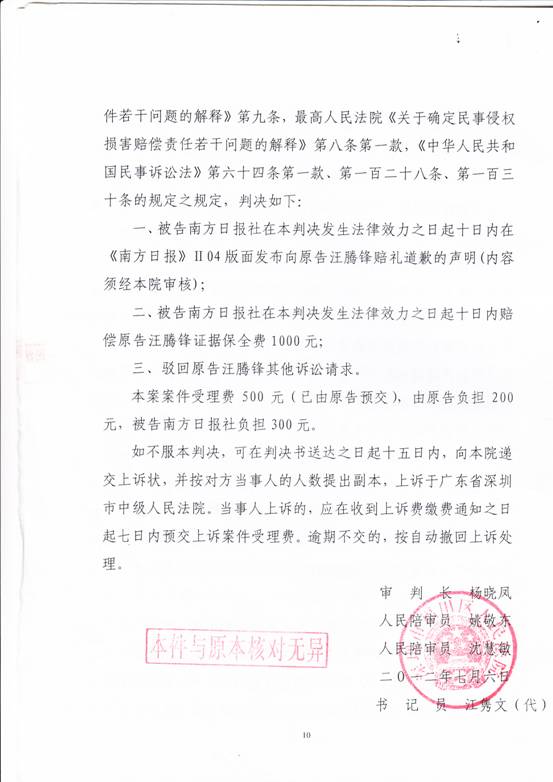
Figure 115: A scanned copy of the main text of the first-instance judgment from the Futian District People's Court.
(To be continued)

