

After the Storm: The Full Story Behind the "Sea Palace" Case (Part 10)
I'm ready to help translate your Chinese legal content into professional English for the Shenzhen Zhiming Law Firm website. Please provide the Chinese text you'd like me to translate.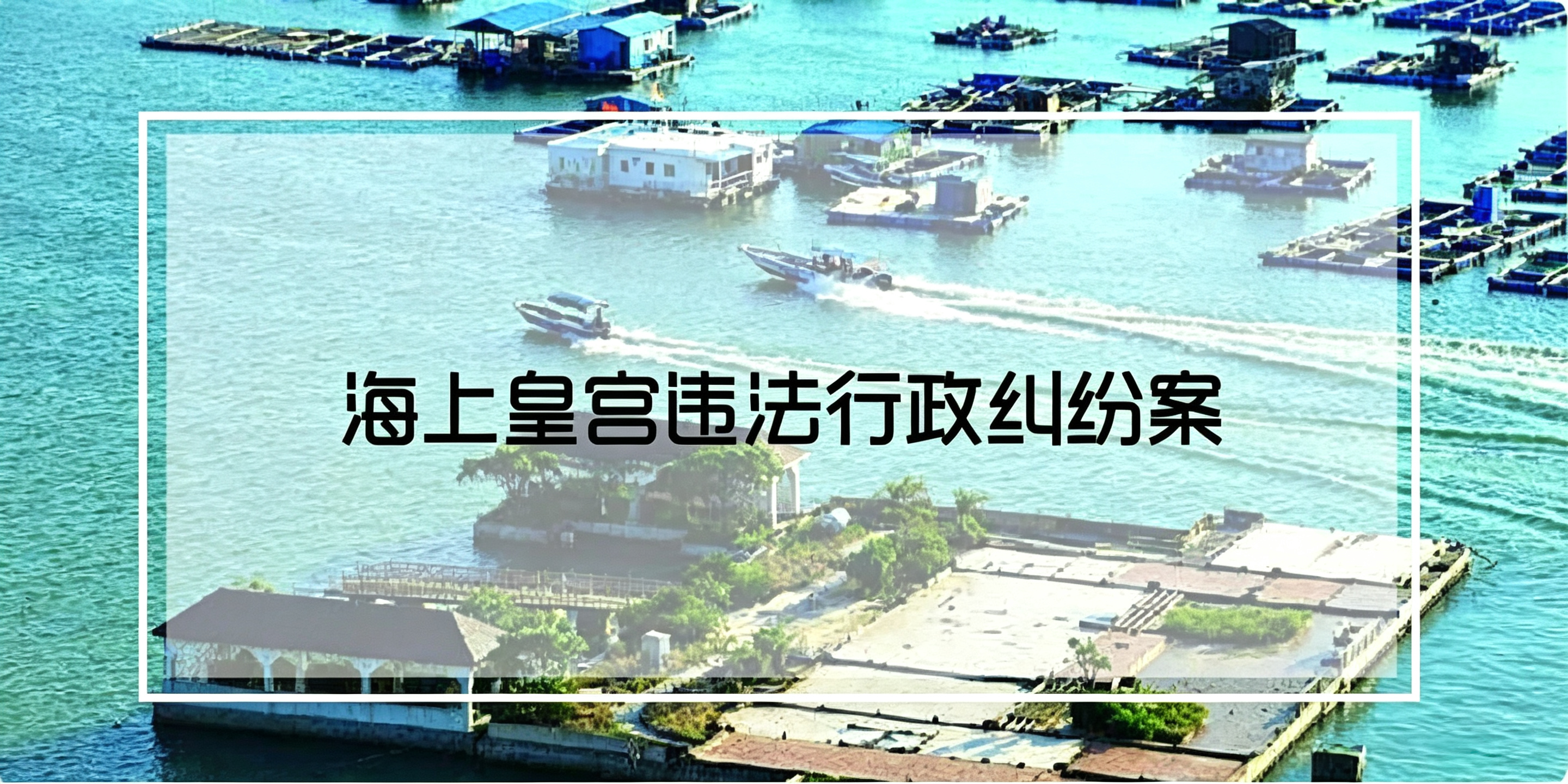
Part One: "Nouveau Riche" Guo So-and-So and His "Sea Palace"
9. After the Rain Clears
As the ancient saying goes, "A violent wind does not last all morning; a sudden downpour does not last all day." Public opinion surges fiercely, coming in haste and departing just as quickly. This is both the power of oversight by public opinion and its inherent weakness, rooted in human nature's inability to sustain attention for long.
After the storm of public opinion, government departments eventually returned to a relatively rational attitude and formed a more objective determination of the illegal nature of the "Sea Palace": a certain Guo's Shenzhen Sea Elite Entertainment Co., Ltd. had obtained a business license in 2007 under the name of operating a leisure fishery project, but it did not operate the "Sea Palace" structure as a leisure fishery project as required by its operational qualifications; instead, it used it as a private club that was not open to the public. As a result, the structure came to fail to meet the requirements of marine functional zoning, could not go through legal formalities, and illegally occupied sea areas.
Based on the more objective determination of the illegal facts concerning the "Maritime Palace" as described above, the Longgang District Oceanic Bureau began to seriously study the issue of how to continue enforcing the "Administrative Penalty Decision" issued by the Shenzhen Municipal Longgang District Oceanic Bureau on February 13, 2009. Paying the fine was a trivial matter for Guo, a major entrepreneur with substantial financial strength, but "returning the illegally occupied sea area and restoring the sea area to its original state" was not so easy. As mentioned earlier, during the construction of the "Maritime Palace," Guo invested huge sums of money, conducted repeated experiments, overcame numerous technical barriers, and solved over a hundred technical problems before successfully developing a floating offshore structure that was corrosion-resistant, typhoon-proof, and as stable as a mountain. It was difficult to build, and it was also difficult to demolish! It was necessary to prevent marine pollution, ensure the safety of the property and persons of neighboring aquaculture households, and was also constrained by the limitation that large tugboats could not enter shallow sea areas. Plans such as demolition by blasting or removing the structure in its entirety by towing could not be perfectly implemented. Based on the new situation of China's marine economic development at that time, and taking into account the actual conditions of the sea areas in Longgang District as well as the demands of the public and the party involved, the Longgang District Oceanic Bureau, after comprehensively considering multiple factors such as "conformity with functional zoning," "maximization of resource utilization," and "no generation of new environmental pollution," and after repeated research, deliberation, and demonstration, reached a consensus and ultimately decided to dismantle and tow away the "Maritime Palace," and, according to its structure and functional requirements, convert it into one aquaculture fish raft and one recreational fishing raft, to be incorporated within the red line of the Dongshan Bay shallow-sea aquaculture area, and to operate it lawfully and in accordance with regulations as a recreational fishery project.
On May 13, 2010, witnessed by the media and the public, the "Sea Palace" was dismantled into three parts and relocated to a sea area designated by the Ocean Bureau. Subsequently, Guo, following the Ocean Bureau's rectification requirements, promptly convened technical personnel and devised a floating island rectification plan that maximally preserved existing innovative achievements, submitting it to the Longgang District Ocean Bureau in a timely manner for approval (Figures 43, 44). This was, in effect, a compromise. On the one hand, the government department did not insist on completely demolishing the "Sea Palace," reflecting their tolerant attitude toward such innovative endeavors and their appreciation for social wealth; on the other hand, the "Sea Palace" was also required to lawfully obtain sea area usage rights, comply with the functional zoning restrictions of the sea area in which it was located, align its primary business with mariculture and recreational fishing, and open its doors to the public.
After spending millions of yuan to dismantle and renovate the "Sea Palace," Sea Elite Entertainment Co., Ltd. again submitted an application to the Longgang District Ocean Bureau for a sea area use right certificate. Based on the "Shenzhen Aquaculture Water Areas and Tidal Flats Plan (2003-2015)" and the "Interim Provisions on the Management of Sea Fishing Rafts in Longgang District," the Longgang District Ocean Bureau conducted an on-site review of the renovated "Sea Palace" structure on December 22, 2010, and approved in principle the registration of the renovated marine structure for aquaculture. On December 25, 2010, the District Ocean Bureau formally issued the aquaculture registration certificate.


(To be continued)

