

First Courtroom Showdown! — The Ultimate Revelation of the "Sea Palace" Case (Part 21)
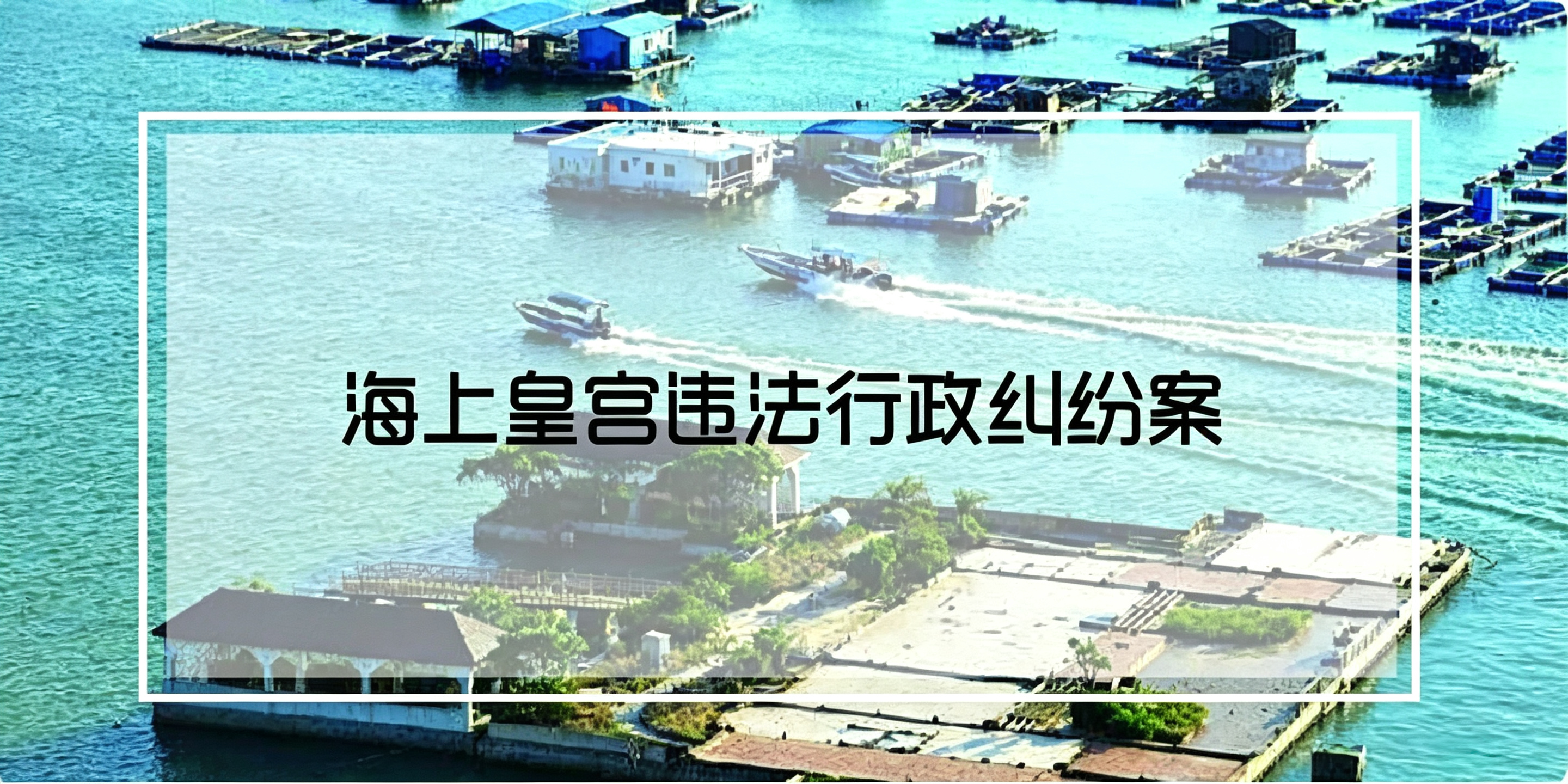
7. First Courtroom Confrontation
At 9:30 AM on the morning of June 21, 2011, the Administrative Division of the Longgang District People's Court held its first hearing in the case of Hai Shang Jing Ying Entertainment Company suing the Shenzhen Longgang District Economic Promotion Bureau for unlawful administrative actions. When Zhiming lawyers and others arrived at the courtroom on time, reporters who had caught wind of the case had already packed the administrative courtroom, which could only hold about twenty people, to overflowing. The attorney representing the defendant in court was Wu Wenhui, a lawyer who had transitioned from serving as a judge for ten years. Zhiming lawyers had crossed paths with him on several occasions before, though at that time, he was the attorney while the other party was a judge handling civil and commercial cases at the Shenzhen Futian District People's Court. Attorney Wu Wenhui held a doctorate in civil and commercial law from Wuhan University. Before 2003, he had worked on civil and commercial cases at the Huizhou Intermediate People's Court in Guangdong Province and the Shenzhen Futian District People's Court. He later switched to practicing law and had since built up considerable reputation and influence. In handling litigation cases, aside from his solid legal foundation, his greatest strength was his ability to put himself in the judge's shoes, which made it easy for him to win over the presiding judge and ultimately secure victory.
Facing so many media reporters in the gallery and a heavyweight opponent at the defendant's table, Attorney Zhiming appeared perfectly composed. With thorough preparation before the trial, he was naturally confident in court. Not to mention that Zhiming had always been highly confident in his debating skills and ability to adapt on the spot. Moreover, the more formidable the opponent, the more it stirred his fighting spirit and passion, and the better it showcased the courtroom advocacy artistry he often took pride in.
As the plaintiff's attorney, Attorney Zhiming spoke first. Based on careful preparation in advance and following the fundamental principles of administrative litigation, he directly targeted the defendant's response. From the outset, he took a clear stance, aiming his attack at the crux of the defendant's administrative actions: the defendant's revocation of the "Reply Regarding Applications for Maritime Aquaculture, Fishing, and Related Certificates" and the "Aquaculture Registration Certificate," as well as the forced demolition of the "Maritime Palace," were all administrative actions that violated legal procedures. Although the defendant erroneously treated the acquisition of a sea area use right certificate as a prerequisite for obtaining an aquaculture registration certificate, exaggerated the luxury fishing raft as a "Maritime Palace" and falsely labeled it as an "illegal structure," and characterized the revocation of its earlier approval of the plaintiff's application and the aquaculture registration certificate issued to the plaintiff as an act of self-correction rather than an unlawful administrative action, while also framing the forced demolition as a "lawful restoration of prior punitive measures" rather than admitting it was an "unlawful imposition of new punitive measures," none of these arguments could remedy the fundamental issue of the legality of the defendant's specific administrative actions!
The defendant's counsel, in turn, seized upon the legality of the "Sea Palace" itself to make a major issue of it, fighting back vigorously. However, the focus of administrative litigation is the legality of the challenged administrative act—that is, whether the challenged administrative act has a legal basis and whether it complies with statutory procedures. Therefore, even if the defendant's rebuttal sounds "somewhat reasonable," it carries no legal significance whatsoever if it cannot remedy the defects in the legality of its own administrative act.
Let us now refer to a report by Zhou Weihan, a journalist from Southern Metropolis Daily, on the court hearing to review the proceedings of that day. Although the journalist is not a legal expert, and his report inevitably carries the limitation of "an outsider watching the excitement," constrained by his superficial understanding of the relevant legal issues and courtroom artistry, he cannot deeply recreate the nuances and highlights of the trial process. Nevertheless, we can roughly discern the offensive and defensive dynamics between the two sides in court. In particular, the judge's questions to both parties during the court investigation clearly indicate that the judge has fully accepted the key point raised by Zhiming's lawyer—namely, the legality of the administrative act being challenged. The judge's inquiries merely served to further verify the details of the defendant's unlawful administrative conduct. To compensate for the lack of thoroughness and vividness in the journalist's written account, the editor has added supplementary notes in parentheses.
The "Sea Palace" angrily sued the Longgang District Economic Promotion Bureau, and after the case was repeatedly postponed, it finally went to court yesterday.
The fame of "Sea Palace" rapidly boosted Guo's reputation. Upon hearing that Guo would appear in court, the trial was scheduled for 9:30 AM. Since there were only 18 observer seats, only 4 seats were allocated for journalists. Around 7:30 AM, media reporters were already crowding at the entrance of Longgang District People's Court, "scrambling" for entry passes.
Around 9 o'clock, after passing through security checks, reporters from over 10 media outlets at the national, provincial, and municipal levels arrived one after another at the Fourth Trial Court of the court. Although the parties involved in the case were not present at the scene, all seats in the public gallery had already been filled by media reporters.
Subsequently, the relevant person in charge of Longgang Court rushed to the scene to explain that arranging a courtroom with only 18 seats was not intentional obstruction. In fact, the court had only this one administrative courtroom and had no way to rearrange the venue.
The official stated that for the sake of fairness, only one media outlet from the national, provincial, municipal, and district levels would be permitted to observe the proceedings, on a first-come, first-served basis. A reporter from Southern Metropolis Daily discovered that some media outlets that had rushed to take seats in the press area did not comply with this rule, while other media outlets that had not been granted observation qualifications remained僵持 at the entrance of the courtroom, refusing to leave.
After negotiation, the court decided to bring in stools to allow all media journalists to enter and observe the proceedings, but they must abide by courtroom rules and are not permitted to take photos or record videos.
A Nandu reporter found that the public gallery, only about 10-plus square meters in area, was packed with nearly 40 people. To obtain first-hand interview information, many media personnel were squeezed two to a stool.
Two demands
At 9:20 AM, Guo, the owner of the "Maritime Palace," arrived at the Fourth Trial Courtroom of Longgang Court, flanked by four or five assistants. He was still dressed in an open Tang suit, wearing a relaxed expression. (In reality, beneath Guo's seemingly relaxed demeanor, it was difficult to conceal his nervousness, anxiety, and anticipation arising from the uncertainty of the trial outcome! — Editor's note.)
This time, Guo, whose full name is withheld, angrily sued the Economic Promotion Bureau, arriving with two demands in hand.
Guo Moumou hopes that the Longgang Economic Promotion Bureau will revoke the "Notice on Revoking the 'Official Reply Concerning Applications for Certificates for Marine Aquaculture, Fishing, and Other Activities'" issued by the former Longgang Marine Bureau on March 1, 2001 (as well as the "Decision on Revoking the 'Aquaculture Registration Certificate'," which the reporter omitted here—editor's note). As a result, Guo Moumou is unable to operate his recreational fishery project. He is very upset about the Marine Bureau's reversal of its earlier decision.
Guo's second claim was to have the court rule that the Longgang Ocean Bureau's demolition of the "Sea Palace" was illegal. Guo no longer cared about money. In an exclusive interview with a Nandu reporter, he said that as long as the public learned of the matter, "whether compensation is paid or not does not matter."
Banned from speaking
As soon as the doors of the courtroom opened, Guo's assistant asked some reporters to give up their seats, but was stopped by Guo. "Let more media pay attention to this matter, don't block them," Guo quietly told the assistant beside him. Then, Guo took a seat next to his defense attorney, Lawyer Zhiming.
Helplessly, the management company of the "Sea Palace" was Shenzhen Sea Elite Entertainment Co., Ltd. Although this company was a subsidiary of the fashion group controlled by Guo, its legal representative was actually a stranger named Guo Jingli. As a result, Guo was informed that he had no right to speak during the trial. (Originally, Guo was supposed to sit in the public gallery, but the seats had to be given to journalists, so he sat next to the plaintiff's lawyer, Zhi Ming. However, he was neither the legal representative of the plaintiff, Shenzhen Sea Elite Entertainment Co., Ltd., nor had he completed the power-of-attorney procedures in advance, so he did not hold the status of the plaintiff company's authorized representative. Hence, he was "silenced" — editor's note)
The court hearing lasted over three hours, during which Guo某某 either smiled or looked down at the materials, but remained completely silent throughout.
Sitting diagonally opposite Guo XX were Wang Airen, former chief of the Marine and Fisheries Section of the Ocean Bureau, and Dai Yuru, captain of the Longgang Fishery Administration and Maritime Surveillance Brigade. Jia Changsheng, the legal representative of the Economic Promotion Bureau of Longgang District, was not present at the scene.
[1] Tit for tat
In this court session, Guo Moumou's side was no longer putting on a one-man show; the Longgang Economic Promotion Bureau, for its part, broke its previous silence. The lawyers for both sides were locked in a sharp confrontation over whether the "Sea Palace" should be demolished and whether the aquaculture registration certificate and recreational fishing certificate should be revoked.
Economic Promotion Bureau: According to the "Temporary Regulations on Fishing Rafts for Offshore Fishing Management in Longgang," fishing rafts shall not exceed 5,000 square meters, the management area shall not exceed 20%, and they shall be uniformly painted blue. The "Maritime Palace" does not comply with the above requirements.
Attorney Zhiming: This regulation has already become invalid.
Economic Promotion Bureau: The Sea Palace does not resemble a tool for making a living, but rather a private club.
Zhiming lawyer: 30 years ago, we went to public baths to wash; now we go to spas. 30 years ago, we went to get our heads shaved; now we go to hair salons to enjoy services. Likewise, can't fish farming and angling have a beautiful, splendid place that shelters from wind and rain? The key is what you're essentially doing. (This was Lawyer Wang Tengfeng's most brilliant performance and display in courtroom debate, but unfortunately the reporter's account was too simplistic—falling short in conveying the meaning, let alone the spirit. Zhiming lawyer's impromptu remarks in court were: "30 years ago, people bathed in public baths—a pair of slippers, a pool of murky water, a towel, a bar of soap, wash and rinse, and it was done. 30 years later today, people bathe in water clubs—soaking in herbal or floral baths while enjoying fine food, movies, TV, music, plus sauna and massage. 30 years ago, people got haircuts at barbershops—a basin of clean water, a razor, a bar of soap, a towel, shave and dry, and it was done. 30 years later today, people get haircuts at hair salons, listening to music, enjoying massages, with beauty treatments and makeup. 30 years later today, when people go to hair salons or water clubs, aren't they still getting haircuts or baths? Their core function remains unchanged—still haircuts, still baths! By analogy, why is a simple fish raft a fish raft, but a creatively built luxurious fish raft—the 'Maritime Palace'—not a fish raft? It's merely luxurious, yet it still retains the basic function of a fish raft for aquaculture and recreational fishing! People's misconception that simplicity is legal and luxury is illegal clearly stems from a national flaw—envy, jealousy, and resentment. But the defendant, as a primary government functional department, should not be hijacked by public opinion, losing its footing and acting unlawfully. The 'Maritime Palace' should not become a sacrifice to the blind conformity of the masses!")
Lawyer Zhi Ming: The Sea Palace was completely rectified in accordance with the requirements of the former Oceanic Administration, passed acceptance inspection, and obtained approval for the aquaculture registration certificate, among others.
Economic Promotion Bureau: The on-site video recorded by law enforcement officers on February 17 this year can prove that this illegal structure is not truly used for sea fishing. The inside is exactly the condition after rectification. Is there any change compared to before rectification?
Economic Promotion Bureau: The racecourse did not use materials from breeding structures.
Lawyer Zhiming: The racecourse horses have all been dispersed. When the authorities carry out renovations, they still need places to sit, stand, and rest, right? These lavish facilities were previously permitted by the defendant. The part of the atrium that was demolished didn't even have breeding facilities.
The judge continued to question.
Longgang Economic Promotion Bureau (hereinafter referred to as the Economic Promotion Bureau)
The certificate was originally issued in error.
Judge: The Sea Palace side had previously requested approval for renovation, and in the official reply dated July 15, 2010, the Oceanic Administration also consented. What was the primary legal basis for this? And what considerations were it based on?
Economic Promotion Bureau replies: First, to prevent the waste of social wealth; second, the other party claimed that a sea area use certificate could be obtained after renovation, but in fact it was not obtained.
Judge: Was there any official document explicitly informing the "Maritime Palace" that it needed to obtain a sea area use certificate after the rectification?
The Economic Promotion Bureau replied: It was roughly informed, with no clear documentation, just a general explanation. This is common knowledge; moreover, the plaintiff has dealt with maritime departments for many years and should have known this.
Judge: After approving the "Sea Palace" application for the mariculture registration certificate and recreational fishing certificate, was an on-site inspection conducted? Was there any in-depth investigation into whether the "Sea Palace" actually existed?
The Economic Promotion Bureau replied: No, we issued the certificate erroneously. Later, we went to inspect that sea area. Apart from being split into three parts, that sea area had merely changed its location; its appearance remained unchanged.
Judge: Was there an on-site inspection before the issuance of the aquaculture registration certificates? What functions do these certificates themselves serve?
The Economic Promotion Bureau replied: Based on inference, they should have gone to the site to inspect. The issuance of these certificates itself was a mistake, and therefore cannot constitute lawful activity. This merely reflects the registration and management situation of the issuing authority at the time; the issuance was based on an erroneous legal understanding. According to the law, aquaculture licenses must be issued by the people's government at or above the county level, and the marine department is not qualified to issue them.
Judge: The demolition of the Sea Palace is because it does not possess the conditions for recreational fishing?
The Economic Promotion Bureau replied: The plaintiff did not obtain a sea area use certificate; moreover, the Sea Palace was not actually used for aquaculture, breeding, or fishing, nor was it used for certain people to engage in health preservation. Let us think about it with common sense — is this really for aquaculture? It looks more like a private club.
Judge: Was the cancellation of the aquaculture registration certificate notified to the Sea Royal Palace side?
The Economic Promotion Bureau replies: This act is a type of administrative approval that is not an administrative license, and there are no legal provisions requiring notification for this act.
Judge: The Sea Palace renovation was suddenly approved, and then its aquaculture registration certificate was suddenly revoked. But how should the substantial funds invested by the plaintiff during this process be handled?
The Economic Promotion Bureau replied: This is not within the scope of trial of this case and may be tried in a separate case.
Attorney Zhiming, representing Sea Elite Entertainment Co., Ltd.:
Transform into effective utilization
Judge: On October 14, 2008, a fine of RMB 497,700 was imposed for illegal occupation of sea areas, and the Longgang Court ruled to enforce it according to law. Has the enforcement been concluded?
Lawyer Zhiming: Executed.
Judge: After law enforcement concluded, the sea area remained occupied. Why did you then think of renovating the structures involved in the case?
Lawyer Zhi Ming: This structure cost nearly 100 million yuan and represents a form of social wealth. Out of consideration for cherishing property, the real question for us is how to utilize it effectively. Moreover, after the penalty, the "Sea Palace" is no longer floating in its original location.
Judge: After relocating to a new site for renovation and reuse, have you considered applying for a sea area use certificate?
Lawyer Zhi Ming: In the Dongshan sea area, so many aquaculture registration certificates, fishing permits, and passage permits have been issued, involving about 200 to 300 households—yet which one of them operates on the premise of holding a sea area use certificate?
At the conclusion of the courtroom debate, addressing the key points of contention in the trial, particularly the main defenses raised by the defendant's counsel during the court investigation and debate phases, Attorney Zhiming reorganized the facts and arguments presented by their side, reiterating and emphasizing seven key aspects to the court. This actually reflects an important facet of Attorney Zhiming's litigation artistry—namely, the ability during trial proceedings to deliver exceptional and expansive performances based on the evolving offensive and defensive dynamics, while maintaining proper control and flexibility, ultimately grounding everything in the most critical and fundamental factual and legal issues of the case. In other words, a trial should not only be "compelling to watch" but also yield favorable outcomes.
1. Regarding the basic facts of this case, the plaintiff lawfully obtained the "Official Reply Concerning the Application for Certificates for Marine Aquaculture, Fishing, and Related Activities," and on that basis was issued the "Aquaculture Registration Certificate." The legitimate rights and interests in operating recreational fishery obtained thereby should be protected. The defendant's revocation of the aforementioned "Official Reply" and "Registration Certificate" has seriously harmed the plaintiff's lawful rights and interests. Specifically, on February 13, 2009, the Ocean Bureau of Longgang District, Shenzhen, issued an "Administrative Penalty Decision" to the plaintiff, and subsequently applied to the Longgang District Court for compulsory enforcement. On November 20, 2009, the Longgang District Court issued a "Ruling on Administrative Enforcement," approving compulsory enforcement of the "Administrative Penalty Decision." After negotiation with the Longgang District Ocean Bureau and the enforcement court, the plaintiff dismantled the marine structures into three sections and removed them from the original sea area. On July 15, 2010, the Longgang District Ocean Bureau issued to the plaintiff the "Official Reply Concerning the Application of Sea Elite Entertainment Co., Ltd. for Renovation of the Dismantled Marine Structures," approving the plaintiff's lawful operation of recreational fishery projects on the aforementioned marine structures after obtaining the aquaculture registration certificate. On December 22, 2010, the defendant issued to the plaintiff the "Official Reply Concerning the Application for Certificates for Marine Aquaculture, Fishing, and Related Activities." On December 25, 2010, the defendant issued the "Aquaculture Registration Certificate" to the plaintiff, thereby granting the plaintiff the qualification to operate recreational fishery projects on the aforementioned marine structures.
2. The plaintiff strictly carried out rectification in accordance with the application materials and the approval, and there was no issue of incomplete rectification. On June 29, 2010, the plaintiff submitted the "Request for Instructions on the Subsequent Renovation of the Previously Dismantled Original Sea Palace Structures" to the Ocean Bureau of Longgang District, Shenzhen, specifying the rectification methods, including the installation of guardrails, keeping the main structure of the atrium unchanged, and adding net cages, and subsequently carried out rectification strictly in accordance with these methods. On July 15, 2010, the former Ocean Bureau of Longgang District, Shenzhen issued the "Reply on the Application of Sea Elite Entertainment Company for the Renovation of the Dismantled Maritime Structures" to the plaintiff, approving the plaintiff's rectification plan. Later, after acceptance inspection, the Longgang District Ocean Bureau and the Agriculture, Forestry and Fishery Bureau issued to the plaintiff the reply and registration certificate involved in this case, which is sufficient to show that the plaintiff's rectification met the requirements of the former Longgang District Ocean Bureau and the Agriculture, Forestry and Fishery Bureau, and there was no issue of incomplete rectification.
3. Regarding the issue of sea area use rights, the Ocean Bureau of Longgang District, Shenzhen issued to the plaintiff the "Official Reply Concerning the Application of Maritime Elite Entertainment Company for the Renovation of Dismantled Maritime Structures." As the administrative authority for sea area use management, it expressly permitted the plaintiff to renovate and operate at the designated location, which in substance constituted lawful approval for sea use. The actual circumstances of this case are that the relevant sea area is covered by a single overarching sea area use right certificate, namely, the sea area use right for the sea area in question is held by the Ocean Bureau and the Agriculture, Forestry and Fisheries Bureau of Longgang District. These two authorities, through the official reply, approved the plaintiff's use of the sea area at the location in question; therefore, there is no issue of illegal occupation of the sea area. As can also be seen from the second item of the official reply issued by the Ocean Bureau of Longgang District, the plaintiff is only required to pay the sea area use fee, without the need to apply for a formal "Sea Area Use Right Certificate" — which, in fact, could not be applied for in any event. Accordingly, the sea area use right for the sea area in question is already vested in the Ocean Bureau and the Agriculture, Forestry and Fisheries Bureau of Longgang District.
4. Regarding the defendant's assertion that the basis for the fishing rafts for angling is the Interim Provisions on the Administration of Offshore Fishing Rafts in Longgang District, and that these Provisions are based on the Trial Measures for the Administration of Recreational Fisheries in Guangdong Province, which became ineffective on March 14, 2010, and therefore the approval should be revoked, such logic is untenable. This is because: (1) According to the Measures for the Supervision and Administration of Administrative Approval in Guangdong Province, when laws and regulations become ineffective, the only legal consequence is that the administrative organ may no longer forcibly conduct approval for the matters covered by such laws and regulations (i.e., no approval is required), and it cannot produce the natural consequence that an already-issued approval decision should be revoked; (2) The Administrative License Law also clearly provides that if the laws, regulations, or rules on which a license is based are amended or repealed, the administrative organ may alter or withdraw the license only when necessary for the public interest. This also makes clear that in the circumstance where the basis has been amended or repealed, the administrative organ cannot naturally revoke the license; (3) The approval explicitly states that a separate application is required for angling matters, so whether the Interim Provisions on the Administration of Offshore Fishing Rafts in Longgang District, as asserted by the defendant, have become ineffective does not affect the validity of the approval; (4) The approval concerns, first, aquaculture and, second, angling. Even if the regulation asserted by the defendant has become ineffective, it only concerns angling matters and has no bearing on aquaculture matters. At most, it is a matter of amending the approval, and there is no issue of revoking the approval.
5. There is no issue of lacking authority to issue aquaculture registration certificates. The existing regulations stipulate that it is the people's government at or above the county level that issues aquaculture registration certificates, not that county-level people's governments issue them. In actual practice, the applicant submits an application to the fishery department, the fishery administrative department reports to the government at the same level for approval, and then the fishery administrative department issues the certificate to the applicant.
6. The defendant, by revoking or withdrawing the "Reply on the Application for Certificates for Marine Aquaculture, Fishing, and Other Purposes" and the "Aquaculture Registration Certificate," deprived the plaintiff of the rights to statement, defense, and administrative reconsideration. Pursuant to Article 7 of the Administrative Licensing Law, the plaintiff should have been afforded the rights to statement, defense, and administrative reconsideration upon the revocation or withdrawal of the aforementioned Reply and Registration Certificate. However, the defendant, when revoking the aforementioned Reply and Registration Certificate, failed to inform the plaintiff that it could exercise the aforementioned rights, thereby effectively depriving the plaintiff of its rights to statement, defense, and administrative reconsideration, which constitutes a serious procedural defect.
7. The defendant's revocation of the "Reply Regarding the Application for Certificates for Marine Aquaculture, Fishing, etc." and the "Aquaculture Registration Certificate" in fact constitutes administrative punishment as prescribed by Item (5), Article 8 of the Administrative Punishment Law, namely "suspension or revocation of permits, suspension or revocation of licenses." The plaintiff should have been granted the rights to statement, defense, and reconsideration in accordance with the provisions of the Administrative Punishment Law; however, in reality, these rights of the plaintiff were not safeguarded.
Based on the seven points above, when the defendant made the administrative penalty decision to revoke the "Approval on the Application for Certificates for Marine Aquaculture, Fishing, etc." and the "Aquaculture Registration Certificate" against the plaintiff, it failed to follow statutory procedures and failed to grant the plaintiff the rights to make statements, provide defenses, or apply for reconsideration. The decision should be found to be procedurally unlawful and should be revoked.
According to the schedule set forth in the court's earlier summons, the court consolidated the three administrative litigation cases filed by Sea Elite Entertainment Co., Ltd., and the trial was divided into two parts. Today, the court first heard the issue of the legality of the defendant's notice and decision to revoke the "Reply on the Application for Certificates for Marine Aquaculture, Angling, etc." and the "Aquaculture Registration Certificate", namely Cases No. 45 and No. 53. The hearing lasted more than three hours. At around 12:40 p.m., the presiding judge announced an adjournment and decided to resume the hearing on the compulsory demolition of the "Sea Palace" (Case No. 47) at 2:30 p.m. on June 24.
As soon as the judge announced the adjournment, Guo, who had been holding back his emotions, couldn't help but stand up excitedly and exclaim, "Great! Great!" Indeed, Attorney Zhiming's brilliant performance in court achieved an excellent courtroom outcome. Particularly noteworthy was his rebuttal to the defendant's argument that the overly luxurious "Maritime Palace" was not a fish raft: "Thirty years ago, people went to barbershops for haircuts; today, people go to upscale hair salons, enjoying music, massages, and hair washing services while getting their hair cut. Thirty years ago, people went to public baths to wash; today, people go to spa clubs for bathing, dining, and entertainment, enjoying star-rated services all in one. Thirty years ago, farmers planted rice by hand with their own hands; today, farmers can operate mechanized farming through electronic controls in modern agricultural estates." This was truly a stroke of genius in courtroom debate! Not only did it employ analogy to clear the clouds and reveal the essence of the "Maritime Palace" that had been obscured by media hype and public outcry, but it was also vivid in imagery and thorough in reasoning. Everyone present in and out of the courtroom was instantly invigorated—so this is what the "Maritime Palace" is all about! Furthermore, Attorney Zhiming subsequently delivered a forceful and righteous argument regarding the enlightening significance of the "Maritime Palace" case and its follow-up handling, which made people suddenly realize that there was strong legal and moral support for the continued existence of the "Maritime Palace." This also won over many journalists and members of the public who had previously harbored hostility toward the "Maritime Palace," largely reversing the unfavorable media atmosphere.
Attorney Zhiming presented a well-reasoned and irrefutable argument in court, engaging in a brilliant verbal duel with the opposing counsel representing the defendant government. Not only did he earn heartfelt applause from all listeners, but even the court bailiffs and security guards maintaining order that day chased after Attorney Zhiming for his business card after the recess. The next day, when Guo's secretary Zhang Guangbin returned to Longgang District People's Court to submit written materials, the presiding judge from the previous day's hearing privately remarked to him with admiration: "Where did you find this lawyer? Incredible!" Major media outlets provided detailed coverage of the court proceedings, and Attorney Zhiming subsequently organized and published his formal written submissions (already fully recorded earlier). Members of the public and general readers praised it after reading: Absolutely brilliant! Many fellow lawyers also couldn't help but marvel: So this is how legal submissions can be written?! It is no exaggeration to say that the courtroom debate in this case, particularly Attorney Zhiming's outstanding performance, had a broad and profound impact across all sectors of society. Some prominent figures in the legal community called Attorney Zhiming a prodigy. Even leaders from the Shenzhen Municipal Justice Bureau, the direct supervisory authority of the city's legal profession, later relayed senior officials' words to Attorney Zhiming: "We heard you're quite formidable in litigation, aren't you?!"


The June 22, 2011 issue of "Shenzhen Commercial Daily" on page A13 also provided a relatively detailed and comprehensive account of the first court session (Figure 87).

(To be continued)

