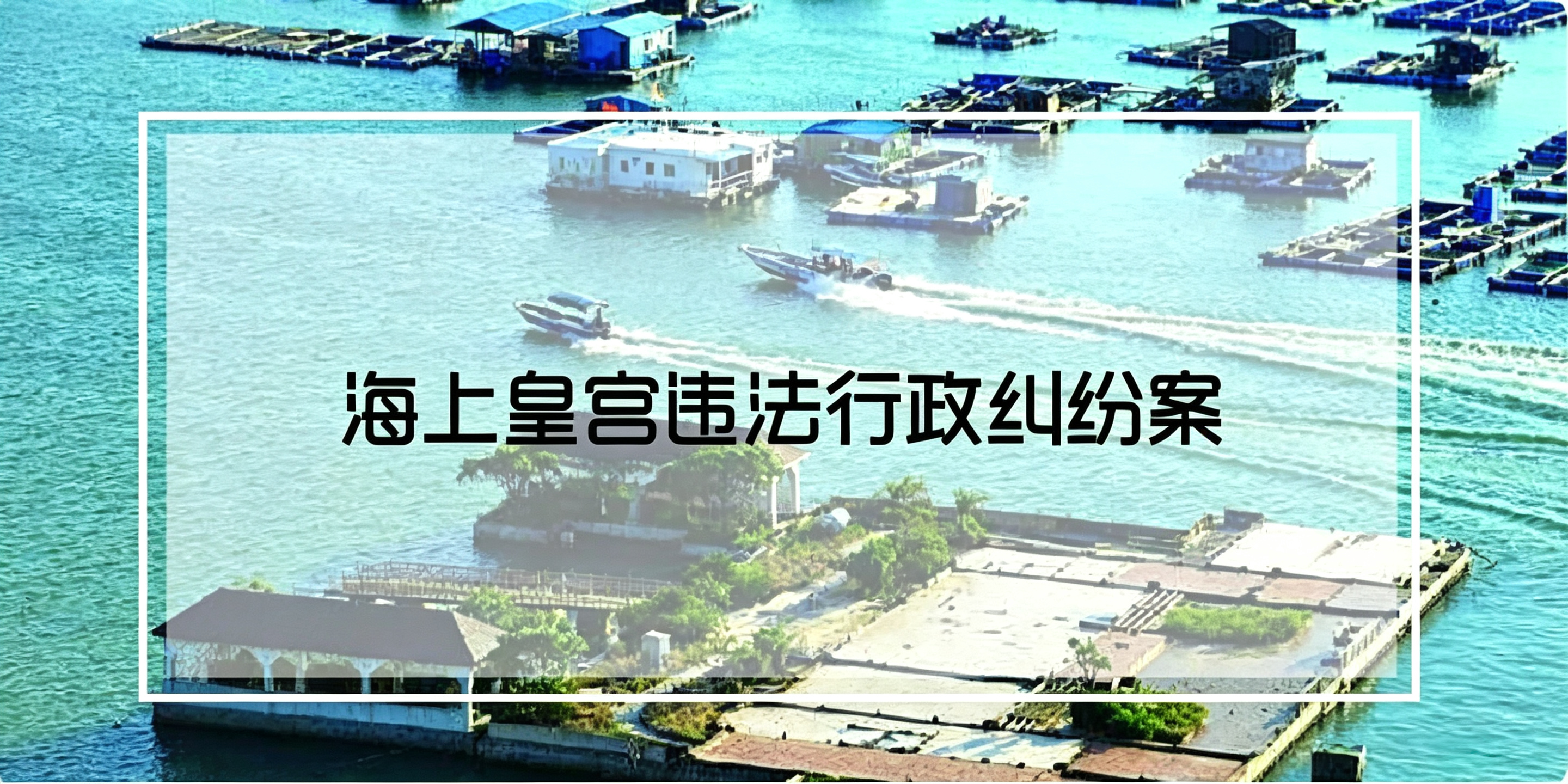
Legal Representation in the "Sea Palace" Illegal Administrative Dispute Lawsuit
Respected Presiding Judge and Judges:
Guangdong Zhiming Law Firm, attorney Zhiming, upon accepting the commission of Shenzhen Hai Shang Jing Ying Entertainment Co., Ltd., provides legal aid services out of a spirit of public welfare. Today, in accordance with the law, we appear in court to participate in the trial proceedings of the case filed by the plaintiff, Shenzhen Hai Shang Jing Ying Entertainment Co., Ltd., against the Longgang District Economic Development Promotion Bureau, concerning illegal administrative acts (illegal forced demolition) and a dispute over substantial compensation claims, heard by the Shenzhen Longgang District People's Court. In order to better distinguish right from wrong, correct erroneous perceptions, defuse indignation, eliminate conflicts, and provide reference opinions for the fair administration of justice, after repeated pre-trial investigations of the facts and careful study and comparison of the law, we now present our representation opinion, and respectfully request that the court give it due consideration and adopt it. This representation opinion is divided into three parts and will take approximately 40 minutes. Details are as follows:
I. The Origin of the "Sea Palace" Illegal Administrative Litigation Dispute:
Starting in 2003, a young entrepreneur surnamed Guo, a top graduate of the Lu Xun Academy of Fine Arts who had transitioned from being a painter to a businessman, carried with him the ideal of developing exquisite marine structures with an artistic approach to ocean resources. After arduous journeys and careful inspections, he arrived at Dongshan Bay in Shenzhen, a coastal city where dreams are made. There, he creatively harnessed folk wisdom and spontaneously invested his own private capital to conduct exploratory development of idle, underutilized shallow sea resources. Through meticulous deliberation, repeated validation, hard work, and inventive effort, and at a cost of nearly 100 million yuan, he started from a simple wooden cabin on the tidal flats and, over many years of persistent dedication and unremitting effort, finally created a dazzling cluster of marine structures. If one were to name it, its essence is a "marine fish raft" (as its construction principles derive from fish rafts), formally known internationally as a "floating island," now commonly referred to by the media as the "Marine Palace." The colloquial name given by the public stems from its exterior design and magnificent presence, which precisely reflects the creative wisdom and diligent efforts of its owner, Mr. Guo, in self-developing shallow sea resources, yielding extraordinary results that have earned admiration and acclaim from the public and society alike. It is said that this luxurious fish raft (artificial floating island) is, in terms of raw materials, design, and investment, the most cost-effective marine structure in the world, integrating aquaculture, fishing, leisure, and sightseeing. Both exquisitely beautiful and robustly practical, it truly represents a first for Shenzhen and a world first. Yet, this classic masterpiece, due to sensationalism in some media, resentment of the wealthy by angry youths, ignorance among the masses, and misleading public opinion, was forcibly dismantled by authorities who, under the pressure of a manipulated and coerced atmosphere, chose to protect themselves, bringing it to the brink of extinction.
To protect their property rights, safeguard original inventions, and preserve social wealth so that it may have the opportunity to benefit the nation, society, and the public in the future, the plaintiff, after numerous unsuccessful efforts, has finally resorted to legal action, seeking the protection of the law to give vitality to the plaintiff's offshore fish farming platforms and floating islands! This is the brief origin of this case.
II. The Rights and Wrongs of the "Sea Palace" Illegal Administrative Litigation Dispute:
Right and wrong are the crux of this case; legality and illegality are its core. Previously, society was rife with misunderstandings about the disputes in this case, filling our ears and eyes everywhere. Today, it is necessary for us to clarify the fundamentals, set things right, and overturn these erroneous views! Regarding the litigation disputes in this case, the Longgang District Economic Development Promotion Bureau has committed the following misconceptions and erroneous practices in its law enforcement:
1. Make obtaining the sea area use right certificate a prerequisite for obtaining the aquaculture registration certificate.
China's "Sea Area Use Management Law" is the comprehensive and specific special law governing the use of sea areas nationwide. Article 7 of this law explicitly stipulates that "the fishery administrative department shall, in accordance with the 'Fisheries Law of the People's Republic of China', exercise supervision and management over marine fisheries." Meanwhile, Article 2 of China's "Fisheries Law" explicitly provides that "any person engaged in aquaculture and fishing of aquatic animals and plants in the inland waters, tidal flats, territorial seas, exclusive economic zones, and all other sea areas under the jurisdiction of the People's Republic of China must comply with this Law." Article 11 stipulates that "the state shall make unified plans for the utilization of waters, determining the waters and tidal flats that can be used for aquaculture... the people's government at the corresponding level shall issue aquaculture permits, licensing the use of such waters or tidal flats for aquaculture, and the specific measures for issuing aquaculture permits shall be formulated by the State Council." Article 5 of the national "Measures for the Administration of Aquaculture Permit Issuance" provides that "the fishery administrative departments of local people's governments at or above the county level shall be responsible for the issuance and management of aquaculture permits for waters and tidal flats within their jurisdiction..." It is thus evident that the relevant laws are interlocking and interconnected, clearly demonstrating that the fishery administrative departments of local people's governments at or above the county level are the legally authorized authorities responsible for issuing aquaculture permits, and that once an aquaculture permit is obtained, it naturally confers the lawful right to use the designated sea (water) area for aquaculture, with no legal provision requiring the separate acquisition of a "sea area use right certificate" as a precondition. Therefore, in this case, the plaintiff's aquaculture (fishing) activities in the designated sea area after obtaining the "aquaculture registration certificate" are entirely lawful. The argument put forward by the Longgang District Economic Development Promotion Bureau that the plaintiff failed to lawfully obtain the sea area use right is purely illegal and unreasonable. Moreover, the fact that over the past three decades, the fishery administration department of Longgang District has, in its actual supervision and management of the aquaculture industry in the sea areas under its jurisdiction, only issued aquaculture registration certificates without requiring the acquisition of a sea area use certificate as a precondition is itself the most powerful supporting evidence, which also contradicts its own argument and collapses on its own!
2. Exaggerating the luxury fishing raft as a "sea palace" and falsely labeling it as an "illegal structure";
It is well known that thirty years ago, people went to barbershops for a haircut; today, people visit upscale hair salons, enjoying music, massages, and hair washing services while getting their hair cut. Thirty years ago, people went to public bathhouses to bathe; today, people visit spa clubs for bathing, dining, and entertainment, enjoying a full range of five-star services. Thirty years ago, farmers planted rice by hand; today, farmers can use electronically controlled mechanized farming in modern agricultural estates. No one wishes to return to the primitive society of slash-and-burn farming, so why can't the plaintiff's luxurious fishing raft be recognized and accepted? Although the plaintiff's fishing raft not only supports aquaculture and fishing, but its ancillary facilities are indeed luxurious, and it can also fully utilize the natural conditions of the sea to enjoy marine scenery, this does not negate its essential nature and function as a fishing raft, nor does it lose its aquaculture and fishing functions! The luxurious and beautiful living quarters for the raft's caretakers, even if resembling a "palace," objectively cause no harm. It only demonstrates the progress of social development and should be encouraged. As for the plaintiff's aquaculture and fishing raft, because it is exquisitely constructed with beautiful scenery, guests often visit to admire it, which is not illegal, as no national law prohibits guests from visiting and admiring anyone's fishing raft. Moreover, no illegal or criminal activities such as gambling, prostitution, or drug use occur on the plaintiff's luxurious fishing raft; only gatherings for sightseeing and socializing take place. People should never assume that the plaintiff's luxurious fishing raft is illegal while others' simple rafts are legal. Such mechanical, narrow-minded, and outdated views that go against the tide of historical development are surely wrong! The private desire of envy and resentment toward the wealthy should not receive support from the law or the government!
3. Misrepresenting the revocation of aquaculture registration certificates and fishing permit approvals as self-correction, while refusing to acknowledge it as unlawful administration;
The facts fully demonstrate that on July 15, 2010, the Longgang District Economic Development Promotion Bureau, after repeated deliberation, extensive coordination, on-site inspections, and careful study, issued an official reply clearly approving that the plaintiff could use the rectified fishing rafts in designated sea areas for aquaculture and recreational fishing operations in accordance with functional planning. On December 22, 2010, it issued another official reply under Document No. 144 [2010] of Shenlong Agricultural Character, approving the plaintiff's aquaculture and recreational fishing matters. Furthermore, on December 25, 2010, it formally issued the "Aquaculture Registration Certificate," permitting the plaintiff to operate lawfully. However, less than three months later, on March 1, 2011, the Longgang District Economic Development Promotion Bureau, influenced by human factors, blatantly violated legal procedures and hastily issued a notice and decision to arbitrarily and high-handedly revoke the approvals for the plaintiff's lawfully obtained aquaculture and fishing certificates, and unlawfully withdrew the "Aquaculture Registration Certificate." This seriously violates the provisions of Article 7 of China's "Administrative Licensing Law" and Article 8, Item 5, and Article 31 of the "Administrative Penalty Law": administrative decisions must undergo statutory hearing procedures, and the affected party (the plaintiff) must be given adequate rights to defend and make statements in advance. Therefore, the administrative action taken by the Longgang District Economic Development Promotion Bureau on March 1, 2011, can only be considered a new act of administrative illegality, and can never be justified as "self-correction" as it claims. Even if the subjective intention was "self-correction," it should still enforce the law in compliance with legal provisions and act according to law, rather than compounding errors. To "self-correct the previous licensing error," it instead violated national statutory procedural requirements again through unlawful law enforcement, committing new errors! And errors in law enforcement must be corrected!
4. Misrepresenting the forced demolition as "lawfully restoring an old penalty measure" while refusing to acknowledge that "a new penalty measure was unlawfully implemented"!
The Longgang District Economic Development Promotion Bureau argued that the forced demolition of the "Sea Palace" was a lawful enforcement measure taken pursuant to Administrative Penalty Decision No. (2008) 1 of Yueshen Longhai, and that it constituted a resumption and continuation of the previous administrative penalty decision. Such an absurd assertion clearly contradicts the facts and violates the law. In reality, the defendant, the Longgang District Economic Development Promotion Bureau, repeatedly admitted in court during the litigation that Administrative Penalty Decision No. (2008) 1 of Yueshen Longhai had already been executed and concluded by the Longgang District People's Court through Administrative Execution Ruling No. (2009) Shenlong Faxingshenzi No. 78, with the plaintiff paying a fine of 490,000 RMB to complete the execution. Despite being fully aware of these facts, the Longgang District Economic Development Promotion Bureau stubbornly denied that the enforcement had concluded and insisted on falsely claiming that this forced demolition was a resumption and continuation of Administrative Penalty No. (2008) 1. If that were truly the case, the Longgang District Economic Development Promotion Bureau should have lawfully applied to the Execution Division of the Longgang District People's Court to resume judicial enforcement. However, in reality, the Longgang District Economic Development Promotion Bureau did not apply for the resumption of judicial enforcement but instead arbitrarily and unilaterally carried out the demolition itself, without any legal basis. If this were a new penalty measure, the Longgang District Economic Development Promotion Bureau failed to grant the affected rights holder (the plaintiff) the statutory rights to defense and statement in accordance with relevant provisions of China's Administrative Licensing Law and Administrative Penalty Law, which is likewise unlawful. Regardless of the grounds on which the defendant, the Longgang District Economic Development Promotion Bureau, based its decision and actions for this forced demolition, they are clearly and seriously unlawful, completely erroneous, and should be corrected and penalized by the people's court in accordance with the law!
Appendix (I): Factual Evidence:
1. On June 11, 2007, the predecessor of the defendant, Shenzhen Longgang District Agriculture, Forestry and Fisheries Bureau, issued Document No. [2007] 66, titled "Reply on the Application for Developing Marine Leisure Fishery Projects." This indicates that the plaintiff's establishment of the marine leisure fish raft project was approved and actively guided by the defendant.
2. On June 3, 2009, the Shenzhen Ocean Bureau, the superior authority of the defendant, issued Document No. [2009] 25, titled "Reply Regarding the Application of Shenzhen Maritime Elite Entertainment Co., Ltd. for a Sea Area Use Certificate." This indicates that the defendant accepted and guided the plaintiff's application for the relevant sea area use right certificate.
3. On July 3, 2009, the Shenzhen Ocean Bureau, the superior authority of the defendant, issued Document No. [2009] 30, titled "Second Reply Regarding the Handling of the Sea Area Use Certificate for the City's Maritime Elite Entertainment Co., Ltd." This indicates that the defendant accepted and guided the plaintiff in applying for the relevant sea area use right certificate.
4. On July 15, 2010, the defendant, Shenzhen Longgang District Ocean Bureau, issued the "Reply Regarding the Application of Maritime Elite Entertainment Co., Ltd. for the Renovation of Demolished Marine Structures." This document indicates that the defendant, after careful consideration, decided to lawfully and in accordance with regulations permit the plaintiff to operate marine leisure projects such as aquaculture and fishing in the designated sea area.
5. On December 22, 2010, the defendant, Shenzhen Longgang District Agriculture, Forestry and Fisheries Bureau, issued Document No. [2010] 144, titled "Reply on the Application for Certificates for Marine Aquaculture, Fishing, and Related Activities." The document indicates that after careful study and on-site verification, the defendant approved and permitted the plaintiff to designate the decomposed floating islands as aquaculture fish rafts and recreational fishing rafts respectively, in accordance with specific plans.
6. On December 25, 2010, the defendant, Shenzhen Longgang District Agriculture, Forestry and Fisheries Bureau, issued the "Aquaculture Registration Certificate" with the fish raft number D126. This demonstrates that the defendant performed its duties in accordance with the law and fulfilled its lawful obligations.
7. On March 1, 2011, the defendant, the Longgang District Agriculture, Forestry and Fisheries Bureau, issued the "Notice on Revoking the 'Reply Regarding Applications for Certificates for Marine Aquaculture, Fishing, and Related Activities'" and the "Decision on Revoking the 'Aquaculture Registration'" as well as the "Notice Ordering Restoration of the Original State of the Sea Area." These actions indicate that the defendant, in haste and for various reasons, made erroneous administrative decisions that contradicted the facts and violated the law, seriously infringing upon the plaintiff's lawful rights and interests.
8. The Notice on Requiring the Return of Illegally Occupied Sea Areas and Restoration of the Sea Area to Its Original State, issued by the Defendant, the Longgang District Oceanic Administration, on March 14, 2011, indicates that the Defendant hastily made an erroneous administrative decision that contradicted the facts and violated the law, seriously infringing upon the Plaintiff's lawful rights and interests.
9. The "Notice on Compulsory Restoration of the Sea Area to Its Original State" issued by the Defendant, Longgang District Oceanic Administration, on March 25, 2011, indicates that the Defendant hastily made an erroneous administrative decision that contradicted the facts and violated the law, seriously infringing upon the Plaintiff's lawful rights and interests.
10. The "Notice on Self-Handling of Demolished Building Materials" issued by the defendant, the Longgang District Agriculture, Forestry and Fisheries Bureau, on March 28, 2011, indicates that the defendant hastily made an erroneous administrative decision that contradicted the facts and violated the law, seriously infringing upon the plaintiff's lawful rights and interests.
11. Facts reported by Xinhua News and other media on April 8, 2011. These indicate that the defendant has already carried out forced demolition, and to date, all structures on the surface of the fish raft platform have been completely removed, leaving only the fish raft platform itself. Due to constraints of technical capability and environmental safety concerns, the defendant is still in the process of evaluating and approving the project, awaiting further forced demolition.
Appendix (II) Legal Basis:
1. The provisions of Articles 2 and 11 of the Administrative Litigation Law of the People's Republic of China, which came into effect on October 1, 1990.
2. Articles 7, 15, 16, and 19 of the "Law of the People's Republic of China on the Administration of Sea Area Use," which came into effect on January 1, 2002,
Provisions 25, 31, 43, and others.
3. Articles 2 and 8 of the Measures for the Administration of Certificates for the Right to Use Sea Areas, issued and implemented on June 7, 2002.
4. Articles 11 and 38 of the "Regulations on the Administration of Fisheries in Guangdong Province," which came into effect on September 1, 2003, stipulate that...
5. Article 7 of the Administrative Licensing Law, effective from July 1, 2004, stipulates that administrative licensing must follow statutory procedures.
Provisions 3, 4, and 18 of the "Guangdong Province Artificial Reef Management Regulations," which came into effect on November 1, 2004.
Article 26 and other provisions of the "Regulations of Guangdong Province on the Administration of Sea Area Use," which took effect on March 1, 2007.
8. Articles 2 and 5 of the "Interim Measures for the Administration of Recreational Fisheries in Guangdong Province," issued and implemented on March 14, 2007, stipulate that...
Sure.
9. Articles 3, 5, 7, 8, and 14 of the Interim Regulations on the Management of Sea Fishing Rafts in Longgang District, which came into effect on February 11, 2009.
10. According to Article 8, Item 5 and Article 31 of the Administrative Penalty Law, which took effect on August 27, 2009, administrative decisions must be made through statutory procedures.
Article 11. Provisions of Articles 2, 11, and 28 of the Fisheries Law of the People's Republic of China, as amended on August 27, 2009.
12. Articles 5, 8, and 10 of the "Measures for the Administration of Aquaculture Certificate Issuance" issued by the Ministry of Agriculture in 2009, among other provisions.
*13. The "Interim Measures of Shenzhen Municipality for Registration of Marine Structures," which took effect on March 1, 2010, and on March 3, 2011, the Shenzhen Municipal Commission of Planning and Land Resources published a notice in the newspaper stating that all relevant rights holders may handle the registration procedures for property rights of marine structures. Provisions include Articles 2, 3, 4, 6, 35, among others.
III. The Implications of the "Sea Palace" Illegal Administrative Litigation Dispute and Its Aftermath Handling:
The above facts and legal analysis fully demonstrate that the luxury fish raft, floating island at sea, or the so-called "Maritime Palace" at the center of this dispute is entirely capable of, and should, legally survive. The tragedy it faces today stems not only from irresponsible misleading by some media outlets and the siege-like pressure created by ignorant resentment of the wealthy among certain members of the public, but also from the fragmented, disconnected, mechanical, and narrowly self-serving working styles of certain individuals within our relevant government functional departments. In particular, the defendant, as a first-level administrative authority, has lacked a sense of responsibility and accountability, lost the courage to innovate, failed to seriously study and accurately grasp laws and regulations, demonstrated weak administrative enforcement, and been unable to effectively, flexibly, and proactively coordinate and handle complex issues and emerging matters. This passive working approach is inseparable from the current predicament. This departmental self-preservation, mechanical rigidity, arbitrary decision-making, and even ultra vires and unlawful administrative conduct have led to erroneous judgments, resulting in the demolition of the floating island, the destruction of wealth, and deep regret. In this regard, Mr. Guo, under the pen name "Floating Island Child," wrote an article titled "The Lament of the Maritime Palace," which fully recounts the tragedy of the floating island and leaves readers deeply moved and sighing. A young entrepreneur full of ideals, leveraging his own intelligence and creative labor, boldly explored and developed marine resources with his own substantial funds, making uncomplaining and active efforts to develop the marine economy and promote China's maritime strength. His efforts objectively played a huge positive role in reclaiming land from the sea and advancing our nation's coastal defense construction. Yet this commendable act has been subjected to criticism and nearly extinguished in the difficult struggle between reason and misunderstanding, legality and illegality, and support and opposition! Some people today may still be constrained by various objective limitations and unable to view this with detachment, but I believe that in the future, when people look back and reflect, they will regret today's mistakes. Even if the floating island cannot stand as a monument upon the sea, it will surely become a monument in the memory of those who retain their conscience! Regardless of people's attitudes, the creation of the floating island has already become a model for efficiently utilizing marine resources and developing the marine economy in our country, making tremendous positive contributions to strengthening our coastal defense capabilities! It has played a constructive role in the development, utilization, and management of our nation's marine waters. We live on the vibrant land of Shenzhen, a city full of innovative spirit. While people sing praises of reform and opening-up that have brought prosperity, we should remain highly vigilant: on one hand, we enjoy the abundant fruits of reform and innovation; on the other hand, we may intentionally or unintentionally become stumbling blocks hindering the continued deepening of reform and ongoing exploration and innovation! It is hoped that all relevant parties will give this serious thought and attention! It is hoped that the defendant will act rationally and calmly, deliberate carefully, dare to take responsibility, summon the courage, and, in the spirit of acting in the interests of the nation, society, and the people, set aside temporary concerns over reputation and personal gain, and examine the dispute in this case with a highly responsible attitude—cherishing and protecting the social wealth of tens of millions approaching one hundred million yuan, and not allowing it to be destroyed by mechanical and rigid working methods. Let us add one more highlight, one more calling card, one more industry, and one more rising star to Shenzhen's coastal leisure tourism. Because preserving the "floating island" benefits the nation, the people, and oneself alike:
First, preserving the "floating island at sea" is beneficial to the nation.
In the "National Marine Economic Development Planning Outline" formulated by our government in 2001, it was already clearly stated that the state should vigorously advocate and encourage private capital to invest and finance the development of coastal areas and promote distinctive tourism. Guangdong Province, in particular, was designated by the State Council as a national marine comprehensive development pilot zone. In 2008, Shenzhen also formulated the "Several Opinions of Shenzhen on Accelerating the Development of the Marine Industry and Building a Strong Marine City." Clearly, the "floating island on the sea," as a typical innovative creation that leverages private wisdom and private capital to develop the marine economy in new ways, aligns with the industrial policy orientation of national and local governments and the direction of marine economic development. It can not only generate additional tax revenue for the state and local governments but also does not compromise the national defense security of the territorial sea and airspace in that area. On the contrary, the "floating island on the sea" initiative is not only beneficial to the economy but also advantageous to national maritime defense, holding significant positive value.
Second, preserving the "floating island at sea" benefits the surrounding communities and the public.
The "Offshore Floating Island" is a coastal aquaculture, fishing, and leisure complex built on floating structures adjacent to the sea. It not only beautifies the coastline and creates distinctive seaside tourist attractions, but also serves as a new source of income growth for local fishing village collectives and individual fishermen, increasing revenue and driving new economic development in fisheries and tourism across the surrounding coastal areas—even setting an example for the entire Shenzhen coastal region. This benefits people's livelihoods. As it is located in a coastal bay, once sewage disposal issues are resolved, it will not interfere with other normal uses of the sea area or harm the marine ecological environment, nor will it disrupt the production and daily life of coastal fishing villagers. On the contrary, it can be developed into a comprehensive leisure fishery and cultural creative industry park integrating fish farming, angling, fish appreciation, leisure, entertainment, seafood tasting, and seafood purchasing—all in one. Through integrated operations and a series of economic developments, it can serve as a splendid tourist attraction for Shenzhen citizens, benefiting society and the public alike!
Third, preserving the "floating island at sea" is beneficial to the company's own development.
The establishment of "floating islands at sea" represents a bold, breakthrough innovation and a beneficial attempt by private enterprise capital to seek new industrial directions and develop emerging industries. If "floating islands at sea" can continue to develop and mature, they are bound to become a new type of industry (sector). In that case, private enterprise capital will not only find new avenues for survival and growth but also generate greater returns, driving the continuous expansion and strengthening of private enterprises and private capital, adding a new path to national prosperity and strength!
In 2010, the Shenzhen Commercial Daily's Spring Festival editorial, the sixth piece titled "Let Dreams Become the Defining Trait of Shenzhen as a City," stated: "After taking office, Wang Rong, member of the Provincial Party Standing Committee and acting mayor, immediately sensed what makes Shenzhen unique. When introducing Shenzhen to others, he particularly favored the evocative word: dreams. During a meeting with Alibaba's Jack Ma, he said: 'Shenzhen grew from nothing, from small to large, gathering so many talented people with dreams who came here to strive and start businesses, precisely because this place offers an exceptional environment for innovation and entrepreneurship—that is Shenzhen's greatest charm. Shenzhen is truly a great place, and it will not disappoint entrepreneurs with dreams!' Clearly, what keeps this land of Shenzhen perpetually vibrant is not tangible policies or institutions, but the intangible power of dreams. There is a term called the American Dream, meaning people firmly believe that through relentless effort in America, one can achieve a better life. And Shenzhen, without a doubt, is the place where people realize the Chinese Dream. It has always been the best city for those with ideals, drive, and a distaste for outdated institutional constraints to fulfill their aspirations. Shenzhen possesses an indescribable environment for innovation and entrepreneurship. This year, the Shenzhen Special Economic Zone turns 30. Thirty is an age no longer young. Yet, as long as we make dreams the defining trait of Shenzhen as a city, our city will never grow old."
In summary, the agent hopes that the editorial rhetoric will not merely remain on paper, but will resonate deeply with people and be implemented in every aspect of practical work. We must not examine or treat the "floating island at sea" in this case with a one-sided, narrow, outdated, mechanical, or short-sighted perspective, but rather with a flexible, forward-looking, and developmental viewpoint. In order to truly uphold social harmony, fairness and justice, progress and development, effectively protect social wealth from unnecessary loss, and efficiently utilize marine resources to develop the marine economy for the prosperity of the nation and the well-being of the people, a just ruling must be made in this case, so that this land of Shenzhen is left with no grievances, no loss of public confidence, and no further controversy! Thank you!
I'm ready to help translate your Chinese legal content into professional English for the Shenzhen Zhiming Law Firm website. Please provide the Chinese text you'd like me to translate.Agent: Guangdong Zhiming Law Firm
Zhiming lawyers
June 21 (24), 2011