

The Second Courtroom Clash in the "Sea Palace" Case — The Ultimate Revelation of the "Sea Palace" Case (Part 22 of the Series)
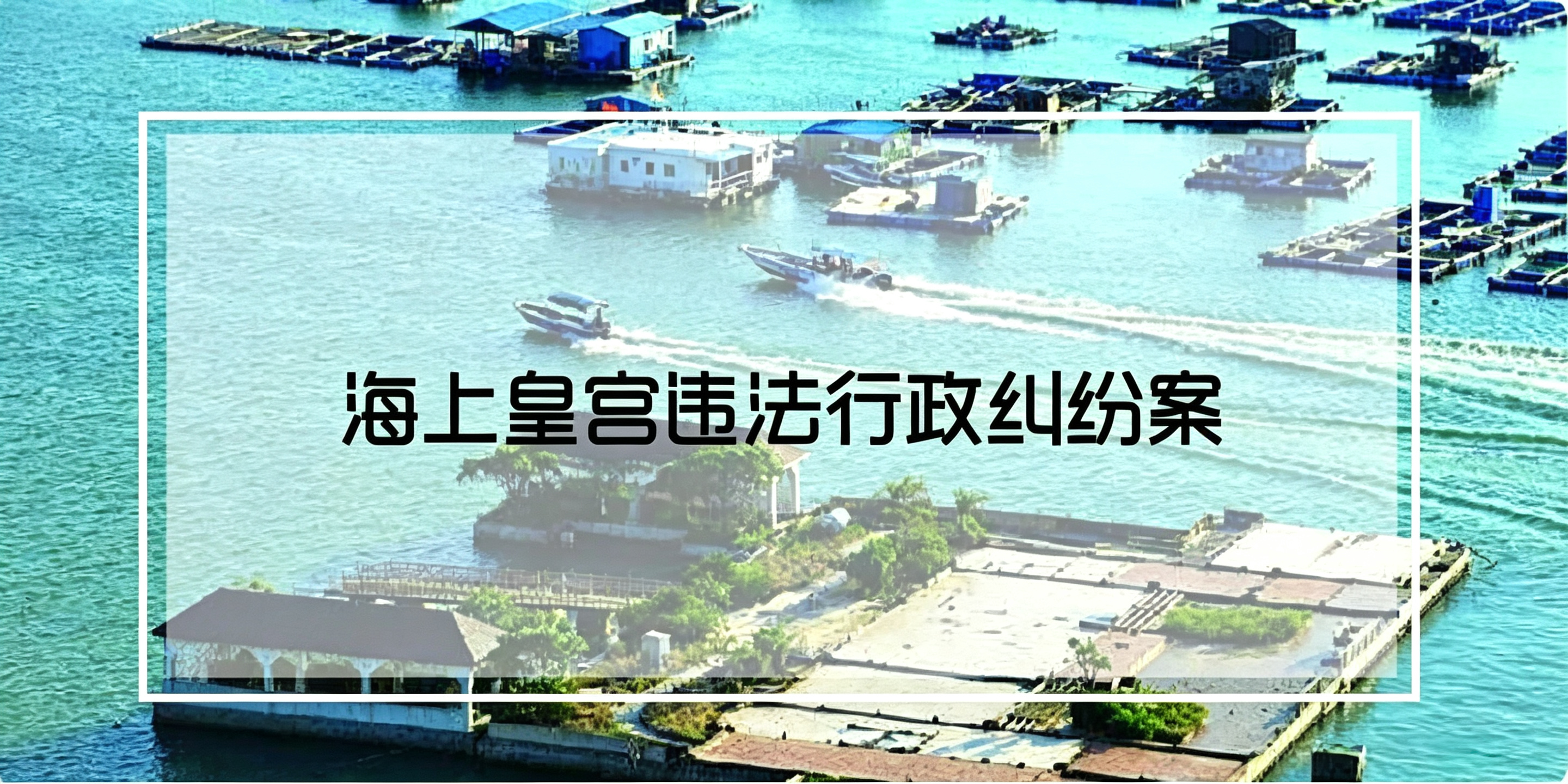
Part Two: A Lawyer's Chivalry — Legal Rescue of the "Sea Palace"
8. The Second Courtroom Clash
Thanks to Attorney Zhiming's outstanding performance, the outcome of the first hearing far exceeded expectations, leaving Guo某某 overjoyed and fully sensing the call of a favorable verdict. His artist's spontaneous spirit and entrepreneur's sharpness returned, prompting him to decide to file a massive claim of 50 million yuan against the government! After seeking Attorney Zhiming's advice and having him draft the Supplementary Administrative Complaint on his behalf, Guo某某 arranged for Hai Shang Jing Ying Entertainment Co., Ltd. to submit the supplementary claims in writing to the Longgang District People's Court on June 23.
Supplementary Administrative Complaint
Plaintiff: Shenzhen Hai Shang Jing Ying Entertainment Co., Ltd.
Address: Room 201, No. 51 Dongshan Village, Nanao Street, Longgang District, Shenzhen
Legal Representative: Guo Jingli
Defendant: Shenzhen Longgang District Economic Promotion Bureau
Address: 10th Floor, East Wing, Customs Building, Longgang District, Shenzhen
Person in charge: Jia Changsheng, Director
Phone: 28948833
Litigation Claims:
1. Request the court to order the defendant to compensate the plaintiff for economic losses of RMB 50 million in accordance with the law for the illegal forced demolition.
Factual Basis:
Starting from March 1 this year, the defendant, under pressure from misguided public resentment toward the wealthy and public opinion, issued an erroneous administrative decision to demolish the plaintiff's offshore fish-raft platform (commonly known as the "Offshore Palace"), and subsequently carried out the wrongful demolition in stages beginning April 8. To date, the upper structure of the plaintiff's luxury offshore fish-raft platform has been almost entirely dismantled. By June 21, the plaintiff learned from two other administrative litigation cases against the defendant that the defendant's unlawful forced demolition had been temporarily halted due to constraints related to technology, environmental protection, safety, and other factors. At this point, after an urgent and careful review and accounting, the plaintiff calculates total economic property losses amounting to RMB 50 million. Accordingly, pursuant to the Administrative Procedure Law of the People's Republic of China and relevant judicial interpretations, the plaintiff hereby specially supplements the claims as stated above and requests that they be adjudicated together and granted in accordance with the law.
Yours sincerely
Longgang District People's Court
Claimant: Shenzhen Sea Elite Entertainment Co., Ltd.
June 23, 2011
Now let us briefly review the circumstances of the second court session, primarily based on the report written by Wu Tao, a journalist from Shenzhen Press Group.
At 2:30 PM on June 24th, the presiding judge struck the gavel on time, and the trial of the "Sea Palace" case resumed. Since both parties had already presented their arguments and revealed their positions to the fullest during the first hearing, and most of the evidence presentation, cross-examination, and debate on the key disputed issues had been completed, the journalists attending as observers again, though somewhat expectant, assumed the case would proceed through the formalities without much drama. Unexpectedly, a bombshell was dropped right from the start—the presiding judge announced that the day before this hearing, the plaintiff had filed an additional claim with the court, demanding 50 million yuan in economic damages from the defendant. Instantly, all the journalists in the audience perked up their ears!
This "sky-high" compensation claim clearly caught the defendant off guard. The defendant's attorney immediately objected in court, arguing that the plaintiff's last-minute addition of claims not only violated the relevant provisions of the Administrative Procedure Law but also failed to give the defendant time to collect and prepare evidence, making it clearly inappropriate. If the plaintiff wished to pursue compensation, they should file a separate lawsuit. The plaintiff's attorney, Zhiming, explained that because they had been unable to ascertain the specific progress and scope of the demolition carried out by the demolishing party, they could not calculate the amount of compensation sought. "During the first hearing on the 21st, we learned that the relevant authorities had largely halted the demolition operations, which allowed us to calculate the corresponding compensation amount and file the claim."
Because the defendant explicitly challenged the plaintiff's new claims, the presiding judge announced a recess, and the collegial panel withdrew to deliberate on whether to accept and hear the plaintiff's new claims. A few minutes later, the three judges returned to the courtroom, and the presiding judge announced the panel's decision: "After deliberation, we find that whether the forced demolition in this case was unlawful is intrinsically logically connected to compensation, with administrative illegality serving as the premise and foundation for compensation. At the same time, the plaintiff naturally bears the burden of proof in raising compensation claims, so the new claims will not increase the defendant's burden of proof."
Building on the confidence established during the first court session, at the second hearing, the true owner of the "Sea Palace," Guo, appeared as the authorized representative of the plaintiff, Sea Elite Entertainment Co., Ltd., and sat openly at the plaintiff's table alongside Attorney Zhiming. Moreover, he broke free from the awkward situation of being "silenced" during the first hearing and, guided by Attorney Zhiming, frequently posed questions to the defendant.
"In the sea area where the 'Sea Palace' is located, there are also many fish raft restaurants and fishing spots. They obtained aquaculture and fishing permits at the same time as the 'Sea Palace' and still hold them now. Why did the defendant revoke only the aquaculture and fishing permits of the 'Sea Palace'?" Guo clearly expressed dissatisfaction with the defendant's "selective enforcement," claiming this is the crux of the case.
The attorney representing the Longgang District Economic Promotion Bureau responded that the "Sea Palace" is fundamentally different from the surrounding fish rafts. It is not a simple venue for dining and fishing, but rather the site of an extremely luxurious high-end club. Membership in this club has extremely high thresholds: only individuals with the status of vice president or above of a Fortune Global 500 company's China branch, or members of royal families, are eligible—only the wealthy and powerful. This constitutes illegal use of public sea areas.
"Is it that 'simple' is legal while 'luxurious' is illegal?" Guo, whose surname is Guo, expressed difficulty accepting the reasons given by the defendant.
Of course, it was still Attorney Zhiming who took the lead in the courtroom confrontation, and his performance remained as outstanding as ever—handling every challenge with ease, like a general repelling troops and a dam holding back floods. At one point, Guo, on the other side, grew somewhat agitated and pointed at the opposing counsel, saying, "You've run out of arguments and are still stubbornly resisting without reason—what's the point?"
The defense attorney, realizing the situation was beyond recovery, set aside the core dispute over whether the forced demolition was lawful and instead focused on contesting the specific amount of 30 million yuan in compensation, arguing vigorously on that point. Since the 30 million yuan claim was a rough estimate hastily calculated by Guo after the first court session, there was no time to properly organize evidence of all the costs invested in building the offshore floating island over the years. The presiding judge agreed with the suggestion from attorney Zhiming and decided to adjourn the court again, requiring the plaintiff to submit supporting evidence for the 50 million yuan claim within a specified period after the hearing. The court would later schedule another session for both parties to examine the evidence, after which the trial would be concluded.
Guo saw that the situation in the two court hearings was highly favorable to him. On one hand, he greatly admired the superb skills demonstrated by Zhiming lawyers during the trials and felt fortunate to have chosen the right counsel; on the other hand, he regained confidence in the future of the "Sea Palace." In his mind, even if the government could not meet his compensation demands, his floating island at sea would at least be able to survive, avoiding complete forced demolition. He still had the chance to openly and legitimately restore his maritime home.
However, Zhiming, the lawyer accompanying them, was not so optimistic. It wasn't that he lacked confidence in his performance in court, but rather, with his professional acumen and years of experience handling administrative litigation against government agencies, he knew that nothing was set in stone until a final judgment was rendered in an administrative case. Given the widespread impact of the "Ocean Palace" case, the government side would certainly not concede easily. Nevertheless, he actively guided Guo and the others in collecting and organizing evidence of the construction costs of the floating island structure, laying a solid evidentiary foundation for Guo's compensation claims and striving for a final victory in the case. He believed in the fairness of the law and, even more so, in its seriousness. As long as their legal reasoning was sound and their arguments rigorous, they had no fear of any undue interference that might affect the outcome of the case.
(To be continued)

