

Public opinion cheers for a "victory" without a winner - The ultimate Revelation of the "Sea Palace" Case (Serial 14)
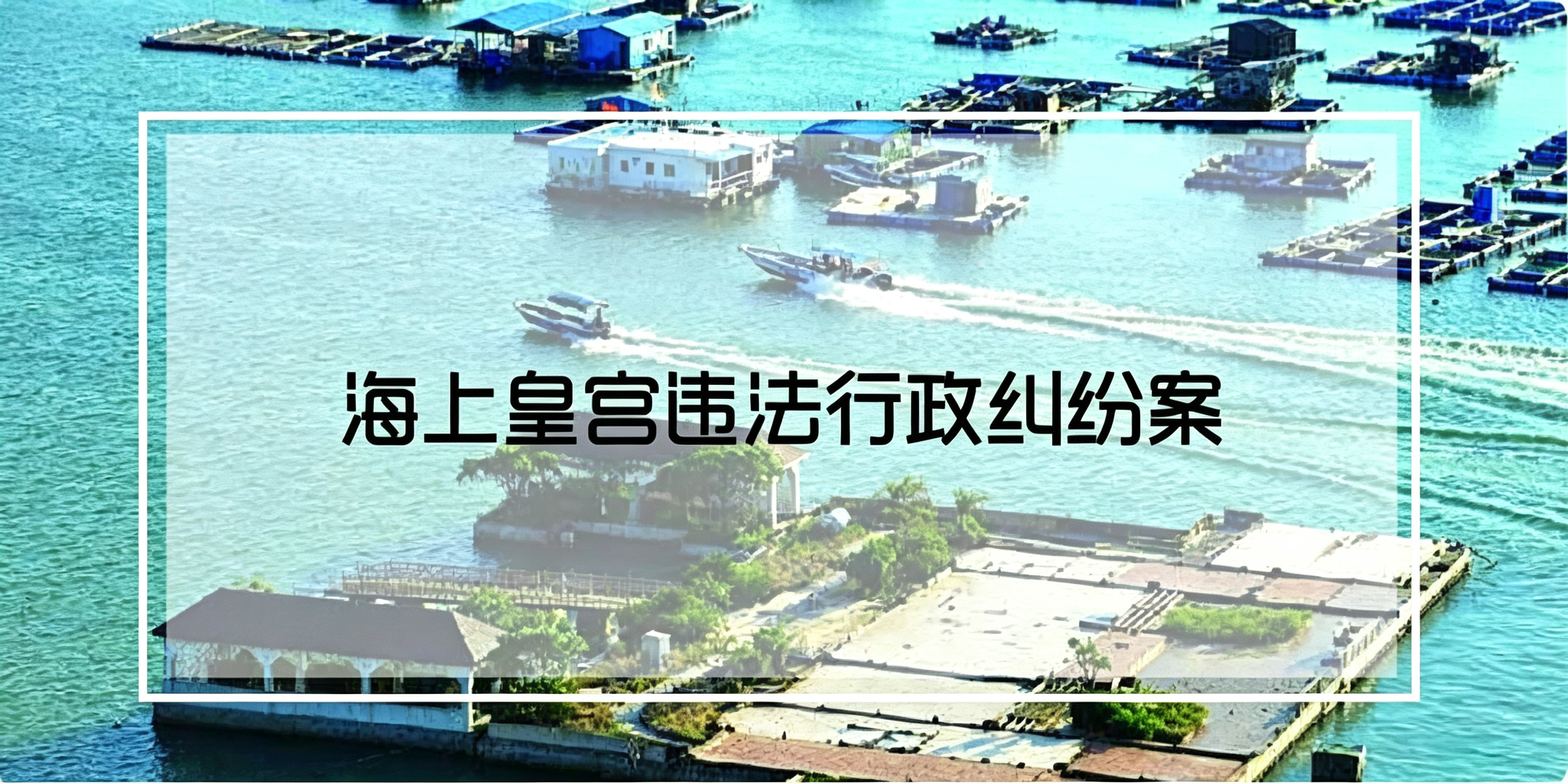
Part One: "Rich Tycoon" Guo XX and His "Sea Palace"
13. The public cheered a "victory" that had no winners.
The government departments' "six golden edicts" are nothing but death warrants! It seems the "Sea Palace" is doomed to be forcibly demolished. However, the resilient vitality of the "Sea Palace" cannot be summed up by a mere word like "demolition." For now, let me keep you in suspense, dear readers—wait and see the revelations in *"The Ultimate Exposé of the 'Sea Palace' Case — Part Two: The Chivalrous and Righteous Lawyer Zhiming Rescues the 'Sea Palace'"*, and all will become clear.
The demolition of the "Sea Palace" is an outcome with no winners, yet shallow media outlets catering to public sentiment still cheer it as a "victory." On April 9, 2011, the Jing Bao reported the forced demolition of the "Sea Palace" the previous day, accompanied by an editorial titled "The Collapse of the 'Sea Palace' Proves the Rule of Law Stands Tall" (Figures 59, 60, 61). The full text is as follows:
As a typical case with significant social impact, the "Sea Palace" holds certain specimen value. In the contest between violation and law enforcement, enforcement must be made more forceful; in the contest between rule by man and rule by law, rule by law must prevail. In this multilateral game involving capital, law enforcement agencies, and public opinion, rule of law ultimately emerged as the victor, public sentiment received a strong response from public management authorities, and the value of justice was upheld.
The demolition of the "Sea Palace" began yesterday under legal enforcement, marking the end of the suspense over whether this highly influential illegal offshore structure would stay or go, after multiple rounds of contention finally brought the matter to a close.
After media reports exposed the illegal use of sea areas by the "Sea Palace," it drew widespread attention. The relevant departments of Guangdong Province and the Shenzhen Municipal Government attached great importance to this issue, and the Guangdong Provincial Ocean and Fisheries Bureau established an investigation team to conduct a comprehensive investigation into the case. The investigation team confirmed that the "Sea Palace" structures occupied sea areas in violation of marine functional zoning, did not meet the conditions for sea use approval, and had never obtained a sea area use certificate. Furthermore, no approval documents for sea use had ever been issued by the provincial, municipal, or district-level marine authorities. The company's illegal occupation of sea areas was clearly established with conclusive evidence. The Longgang District Ocean Bureau of Shenzhen lawfully applied to the Longgang District People's Court for compulsory enforcement.
However, the enforcement process did not go smoothly. The "Sea Palace" attempted to find a way around the regulations by obtaining aquaculture registration certificates and other means to secure its continued existence. This move once raised public concerns that the "Sea Palace" might once again pull off a new escape act, as it had done in the past. When the Crystal Daily initially reported on the "Sea Palace," the owner of the illegal structure had boldly declared that the probability of the "Sea Palace" being demolished was akin to the Earth colliding with the Moon. Now, the fact that it has been forcibly demolished demonstrates that no one can stand above the rule of law.
Under further media supervision, the Shenzhen court lived up to public expectations by revoking the "aquaculture registration certificate" of Guo Jingli, the legal representative of Hai Shang Jing Ying Entertainment Co., Ltd., and ordering the company to tow its offshore structures out of Shenzhen waters or dismantle them on its own, restoring the sea area to its original state. As the company failed to comply, in accordance with the relevant provisions of the "Law of the People's Republic of China on the Administration of Sea Area Use," the relevant authorities in Longgang District decided to carry out a compulsory demolition in accordance with the law, and the enforcement process was initiated yesterday. The demolition will proceed safely and orderly, with efforts to minimize secondary disasters such as pollution to the surrounding sea area, and progress will be promptly disclosed to the public. News media and the general public have also been invited to supervise the process. All of this demonstrates that Shenzhen's functional departments have handled the "Sea Palace" issue in accordance with the law and due procedures, while ensuring openness and transparency.
Reviewing the twists and turns of this case, it spanned more than seven years from start to finish, meaning the game-playing also lasted seven years. As a typical case with significant social impact, the "Sea Palace" holds certain specimen value. In the struggle between violation and law enforcement, law enforcement must be made more forceful; in the struggle between rule by man and rule by law, it must be rule by law that prevails. In this multilateral game involving capital, law enforcement agencies, and public opinion, rule of law emerged as the ultimate victor, public sentiment received a strong response from public management authorities, and the value of justice was upheld.
The collapse of the "Sea Palace" signifies the triumph of the rule of law; the forced demolition of the Sea Palace is a demolition of acts that challenge the rule of law. As Shenzhen embarks on a new 30-year journey of development, greater emphasis will be placed on the quality and standards of growth during the "12th Five-Year Plan" period, inevitably raising the bar for the rule of law. The compulsory demolition of the "Sea Palace" exemplifies the spirit of the rule of law, conveying to society the city's character of steadfastly upholding the rule of law, and will undoubtedly further strengthen citizens' confidence in Shenzhen's legal framework.
This case also serves as a lesson for businesses on how to operate in accordance with the law. The creator of the "Sea Palace" once took great pride in his masterpiece, but because he disregarded regulations and began construction and operation without obtaining legal permits, his "achievement" was destined to be short-lived, regardless of its splendor, and was not protected by law. This case once again demonstrates that a market economy must be a rule-of-law economy, and that integrity and fair order must be established through the rule of law.


Extended Topic: Capitalists, Entrepreneurs, and Entrepreneurship
The term "capitalist" has faded from the common vocabulary of our modern life, but in the depths of the minds of older Chinese people, traces of ideological education from the past remain, such as "capitalist," "exploitation," and "surplus value." This is because Karl Marx, the founder of socialist/communist theory, defined capitalists in his work *Das Kapital* as those who own the means of production, dominate the labor relations under the capitalist mode of production, control the entire production process, and live by exploiting the surplus value created by wage laborers.
In reality, it is neither comprehensive nor objective for Marx to simply define capitalists as exploiters. According to research findings in modern institutional economics, the surplus value generated by a business's operations is enjoyed by the business owner (capitalist), meaning the owner holds the residual claim on the enterprise, because the owner is the ultimate bearer of the enterprise's operational risks. In plain terms, a business's operations can either yield profits (generating surplus value) or incur losses, and this risk is borne by the business owner (capitalist). Hired workers, on the other hand, receive fixed wages and do not bear the enterprise's operational risks. Even if the enterprise goes bankrupt and is liquidated, the law mandates that workers' wages must be paid with priority. Additionally, national taxes and debts owed to corporate creditors must also be settled before the business owner, who may ultimately end up losing everything. The principle that returns should match risks is a fundamental tenet of modern financial management. Since the business owner bears the primary risks of the enterprise, they should be entitled to the surplus value created by the enterprise (modern finance prefers the concept of "economic value added").
In the past, because capitalists were always equated with exploiters, the term "capitalist" in modern Chinese remained a highly negative word for a long time. However, after the reform and opening-up, Chinese people gradually set aside the meaningless ideological debate over "socialist" versus "capitalist," replacing the planned economy with a market economy, encouraging some people to "get rich first," and substituting the term "entrepreneur" for "capitalist." Many of those who got rich first were indeed "entrepreneurs," and as a result, "entrepreneur" gradually became a commendatory term. In today's context, entrepreneurs like Ma Yun, who surpassed Li Ka-shing as Asia's richest man after Alibaba's listing in the United States, have become national heroes admired by millions. The country is now vigorously promoting innovation and entrepreneurship, and encouraging entrepreneurship is essentially encouraging people to become entrepreneurs! Entrepreneurs can solve their own employment problems, and once they succeed and become entrepreneurs, they can also solve employment problems for many others, thereby creating wealth for themselves and for society.
The term "entrepreneur" is borrowed from French, originally meaning "an operator or organizer of a risky venture." In modern enterprises, entrepreneurs are generally divided into two categories: one is the owner-entrepreneur, who, as the owner, still engages in the management and operation of the enterprise, combining the roles of shareholder and senior executive; the other is the professional entrepreneur employed by the owner. However, in most cases, the term "entrepreneur" refers only to the first type, while the second type is referred to as professional managers.
What makes entrepreneurs who they are is the "entrepreneurship" embedded in them. And the soul of entrepreneurship is innovation. In a fiercely competitive market environment, the greatest hidden danger for a company is the demise of its innovative spirit. But innovation is not merely "a flash of genius"; it is equally the result of hard work by entrepreneurs. Innovation can be described as the defining characteristic of entrepreneurial activity, ranging from product innovation to technological innovation, market innovation, and organizational innovation. In the operations of successful companies, innovation is everywhere. The essence of the innovative spirit is "doing different things, rather than doing what has already been done better." Therefore, an entrepreneur with an innovative spirit is more like a passionate artist.
Beyond innovation, modern economists also habitually associate entrepreneurship with risk or uncertainty. Without the courage to take risks and bear responsibility, one cannot become an entrepreneur. Looking at the growth history of well-known modern enterprises, such as Hewlett-Packard founded in Silicon Valley in 1939, Sony founded in Tokyo in 1946, Acer founded in Taiwan in 1976, Lenovo and Haier founded in Beijing and Qingdao respectively in 1984, and Alibaba, the legendary company founded by entrepreneur Jack Ma in 1999 with a team of 17 people, although the founders of these enterprises grew up in different environments, had different backgrounds, and seized different entrepreneurial opportunities, they all, without exception, dared to be the first to step forward and take the plunge under conditions where circumstances were extremely immature and the external environment was highly uncertain. People often say that entrepreneurs (commonly known as bosses) work for themselves, while hired workers (employees) work for others. Both are "workers," but the only essential difference is that the former bears all the risks of the enterprise, while the latter only needs to worry about whether their wages are secure.
The story of Guo and the "Sea Palace" is a tale of entrepreneurial innovation and risk-taking! However, the experiences of Guo and the "Sea Palace" reveal that our society is far from mature enough to rationally view entrepreneurs and their ventures. On the surface, we call for entrepreneurs, admire them, and envy them; yet on the other hand, we pay insufficient attention to fostering a healthy and supportive ecosystem and environment for entrepreneurs. In reality, our attitude toward entrepreneurs has not surpassed the ancient mindset of Lord Ye, who professed a love for dragons but was terrified when faced with a real one.
(First part serialized, to be continued)

