Zhiming Lawyer Achieves Complete Victory in "Citizen vs. Government" Administrative Litigation Case

[2] ▲ Shenzhen Municipal Government (Image source: Internet)
Historically, it has been difficult for lawyers to represent clients in administrative litigation—"citizen suing official"—because such cases involve private rights contending against powerful public authority, and the difficulty is easy to imagine. However, recently, in an administrative lawsuit filed by Zhang Mou against the Shenzhen Municipal Government, represented by Director Zhang Yong, a lawyer from Zhiming Law Firm, a complete victory was achieved through litigation strategy. After both the first instance and second instance trials, the court repeatedly ruled in favor of our side (the appellee in the second instance).
I need the actual Chinese text to translate. Please provide the content you'd like me to translate.
The case originated from our client, Mr. Zhang, who filed an administrative lawsuit against the Shenzhen Municipal Human Settlements and Environment Commission (in a separate case) due to environmental pollution caused by a new power plant project initiated by the government. Because that case involved the disclosure of government information, this "case within a case" arose. Mr. Zhang requested that the Shenzhen Municipal People's Government disclose, in accordance with the law, three government documents on which the new power plant project was based: the "Research on the Site Selection and Planning Design Conditions for a Certain Power Plant in Shenzhen (Draft for Review)" (hereinafter referred to as the "Draft for Review") by the Shenzhen Municipal Planning, Land and Resources Commission, the written opinions of the Shenzhen Municipal Urban Planning Committee reviewing the aforementioned project and documents (hereinafter referred to as the "Planning Committee Opinions"), and the written document by which the Shenzhen Municipal Government approved the aforementioned project and documents (hereinafter referred to as the "Municipal Government Opinions"). Because these three documents pertain to the public interest and are of significant importance to the new power plant project, they also play a crucial role in the adjudication of the separate case. After review by the relevant authorities, in July 2016, the Shenzhen Municipal Government made a decision that "the Draft for Review and the Municipal Government Opinions, being process-related information under review and study, shall not be disclosed; the Planning Committee Opinions shall be applied for disclosure by the party through other departments." Mr. Zhang disagreed with this decision, believing that the Municipal Government Opinions should be disclosed to the public, and therefore filed a lawsuit with the Shenzhen Intermediate People's Court. After trial at first instance, the court ruled against the defendant, the Shenzhen Municipal Government, which then appealed to the Guangdong Provincial Higher People's Court. In August of this year, this administrative litigation case, which had spanned more than two years, finally came to a successful conclusion, with the provincial higher court issuing a final judgment "dismissing the appeal of the Shenzhen Municipal Government and upholding the original judgment," resulting in a complete victory.
Facing a powerful defendant, both the intermediate court and the higher court supported our claims and ruled in our favor, which is uncommon in administrative litigation handled by lawyers. Behind this victory lies the profound professional expertise and superb courtroom skills of Zhiming lawyers, as well as their courageous spirit of contestation and brilliant wisdom in administrative litigation cases. In this case, our attorneys, proceeding from the perspective of major public interests, focused on the government's "approval information" and what it called "procedural information" as key entry points. They conducted in-depth research on administrative substantive law and procedural law, seized upon the government's flaw of "conflating its own deliberative decision-making actions with the specific actions of functional departments," and boldly and directly argued that "the government's decision to refuse disclosure was a deliberate misinterpretation of legal provisions, lacking due responsibility, and intended to shift blame and avoid conflicts." With compelling persuasion, our attorneys ultimately won the support of both courts, marking another classic major case in the achievement of cultural rights protection litigation.
Conclusion
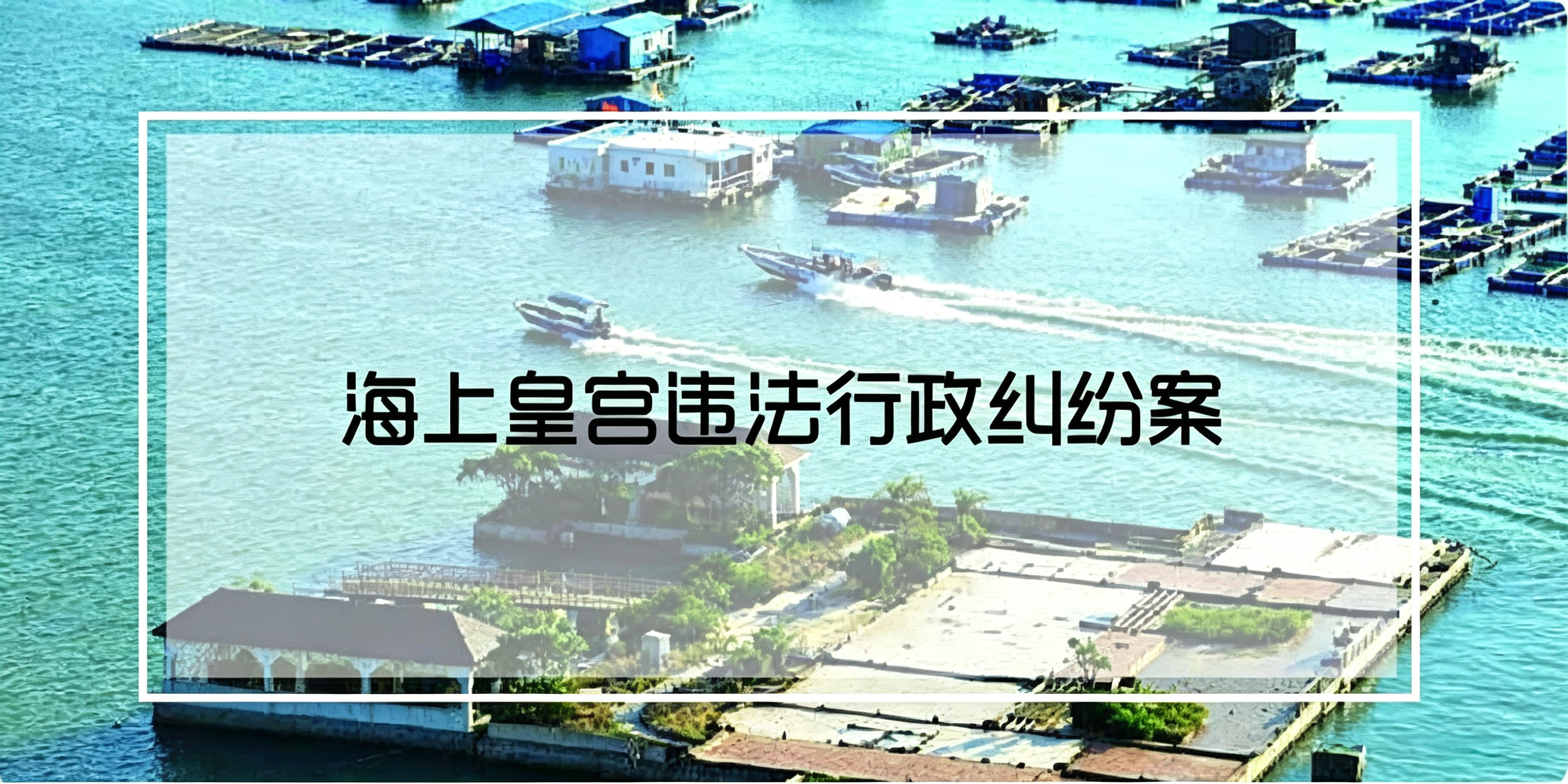
When it comes to Zhiming Lawyers handling administrative litigation cases, one cannot overlook the "Maritime Palace" case from seven years ago. Represented by Zhiming Lawyers, this case caused a social sensation and drew extensive coverage from domestic and international media. It has become an enduring classic in the field of administrative litigation in China, and has been included in the Supreme People's Court Gazette and law textbooks used by political science and law institutions.
Attached judgment