Shenzhen Administrative Litigation Lawyer – Administrative Compulsory Demolition Dispute Rights Protection


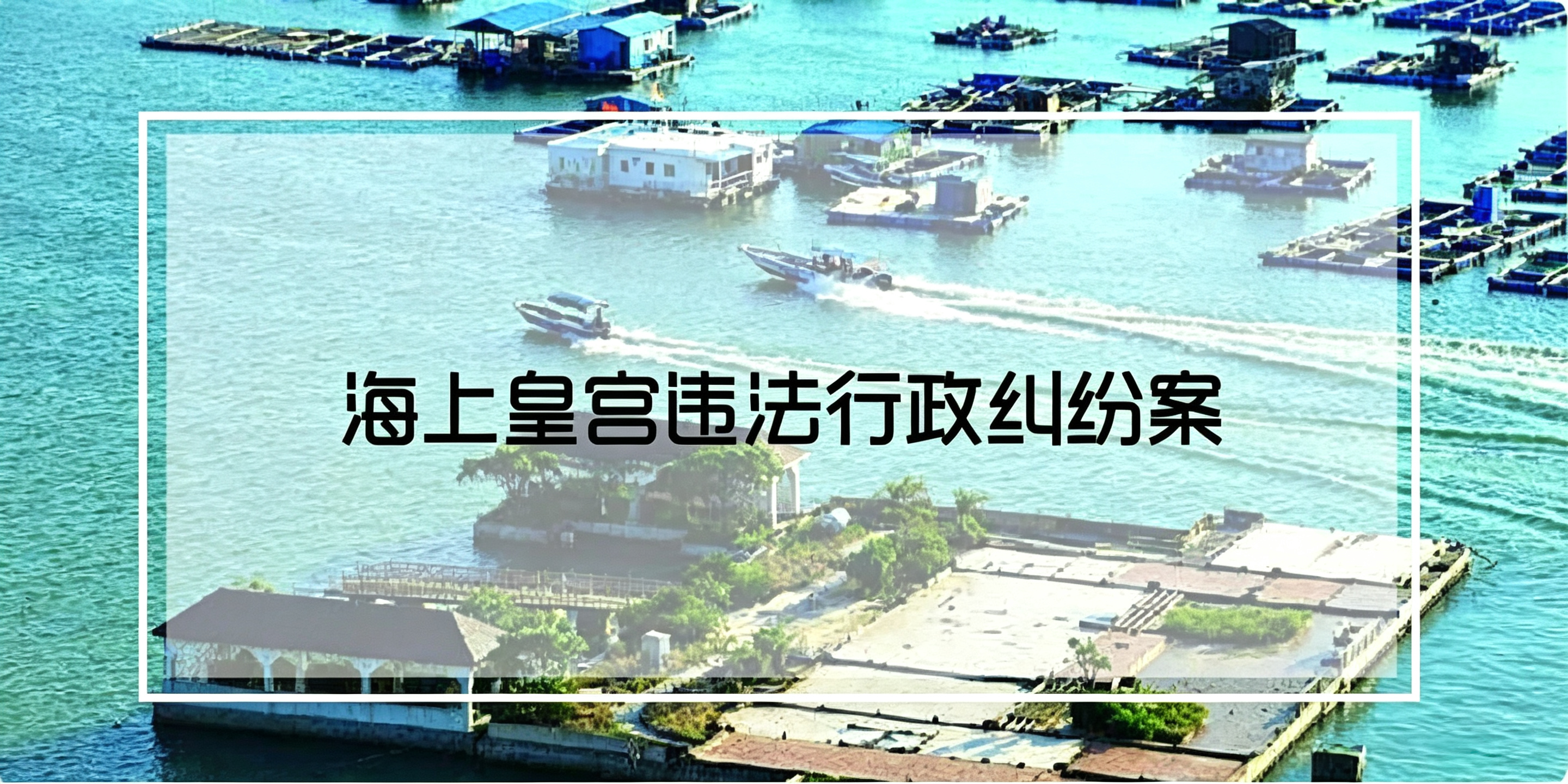
"Sea Palace" Main Floating Island (2010) I. Case Background Dongshan Bay in Nan'ao, Longgang District, Shenzhen, had long been an aquaculture area for local fishermen, and many fishermen had for generations built fish rafts and living quarters on this tranquil bay for production and daily use. Around 2011, the Shenzhen "Sea Palace" that shocked the nation referred precisely to the floating island on Dongshan Bay. Original Condition of the "Sea Palace" (2009) Original Condition of the Main Structure of the "Sea Palace" As early as 2003, entrepreneur Guo某某, building on traditional fish rafts, began constructing a relatively large-scale offshore floating island (later dubbed the "Sea Palace" by the media). Because the offshore floating island was a novelty, for a time no unit was willing to issue a sea area use right certificate for it. By January 2008, the former Longgang District Agriculture, Forestry and Fishery Bureau (hereinafter the Ocean Bureau) imposed a fine of 711,000 yuan on the "Sea Palace" party and ordered it to restore the sea area to its original condition within a prescribed period. However, through the active efforts of the "Sea Palace" party, Li Zhujiang, then Director of the Guangdong Provincial Ocean and Fishery Bureau, in the spirit of encouraging innovation, issued instructions on the "Sea Palace" matter, designating the Longgang Brigade to withdraw the case. Nevertheless, out of deference to the former Longgang District Ocean Bureau, the "Sea Palace" party still chose to pay the fine. Development Agreement Between the "Sea Palace" Party and the Nan'ao Side On January 13, 2010, some Shenzhen media published reports on the "illegal" use of the sea area by this offshore floating island and named it the "Sea Palace," immediately attracting national attention. For a time, reporters from all over gathered at Dongshan Bay, as if there were a momentum to flatten the "Sea Palace." Amid media commentary alleging "collusion between officials and businessmen," the "Sea Palace" was dismantled into three large sections on May 13 and towed away from the original sea area, but was left floating on the surface of Dongshan Bay pending rectification. After active rectification by the "Sea Palace" party, on December 26 of the same year, the former Longgang District Ocean Bureau issued an Aquaculture Registration Certificate and an approval for recreational fishing to the rectified "Sea Palace." The "Sea Palace" Divided into Three Large Sections, Prepared for Comprehensive Rectification by the Former Longgang District Ocean Bureau (2010) Rectification Plan to Convert the "Sea Palace" Floating Island into an Aquaculture and Fishing Raft Approval and Certification for Aquaculture and Fishing Issued by the Former Longgang District Ocean Bureau to the "Sea Palace" Party Aquaculture Certificate Issued by the Former Longgang District Ocean Bureau to the "Sea Palace" Party The "Sea Palace" After Comprehensive Rectification and the Aquaculture Fish Rafts Added Around It Just as the "Sea Palace" party was preparing to open the floating island to the public, with the intervention of some media once again, the Shenzhen Ocean Bureau and Longgang District were compelled to issue a joint notice on March 2, 2011, declaring that the "Sea Palace" constituted illegal occupation of the sea area and ordering the former Longgang District Ocean Bureau to revoke the Aquaculture Registration Certificate it had issued to the "Sea Palace" party. On April 8, the Longgang District Ocean Bureau, without going through the statutory administrative procedures, began organizing forces to forcibly demolish the superstructure of the "Sea Palace." Decision of the Former Longgang District Ocean Bureau to Revoke the "Sea Palace" Aquaculture Certificate Scene of the Former Longgang District Ocean Bureau Organizing Forces to Forcibly Demolish the "Sea Palace" The "Sea Palace" During Forced Demolition Nanfang Daily News Report on the Forced Demolition of the "Sea Palace" As early as March 28 prior to this, the "Sea Palace" party had already sued the former Longgang District Ocean Bureau for its administrative penalty conduct of going back on its word and violating procedures. On April 20, the Longgang District Court decided to accept the administrative lawsuit filed by the "Sea Palace" party in accordance with law. The former Longgang District Ocean Bureau also ceased the relevant demolition work after completely demolishing the main buildings in the atrium portion of the floating island. Subsequently, the plaintiff, the "Sea Palace" party, retained Attorney Wang Tengfeng of Guangdong Zhiming Law Firm to represent it in this case. Scene of the First Hearing of the "Sea Palace" Administrative Litigation Case on June 21 II. Heated Courtroom Debate The case was first heard on June 21, 2011, in Courtroom No. 4 of the Longgang District People's Court. During the hearing, Zhiming attorneys mainly articulated the following points in their defense statement: 1. After obtaining the Aquaculture Registration Certificate, the plaintiff's aquaculture (fishing) in the designated sea area was entirely lawful. First, the fishery administrative department of a people's government at or above the county level is the statutory authoritative organ responsible for issuing aquaculture license certificates, and once an aquaculture license certificate is obtained, the holder naturally possesses the lawful right to use the relevant designated sea (water) area for aquaculture, and there is no legal provision requiring a separate "sea area use right certificate" as a precondition. The so-called assertion by the Longgang District Economic Development Promotion Bureau (i.e., the former Longgang District Ocean Bureau) that "the plaintiff did not lawfully obtain the sea area use right" was purely unlawful and unreasonable. Second, for nearly thirty years, the fishery administration departments of Longgang District, in actually supervising the aquaculture industry within the sea areas under their jurisdiction, had likewise only issued aquaculture registration certificates, without making the obtaining of a sea area use certificate a precondition. 2. It is unreasonable to falsely characterize the luxury fish raft as an "illegal structure," and the private desire born of wealth-hating jealousy should not receive legal support. The plaintiff's fish raft was indeed luxurious, but this cannot negate its essential attributes and functions as a fish raft, nor does it deprive it of its aquaculture and fishing functions. Second, the frequent visits of guests to the plaintiff's aquaculture and fishing raft for sightseeing are not illegal, and there is no provision in Chinese law stipulating that guests are prohibited from visiting or sightseeing at any fish raft. Finally, no illegal or criminal circumstances such as pornography, gambling, or drugs occurred on the plaintiff's luxury fish raft; only sightseeing and gatherings existed. Before any "law" defines its nature, the "Sea Palace" should not be characterized as an "illegal structure." 3. Revoking the Aquaculture Registration Certificate and the recreational fishing approval constituted "unlawful administration" rather than "self-correction." The Longgang District Economic Development Promotion Bureau first agreed to allow the plaintiff to conduct aquaculture and recreational fishing operations with the rectified fish raft, and in December 2010 issued the Aquaculture Registration Certificate, permitting the plaintiff to operate lawfully. But three months later, due to the negative impact of media reports, it openly violated statutory procedures by revoking the approvals and certifications for aquaculture and fishing that the plaintiff had lawfully obtained, and forcibly reclaimed the Aquaculture Registration Certificate, seriously violating the provisions of China's Administrative Licensing Law and depriving the plaintiff of its due rights to make statements and defenses. This clearly can only be a new administrative violation. Even for the purpose of "self-correcting the previous error in issuing the certificate," it cannot once again violate the statutory procedures prescribed by the state and commit a new error in law enforcement. 4. The forced demolition was in substance a new unlawful penalty, rather than the restoration of the old penalty measure. Although the Longgang District Economic Development Promotion Bureau argued that its forced demolition of the "Sea Palace" was a lawful compulsory measure taken on the basis of the old administrative penalty decision, this clearly contravened the facts and violated legal provisions. In fact, the old administrative penalty had already been ruled by the Longgang District People's Court as having been fully enforced. Therefore, the Longgang District Economic Development Promotion Bureau did not apply for resumption of judicial enforcement of the "forced demolition," but merely carried out the demolition arbitrarily on its own, without legal basis. (For details of the full agency statement in the "Sea Palace" case, please see the article on this website, "Agency Statement of Zhiming Attorneys in the 'Sea Palace' Unlawful Administrative Dispute Litigation Case.") Zhiming attorneys during the hearing Subsequently, the agency attorneys of the Longgang District Economic Development Promotion Bureau were not to be outdone, and likewise raised sharp rebuttals. The attorneys for both sides engaged in fierce debate over many detailed issues in the case. The reporters present listened almost holding their breath. Ultimately, through unremitting efforts, Zhiming attorneys successfully found strong support in legal principle and reason for the survival of the "Sea Palace." They not only persuaded the judge, but also persuaded the news reporters covering the case, gradually turning the public opinion situation in a favorable direction. After the First Hearing, Zhiming Attorneys Accepting a News Interview with Guangdong Television's "Today's Focus" Program Shenzhen Economic Daily News Report on the Hearing of the "Sea Palace" Administrative Litigation Case Two days after the adjournment, the two sides organized a second hearing at the court on June 24. Before the hearing, Zhiming attorneys transformed