

The "Marine Palace" Case: Strategic Deployment — The Ultimate Revelation of the "Marine Palace" Case (Serial 20)
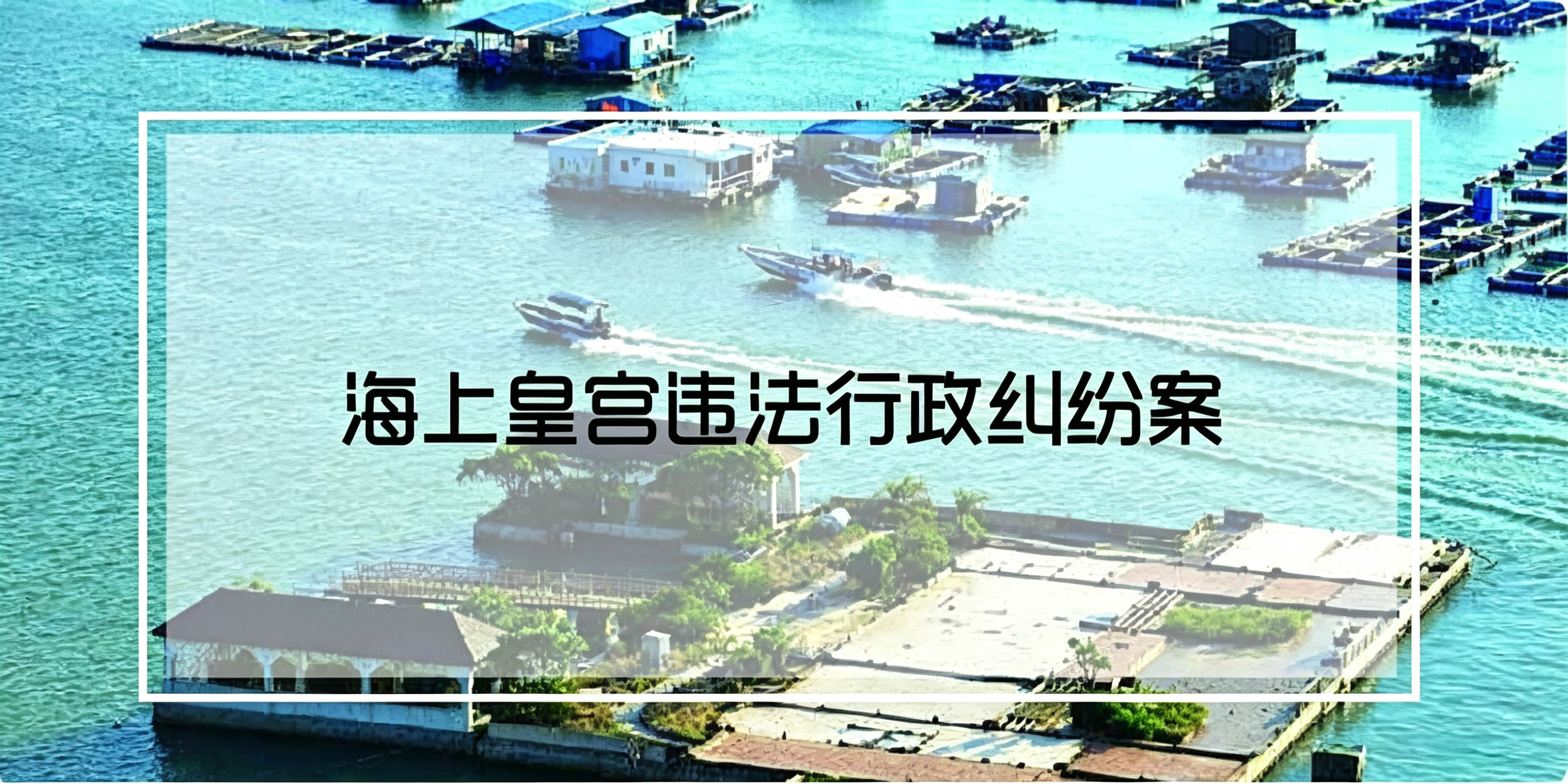
6. Deploying Troops
Before introducing the fascinating courtroom proceedings, let us first compare and study the defense statement of the Longgang District Economic Promotion Bureau (Longgang District Oceanic Bureau) and the written representation opinions that Zhiming lawyers prepared in just a few days. This will allow us to gain a comprehensive understanding of both parties' litigation strategies, and then, during the trial, observe the courtroom effects produced by different litigation strategies, thereby reaching an objective judgment on which party's litigation strategy is superior. However, we must also always keep in mind that the essence of administrative litigation is judicial review of specific administrative actions taken by government departments, and the focus of review is limited solely to the legality of administrative actions, not the reasonableness (appropriateness) of such actions. As early as several months ago, when Zhiming lawyers were interviewed by a reporter from Southern Daily, they had already pinpointed the crux of this case: the three decisions made by the Longgang District Oceanic Bureau on March 1, 2011, and the forced demolition carried out on April 8 were all procedurally illegal! However, the uniqueness of the "Sea Palace" as a new phenomenon, as well as the complex social background factors that led to the dispute over the "Sea Palace," cannot be overlooked. To seize the moral high ground, reverse the unfavorable public opinion atmosphere, and win the understanding and sympathy of the judges, highly skilled litigation lawyers must handle this issue reasonably and appropriately both in court and in out-of-court maneuvering. The representation opinions prepared by Zhiming lawyers not only highlighted the key issue of the illegality of administrative actions but also provided a reasonable and appropriate reconstruction of the "Sea Palace" story. It should be only natural that such a litigation strategy achieved excellent courtroom results. On the other hand, the Achilles' heel of the "Sea Palace" is that it had never obtained legal status for many years, and the business activities conducted there far exceeded the scope of "aquaculture and recreational fishing." Moreover, it had previously experienced administrative penalties. It was also within expectation that the defendant would seize on this issue and make a big deal out of it.
With the assistance of their attorney, the defendant submitted three Administrative Statements of Defense in response to the claims in Cases No. 45, 47, and 53, respectively. For the purpose of comparative study, the key points of the three Administrative Statements of Defense are summarized and excerpted as follows:
Defense opinions regarding Cases No. 45 and No. 53, concerning the "Notice on the Revocation of the 'Reply on Applications for Certificates for Marine Aquaculture, Fishing, etc.'" and the "Decision on the Revocation of the 'Aquaculture Registration Certificate'":
I. Basic Facts of the Case
1. On June 29, 2010, Haishang Company (abbreviation of "Shenzhen Haishang Elite Entertainment Co., Ltd." — noted by the compiler) submitted the "Request Regarding Subsequent Renovation of the Dismantled Original 'Maritime Palace' Structures" to the former Longgang District Ocean Bureau, concerning its offshore structures (i.e., the "Maritime Palace") built in the waters of Dongshan Bay, Nanao Subdistrict, Longgang District, Shenzhen, applying to convert the "Maritime Palace" into a comprehensive aquaculture and fishing raft with both "aquaculture and recreational angling" functions, as well as a recreational angling raft. On December 12 of the same year, Haishang Company submitted the "Report on the Rectification of the Offshore Floating Island" to the Longgang District Ocean Bureau, claiming that the rectification project had been successfully completed.
2. On December 18, 2010, Haishang Company submitted to the former Longgang District Agriculture, Forestry and Fishery Bureau the "Request for Certificates for Marine Aquaculture, Angling, and Related Matters", again claiming that rectification had been completed. Accordingly, on December 22, 2010, the former Longgang District Agriculture, Forestry and Fishery Bureau issued the "Reply on the Application for Certificates for Marine Aquaculture, Angling, and Related Matters" [Shen Long Nong Zi (2010) No. 144] (hereinafter referred to as the "Reply"), and on December 25 of the same year issued the "Aquaculture Registration Certificate" with fish raft number D126.
3. Subsequently, the former Agriculture, Forestry and Fishery Bureau of Longgang District discovered through various channels that the offshore company had not actually converted the "Sea Palace" into an "aquaculture and fishing raft," and that the "Sea Palace" had always been an extremely luxurious private club or clubhouse. The "Sea Palace" had never obtained the "Sea Area Use Right Certificate" for the sea area where it was located.
4. On March 1, 2011, the former Agriculture, Forestry and Fisheries Bureau of Longgang District, on the grounds that Haishang Company had not obtained the right to use sea areas, had not strictly implemented rectification as required, and that the proportion of area actually used for aquaculture was small and did not meet the requirements of the shallow-sea aquaculture functional zoning, determined that Haishang Company still did not possess the conditions for engaging in recreational fishing and aquaculture production. After deliberation, it issued the "Notice on Revoking the 'Reply Concerning the Application for Certificates for Marine Aquaculture, Recreational Fishing, etc.'" and the "Decision on Revoking the 'Aquaculture Registration Certificate.'"
5. II. The "Reply on the Application for Certificates for Offshore Aquaculture and Fishing" should be revoked in accordance with the law.
1. The Offshore Company did not genuinely transform the "Maritime Palace" into an "aquaculture and fishing raft" consistent with the functional positioning of the sea area in which it was located; the "Maritime Palace" has always been an extremely luxurious private club or venue. Moreover, the "Maritime Palace" never obtained the "Sea Area Use Certificate" for the sea area in question throughout its existence—clearly, the "Maritime Palace" in substance failed to meet the requirements set forth by the former Longgang District Agriculture, Forestry and Fisheries Bureau in the "Official Reply," and ran contrary to the original intent of issuing the "Official Reply," seriously violating the relevant provisions of the "Sea Area Use Law of the People's Republic of China," the "Fisheries Law of the People's Republic of China," and other laws and regulations.
2. The administrative act basis for the "Reply" regarding recreational fishing rafts is the "Interim Provisions on the Administration of Offshore Recreational Fishing Rafts in Longgang District" issued by the Longgang District People's Government, which in turn is based on the "Trial Measures for the Administration of Recreational Fisheries in Guangdong Province" [Yuefu Ban (2007) No. 22] issued by the People's Government of Guangdong Province on March 14, 2007. Article 28 of this local regulation explicitly stipulates: "These Measures shall come into effect as of the date of issuance, with a trial period of three years." Clearly, this local regulation has already ceased to be effective as of March 14, 2010. Accordingly, the basis for the "Reply" issued by the former Longgang District Agriculture, Forestry and Fisheries Bureau, namely the "Interim Provisions on the Administration of Offshore Recreational Fishing Rafts in Longgang District," has also naturally expired.
In summary, pursuant to the provisions of the Administrative Approval Management and Supervision Measures of Guangdong Province and relevant laws and regulations, the Respondent believes that the Reply should be revoked in accordance with the law.
3. The "Aquaculture Registration Certificate" should be revoked according to law.
According to Article 11 of the "Fisheries Law of the People's Republic of China" and Article 3 of the "Measures for the Registration and Issuance of Aquaculture Certificates for Waters and Tidal Flats," the issuance of an "Aquaculture Certificate" falls within the statutory authority of the local people's government at or above the county level. The former Agriculture, Forestry and Fisheries Bureau of Longgang District, as the competent fisheries administrative department of the government, had no authority to issue an "Aquaculture Certificate" to Maritime Company. Therefore, in accordance with the "Administrative Examination and Approval Management and Supervision Measures of Guangdong Province" and relevant laws and regulations, the Respondent believes that the "Aquaculture Registration Certificate" should be revoked in accordance with the law.
Fourth, the former Longgang District Agriculture, Forestry and Fisheries Bureau had the authority to revoke the Reply and the Breeding Registration Certificate, and the corresponding procedures did not violate any legal provisions.
1. The former Agriculture, Forestry and Fishery Bureau of Longgang District had the authority, upon discovering that the "Sea Palace" substantially failed to meet the requirements set forth in the "Official Reply," also contravened the original intent behind the issuance of the "Official Reply," and where there was no legal basis or where the legal basis had lapsed, to self-correct and directly revoke the "Official Reply" it had originally issued, in accordance with legal provisions such as the "Measures of Guangdong Province for the Administration and Supervision of Administrative Examination and Approval" and the "Several Provisions of Shenzhen Municipality on Non-Administrative Licensing Examination and Approval and Registration."
2. The original Agriculture, Forestry and Fisheries Bureau of Longgang District had the authority to self-correct and directly revoke the "Aquaculture Registration Certificate" it had previously issued upon discovering administrative overreach or other issues, in accordance with regulations such as the "Guangdong Province Administrative Approval Supervision and Management Measures."
3. There is no legal mandate requiring a hearing for actions such as the Longgang District Agriculture, Forestry and Fisheries Bureau's self-correction in revoking the "Approval" and the "Aquaculture Registration Certificate." The revocation of the "Approval" and the "Aquaculture Registration Certificate" by the former Longgang District Agriculture, Forestry and Fisheries Bureau did not violate any legal provisions.
Regarding Case No. 47, defense opinions on the forced demolition action:
I. Basic Facts of the Case
1. On October 14, 2008, the former Longgang District Oceanic Administration issued a Notice of Administrative Penalty to the Haishang Company concerning the marine structure (i.e., the "Sea Palace") built by it in the sea area of Dongshan Bay, Nanao Subdistrict, Longgang District, Shenzhen; on January 13, 2009, the former Longgang District Oceanic Administration lawfully held a hearing on the case, and on February 13 of the same year, it issued the Decision on Administrative Penalty [Yue Shen Long Hai Chu Fa (2008) No. 1, hereinafter referred to as the "Penalty Decision"].
2. Since the Haishang Company failed to perform the Penalty Decision within the prescribed time limit, the former Longgang District Ocean Bureau applied to the Longgang District People's Court for compulsory enforcement. On November 20, 2009, the Longgang District People's Court issued the Administrative Enforcement Ruling [(2009) Shen Long Fa Xing Shen Zi No. 78], ruling that compulsory enforcement be granted in accordance with law.
3. On June 29, 2010, Marine Company submitted to the former Longgang District Ocean Bureau the "Report on the Subsequent Renovation of the Dismantled Original 'Marine Palace' Structures," applying to convert the "Marine Palace" into a comprehensive aquaculture and leisure fishing raft with the functions of "aquaculture and leisure fishing," as well as a leisure fishing raft. On December 12 of the same year, Marine Company submitted the "Report on the Rectification of the Marine Floating Island" to the Longgang District Ocean Bureau, claiming that the rectification project had been successfully completed.
4. On December 18, 2010, Haishang Company submitted the "Request for Certificates Such as Marine Aquaculture and Recreational Fishing" to the former Agriculture, Forestry and Fishery Bureau of Longgang District, again claiming that rectification had been completed. Accordingly, on December 22, 2010, the former Agriculture, Forestry and Fishery Bureau of Longgang District issued the "Reply on Application for Certificates for Marine Aquaculture and Recreational Fishing" [Shen Long Nong Zi (2010) No. 144] (hereinafter referred to as the "Reply"), and on December 25 of the same year issued the "Aquaculture Registration Certificate" with fish raft number D126 (hereinafter referred to as the "Registration Certificate").
5. Subsequently, the former Agriculture, Forestry and Fisheries Bureau of Longgang District and the Ocean Bureau discovered through various channels that the Maritime Company had not actually transformed the "Sea Palace" into a "fishing and aquaculture fish raft," and that the "Sea Palace" had always been an extremely luxurious private club. On March 1, 2011, the former Agriculture, Forestry and Fisheries Bureau of Longgang District issued the "Notice of Revocation of the 'Reply on the Application for Certificates for Marine Aquaculture and Fishing' and the 'Decision on Revocation of the 'Aquaculture Registration Certificate''."
6. The former Longgang District Oceanic Administration issued notices on March 1 and March 14, 2011, respectively, requiring Haishang Company to return the illegally occupied sea area and restore the sea area to its original condition within a specified time limit. Given that Haishang Company refused to comply, the former Longgang District Oceanic Administration issued the "Notice on Compulsory Restoration of the Sea Area to Its Original Condition" to Haishang Company on March 25, 2011, deciding to forcibly demolish the "Sea Palace" in accordance with the law. On April 8, 2011, the former Longgang District Oceanic Administration began organizing the demolition of the "Sea Palace."
II. The sea area occupied by the "Sea Palace" shall, in accordance with the law, be subject to "restoration of the sea area to its original state."
The maritime company never obtained a Sea Area Use Right Certificate or an aquaculture permit, and the large-scale maritime structure "Maritime Palace" it illegally occupied the sea area with for a long time constitutes an illegal maritime structure—such conduct has clearly and seriously violated the provisions of the Sea Area Use Management Law of the People's Republic of China. In accordance with the relevant provisions of the aforementioned law, the sea area occupied by the "Maritime Palace" should undoubtedly be restored to its original condition. The "Penalty Decision" issued by the former Longgang District Oceanic Administration after strict legal procedures such as a hearing in the "Maritime Palace" case is a legally effective document and also explicitly requires "restoration of the sea area to its original condition."
III. The former Longgang District Oceanic Administration has the legal authority to demolish the "Sea Palace" in accordance with the law.
1. The "Marine Area Use Management Law of the People's Republic of China" grants the former Longgang District Ocean Bureau the administrative enforcement power to "restore the sea area to its original state." Article 42 of this Law stipulates that "where anyone illegally occupies a sea area without approval or by fraudulent approval, the violator shall be ordered to return the illegally occupied sea area, restore the sea area to its original state, and confiscate illegal gains..."
2. The “Penalty Decision” is an effective legal instrument and has compulsory execution force. After the “Penalty Decision” had been enforced by the Longgang District People’s Court, the former Longgang District Ocean Bureau discovered that the Maritime Company had not strictly “restored the sea area to its original state” in accordance with the “Penalty Decision.” Under such circumstances, the former Longgang District Ocean Bureau is entitled, by reference to Article 87 of the Interpretation of the Supreme People’s Court on Several Issues Concerning the Implementation of the Administrative Procedure Law of the People’s Republic of China and in accordance with Article 42 of the Law of the People’s Republic of China on the Administration of the Use of Sea Areas, to choose to apply to the court for compulsory execution or to directly carry out compulsory execution, i.e., to forcibly “restore the sea area to its original state” with respect to the sea area occupied by the “Sea Palace.”
3. The "restoration of the sea area to its original state" as provided in Article 42 of the "Maritime Space Utilization Administration Law of the People's Republic of China" refers to: "ceasing all production and business operations and other related activities in the illegally occupied sea area, dismantling the illegal sea-use facilities and structures in that sea area, and where the sea area has been damaged, adopting remedial measures to carry out rehabilitation and restore the sea area to the state prior to the illegal occupation." The former Oceanic Administration of Longgang District had already issued multiple notices requiring the Marine Company to return the illegally occupied sea area and restore the sea area to its original state within a prescribed time limit. In view of the Marine Company's refusal to comply, the former Oceanic Administration of Longgang District has the right, in accordance with the law, to compulsorily restore the sea area to its original state, including the compulsory demolition of the "Marine Palace".
4. The procedures by which the former Longgang District Ocean Bureau demolished the "Sea Palace" in accordance with the law did not violate any legal provisions.
1. The basis for the original Longgang District Ocean Bureau's forced demolition of the "Sea Palace" was the "Penalty Decision." This forced demolition was a continuation of the enforcement of the original "Penalty Decision," which itself was a legally effective document that took effect after strict legal procedures such as hearings. It should be noted that the demolition itself is not an administrative penalty, but rather an administrative enforcement action carried out pursuant to an already effective legal document.
2. No law mandates that an administrative compulsory enforcement action, such as the demolition of the "Sea Palace" conducted by the former Longgang District Oceanic Administration, must be subject to a hearing. The procedures followed by the former Longgang District Oceanic Administration in demolishing the "Sea Palace" did not violate any legal provisions.
The following is the full text of the closing argument submitted by Attorney Zhi Ming in the "Sea Palace" case. When compared with the defendant's defense statement above, the dynamics of attack and defense are fully revealed, and the disparity in litigation strategy and the art of advocacy is immediately apparent. As a matter of practical experience, one should generally prepare a detailed outline of the argument before trial, laying a solid foundation for a high-caliber performance during the hearing. After the trial, based on the pre-trial outline and incorporating the creative effects and circumstances of the courtroom proceedings, the final written closing argument should be completed and formally submitted to the court as the basis for the final judgment.
Attorney's Statement in the Case of the "Sea Palace" Illegal Administrative Dispute Lawsuit
Respected Presiding Judge and Judges:
Guangdong Zhiming Law Firm, at the request of Mr. Guo Moumou's investment company, Shenzhen Hai Shang Jing Ying Entertainment Co., Ltd., has provided legal aid services in the spirit of public welfare. Today, in accordance with the law, we are attending the court hearing at the Shenzhen Longgang District People's Court regarding the lawsuit filed by the plaintiff, Shenzhen Hai Shang Jing Ying Entertainment Co., Ltd., against the Longgang District Economic Development Promotion Bureau for illegal administrative actions (illegal forced demolition) and substantial compensation claims. To better distinguish right from wrong, correct misconceptions, ease intense emotions, resolve conflicts, and provide reference opinions for fair judicial adjudication, we have conducted repeated pre-trial investigations into the facts and studied relevant laws. We now present our代理意见 (representation opinions), hoping the court will give them due consideration and adopt them. These representation opinions are divided into three parts and will take approximately 40 minutes to present. The details are as follows:
I. The Origin of the "Sea Palace" Illegal Administrative Litigation Dispute Case:
Since 2003, Mr. Guo, a young entrepreneur who graduated from Lu Xun Academy of Fine Arts as a top student and had transitioned from a painter, harboring the ideal of developing exquisite marine structures from ocean resources with an artistic attitude, traveled across mountains and rivers and, after arduous inspections, arrived at Dongshan Bay, Shenzhen, a coastal city for creating dreams. There, he creatively brought folk wisdom into play, spontaneously used his own private capital, and attempted an exploratory development of idle shallow sea resources that had never been developed or utilized. After careful deliberation, repeated validation, hard work, and inventive creation, at a cost of nearly one hundred million yuan, he started from a small wooden cabin on the tidal flats and, through years of persistent and unremitting effort, finally created a dazzling cluster of marine structures. If one were to name it, its essence is a "marine fish raft" (because its structural principle derives from fish rafts); its formal academic name is internationally known as a "floating island," and it is now commonly called the "Maritime Palace" by the media. The popular, colloquial name comes from its exterior design and magnificent bearing, and this precisely demonstrates that the creative wisdom and hard work of Mr. Guo, the owner of the fish raft, in the independent development of shallow sea resources have yielded extraordinary and abundant results, earning the envy and admiration of the public and society. It is said that this luxury fish raft (artificial floating island), in terms of raw materials, design, and investment, is the most cost-effective marine structure in the world. Integrating aquaculture, fishing, leisure, and sightseeing, and being both exquisitely ornate and robustly practical, this marine fish raft is truly a first for Shenzhen and a first for the world. Yet this classic masterpiece, due to sensational hype by some media, the wealth-hatred of angry youths, the ignorance of the vulgar masses, and misleading public opinion, caused the administration, amid an atmosphere shaped by deception and coercion, to forcibly dismantle it in order to protect themselves, and it now faces imminent extinction.
To protect their property rights, safeguard original inventions, and preserve social wealth so that it may have the opportunity to benefit the nation, society, and the public in the future, the plaintiff, after numerous unsuccessful efforts, has finally resorted to legal action, seeking the protection of the law to give vitality to the plaintiff's offshore fish farming platforms and floating islands! This is the brief origin of this case.
II. The Rights and Wrongs of the "Sea Palace" Illegal Administrative Litigation Dispute Case
Right and wrong are the crux of this case; legality and illegality are its core. Previously, society was rife with misunderstandings about the disputes in this case, filling our ears and eyes everywhere. Today, it is necessary for us to clarify the fundamentals, set things right, and overturn these erroneous views! Regarding the litigation disputes in this case, the Longgang District Economic Development Promotion Bureau has committed the following misconceptions and erroneous practices in its law enforcement:
1. Making the acquisition of a sea area use right certificate a prerequisite for obtaining an aquaculture registration certificate.
China's "Sea Area Use Management Law" is the overall, specific, and specialized law governing the nationwide right to use sea areas. Article 7 of this Law explicitly stipulates that "the fishery administrative department shall, in accordance with the Fishery Law of the People's Republic of China, exercise supervision and management over marine fisheries," while Article 2 of China's "Fishery Law" explicitly provides that "any person engaged in fishery production activities involving the cultivation and capture of aquatic animals and aquatic plants in the internal waters, tidal flats, territorial seas, exclusive economic zones, and all other sea areas under the jurisdiction of the People's Republic of China must comply with this Law." Article 11 provides that "the state shall make unified plans for the utilization of waters, determining the waters and tidal flats that may be used for aquaculture... the people's government at the corresponding level shall issue aquaculture certificates, permitting the use of such waters and tidal flats for aquaculture, and the specific measures for issuing aquaculture certificates shall be prescribed by the State Council." Article 5 of the national "Measures for the Administration of the Issuance of Aquaculture Certificates" stipulates that "the fishery administrative departments of local people's governments at or above the county level shall be responsible for the issuance and administration of aquaculture certificates for waters and tidal flats within their jurisdiction..." It can thus be seen that the relevant laws are interlocking and interconnected, clearly demonstrating that the fishery administrative department of the local people's government at or above the county level is the legally authorized authority responsible for issuing aquaculture licenses, and that once an aquaculture license is obtained, the holder naturally possesses the lawful right to conduct aquaculture in the designated sea (water) areas, with no legal provision requiring the separate acquisition of a "sea area use right certificate" as a prerequisite. Therefore, in this case, the plaintiff's aquaculture (fishing) activities in the designated sea area after obtaining the "aquaculture registration certificate" are entirely lawful. The argument of the Longgang District Economic Development Promotion Bureau that the plaintiff did not lawfully obtain the right to use the sea area is purely illegal and unreasonable. Moreover, the fact that over the past thirty years, the Longgang District fishery administration department has, in its actual supervision and management of aquaculture in the sea areas under its jurisdiction, only issued aquaculture registration certificates without requiring the acquisition of sea area use certificates as a prerequisite is in itself the most powerful corroborating evidence, which also contradicts its own specious argument and collapses it of its own accord!
2. Exaggerating luxurious fishing rafts as a "Maritime Palace" and falsely accusing them of being "illegal structures"
We all know that thirty years ago people went to barbershops for haircuts; today, people go to upscale hair salons, enjoying music, massage, shampooing, and other services while getting their hair cut. Thirty years ago, people
3. The revocation of the aquaculture registration certificate and fishing license approval is claimed as self-correction without admitting it is illegal administration.
Facts fully demonstrate that on July 15, 2010, after repeated deliberation, multiple rounds of coordination, on-site inspections, and careful consideration, the Longgang District Economic Development Promotion Bureau issued a written official reply clearly approving that the plaintiff could carry out aquaculture and recreational fishing operations with the rectified fish rafts in designated waters in accordance with functional planning, and on December 22, 2010, issued another official reply under Document No. Shen Long Nong Zi [2010] No. 144 approving the plaintiff's aquaculture and recreational fishing matters. Furthermore, on December 25, 2010, the Bureau formally issued the "Aquaculture Registration Certificate," permitting the plaintiff to operate lawfully. However, less than three months later, the Longgang District Economic Development Promotion Bureau, influenced by human factors, openly violated statutory procedures and hastily issued a notice and decision on March 1, 2011, arbitrarily and peremptorily revoking the official replies for the aquaculture and fishing certificates lawfully obtained by the plaintiff, and illegally took back the "Aquaculture Registration Certificate." This seriously violates the provisions of Article 7 of China's "Administrative Licensing Law" and Article 8, Item 5, and Article 31 of the "Administrative Penalty Law": administrative decisions must go through statutory hearing procedures, and the affected rights holder (the plaintiff) must be given full rights of defense and statement in advance. Therefore, the administrative action of the Longgang District Economic Development Promotion Bureau on March 1, 2011 can only be characterized as a new administrative illegality, and can never be justified as "self-correction" as it claims. Even if the subjective intention was "self-correction," it should still uphold the law and act in accordance with the law, and should not compound one error with another. In order to "self-correct the previous error in issuing the certificates," it again violated the statutory procedural provisions of national law through unlawful law enforcement, committing new errors! And errors in law enforcement must be corrected!
4. Characterizing forced demolition as "lawfully reinstating the original penalty measures" while refusing to acknowledge that "new penalty measures have been unlawfully implemented"!
The Longgang District Economic Development Promotion Bureau argued that the forced demolition of the "Sea Palace" was a lawful compulsory measure taken in accordance with Administrative Penalty Decision No. (2008)1 of Yuet Shen Long Hai Chu Fa, and that it constituted the resumption and continued execution of a previous administrative penalty decision. Such an absurd statement clearly contradicts the facts and violates the law. In reality, the defendant, the Longgang District Economic Development Promotion Bureau, repeatedly admitted in court during the litigation that Administrative Penalty Decision No. (2008)1 of Yuet Shen Long Hai Chu Fa had already been executed and concluded by the Longgang District People's Court through Administrative Execution Ruling No. (2009) Shen Long Fa Xing Shen Zi No. 78, and that the execution was completed upon the plaintiff's payment of the 490,000 RMB fine. The Longgang District Economic Development Promotion Bureau was fully aware of this fact, yet stubbornly denied that the execution had been concluded, insisting on falsely claiming that this forceful demolition was a resumption and continuation of Administrative Penalty No. (2008)1. If that were truly the case, the Longgang District Economic Development Promotion Bureau should, according to law, have applied to the Enforcement Division of the Longgang District People's Court to resume judicial execution. In reality, however, the Longgang District Economic Development Promotion Bureau did not apply for the resumption of judicial execution, but instead unilaterally and arbitrarily carried out the demolition on its own, without any legal basis. If this were the adoption of a new penalty measure, the Longgang District Economic Development Promotion Bureau failed to grant the rights holder (the plaintiff) the legally prescribed rights of defense and statement in accordance with the relevant provisions of China's Administrative Licensing Law and Administrative Penalty Law, which is likewise unlawful. Regardless of the grounds on which the defendant, the Longgang District Economic Development Promotion Bureau, based its decision and actions for this demolition, they are clearly and seriously unlawful and completely erroneous. The People's Court should, according to law, rectify such actions and impose sanctions!
Appendix (I): Factual Evidence
1. On June 11, 2007, the predecessor of the defendant, Shenzhen Longgang District Agriculture, Forestry and Fisheries Bureau, issued Document No. [2007] 66, titled "Reply on the Application for Developing Marine Leisure Fishery Projects." This indicates that the plaintiff's establishment of the marine leisure fish raft project was approved and actively guided by the defendant.
2. On July 11, 2007, the "Cooperation Agreement" and cooperation fee receipts between Shenzhen Haishang Jingying Entertainment Co., Ltd. and Shenzhen Nanao Dongyu Cooperative Company. This indicates that both parties jointly developed recreational fisheries, promoted marine-featured tourism, and committed to addressing the issue of local fishermen escaping poverty and achieving prosperity.
3. The Reply, Document No. [2009]25 of the Shenzhen Ocean Bureau, the defendant's superior authority, issued on June 3, 2009, titled "Reply Concerning the Application of Shenzhen Maritime Elite Entertainment Co., Ltd. for the Sea Area Use Certificate." This indicates that the defendant accepted and guided the plaintiff in applying for the relevant sea area use right certificate.
4. On July 3, 2009, the defendant's superior authority, the Shenzhen Municipal Ocean Bureau, issued Document No. Shenhan [2009] 30, titled "Further Reply Regarding the Handling of the Sea Area Use Certificate Application of Shenzhen Maritime Elite Entertainment Co., Ltd." This indicates that the defendant accepted and guided the plaintiff in applying for the relevant sea area use rights certificate.
5. On July 15, 2010, the defendant, the Ocean Bureau of Longgang District, Shenzhen, issued the "Official Reply Regarding the Application of Maritime Elite Entertainment Co., Ltd. for the Renovation of Demolished Offshore Structures." This document indicates that the defendant, after careful study, decided to lawfully and in accordance with regulations permit the plaintiff to operate marine leisure projects such as aquaculture and fishing in the designated sea area.
6. On December 22, 2010, the document "Reply on the Application for Certificates for Marine Aquaculture, Fishing, etc." (Shen Long Nong Zi [2010] No. 144) was issued by the defendant, the Agriculture, Forestry and Fishery Bureau of Longgang District, Shenzhen. The document indicates that after careful study and on-site verification, the defendant approved the plaintiff to designate the decomposed floating islands as aquaculture fishing rafts and recreational fishing rafts respectively according to the specific plans.
7. On December 25, 2010, the defendant, the Agriculture, Forestry and Fisheries Bureau of Longgang District, Shenzhen, issued the "Aquaculture Registration Certificate" with fish raft number D126. This demonstrates that the defendant administered according to law and fulfilled its lawful obligations.
8. On March 1, 2011, the defendant, the Agriculture, Forestry and Fishery Bureau of Longgang District, issued the "Notice on Revoking the 'Reply Concerning the Application for Certificates for Mariculture, Angling, etc.'", the "Decision on Revoking the 'Aquaculture Registration Certificate'", and the "Notice on Ordering the Restoration of the Sea Area to Its Original State". These demonstrate that the defendant hastily made erroneous administrative decisions that were inconsistent with the facts and violated the law, seriously infringing upon the plaintiff's lawful rights and interests.
9. The Notice on Requiring the Return of Illegally Occupied Sea Areas and Restoration of the Sea Areas to Their Original State, issued by the Marine Bureau of Longgang District on March 14, 2011, demonstrates that the defendant hastily made an erroneous administrative decision contrary to the facts and in violation of the law, which seriously infringed upon the plaintiff's lawful rights and interests.
10. The Notice on Forced Restoration of the Sea Area to Its Original State, issued by the defendant, the Ocean Bureau of Longgang District, on March 25, 2011, demonstrates that the defendant hastily made an erroneous administrative decision that contradicted the facts and violated the law, seriously infringing upon the plaintiff's legal rights and interests.
11. On March 28, 2011, the defendant, the Longgang District Agriculture, Forestry and Fisheries Bureau, issued the "Notice on the Self-Handling of Demolished Building Materials." This indicates that the defendant, for whatever reason, hastily made an erroneous administrative decision that contradicted the facts and violated the law, seriously infringing upon the plaintiff's lawful rights and interests.
12. Facts reported by media such as Xinhuanet on April 8, 2011 indicate that the defendant had already carried out forced demolition, and to date, all structures on the surface of the fishing raft platform have been completely removed, with only the fishing raft platform itself remaining; however, due to constraints of technical capability and environmental safety concerns, the defendant is still in the process of demonstrating, project approval, and awaiting further forced demolition.
Appendix (II): Legal Basis
1. Articles 2 and 11 of the Administrative Litigation Law of the People's Republic of China, effective from October 1, 1990.
2. Provisions of Articles 7, 15, 16, 19, 25, 31, and 43 of the Law of the People's Republic of China on the Administration of the Use of Sea Areas, implemented as of January 1, 2002.
3. Provisions under Articles 2 and 8 of the Measures for the Administration of Sea Area Use Right Certificates, issued and implemented on June 7, 2002.
4. Provisions under Articles 11 and 38 of the "Regulations on Fisheries Administration of Guangdong Province," effective from September 1, 2003.
5. Article 7 of the Administrative Licensing Law, effective from July 1, 2004, stipulates: Administrative licensing must undergo statutory procedures.
6. Provisions of Articles 3, 4, and 18 of the Regulations of Guangdong Province on the Administration of Artificial Reefs, implemented as of November 1, 2004.
7. Provisions such as Article 26 of the "Regulations of Guangdong Province on the Administration of Sea Area Use," implemented from March 1, 2007.
8. Provisions of Articles 2 and 5 of the Interim Measures for the Administration of Recreational Fisheries in Guangdong Province, issued and implemented on March 14, 2007.
9. Provisions of Articles 3, 5, 7, 8, and 14 of the Interim Regulations of Longgang District on the Management of Sea Fishing Rafts, effective from February 11, 2009.
10. Articles 8(5) and 31 of the Administrative Penalty Law, effective as of August 27, 2009, provide that: the making of an administrative decision must follow legal procedures.
11. Provisions of Articles 2, 11, and 28 of the Fisheries Law of the People's Republic of China, as amended on August 27, 2009.
12. Provisions of Articles 5, 8, and 10 of the "Measures for the Administration of Aquaculture Certificate Issuance" issued by the Ministry of Agriculture in 2009.
13. The Interim Measures of Shenzhen Municipality for the Registration of Offshore Structures, implemented from March 1, 2010, and the Shenzhen Municipal Planning, Land and Resources Commission published a notice in newspapers on March 3, 2011, stating that all relevant rights holders may complete the registration procedures for property rights of maritime structures. Provisions include Articles 2, 3, 4, 6, and 35.
III. The Enlightening Significance and Aftermath Handling of the "Sea Palace" Illegal Administrative Litigation Dispute Case:
The above facts and law have fully demonstrated that the luxury fish raft, offshore floating island, or so-called "Sea Palace" involved in this dispute can legally and should legitimately survive under the law. The tragedy it faces today is inseparable from, in addition to the irresponsible misleading by some media and the siege formed by some members of the public out of ignorance and hatred of the wealthy, the fragmented departmental divisions, disconnection between upper and lower levels, mechanical operation, narrow and conservative departmental egotism and other work styles of certain individuals in our relevant government functional departments—particularly the negative working methods of the defendant, as a first-level administrative authority, which lacked a spirit of responsibility and accountability, lost the courage to innovate, failed to seriously study and accurately grasp the provisions of laws and regulations, administered inaccurately, enforced the law ineffectively, and moreover failed to effectively, flexibly, and proactively coordinate, handle, and respond to complex problems and new things in a responsible manner. This kind of self-protective departmental egotism, mechanical rigidity, blind arbitrariness, and even ultra vires and illegal administrative style led to erroneous decisions, resulting in the demolition of the floating island, the destruction of wealth, which is deeply regrettable. In this regard, Mr. Guo XX, under the pen name "Floating Island Boy," fully recounted the tragedy of the floating island in his article "The Lament of the Sea Palace," which is deeply moving upon reading. A young entrepreneur full of ideals, using his own wisdom, through creative labor and his own substantial funds, boldly explored and developed marine resources, making uncomplaining and active efforts to develop the marine economy and promote a maritime power. His efforts also objectively played a huge positive role in reclaiming land from the sea and promoting China's maritime defense construction. This good deed has actually suffered censure and been strangled to death in the difficult contest between reason and misunderstanding, legality and illegality, support and opposition! Some people today may still be confined by various objective limitations and unable to examine this with detachment; I believe that one day in the future, when people look back and reflect, they will regret today's mistakes. If the offshore floating island cannot become a monument standing on the sea, it will surely become a monument in the memories of people who retain their conscience! Regardless of people's attitudes, the creation of the offshore floating island has already become a model for efficiently utilizing marine resources and developing the marine economy in China, making tremendous positive contributions to strengthening China's maritime defense construction! It has contributed constructively to the development, utilization, and management services of China's marine waters. We live in the hot land of Shenzhen, full of innovative spirit. While people loudly sing of reform and opening-up making us prosperous, they should be highly vigilant: on the one hand, enjoying the fruitful achievements of reform and innovation; on the other hand, intentionally or unintentionally becoming stumbling blocks hindering the continued deepening of reform and continuous exploration and innovation! We hope that all relevant parties will give this deep thought and attention! We hope the defendant can be rational and calm, thoughtful, dare to take responsibility, summon the courage, act in accordance with the principle of considering the interests of the country, society, and the people, disregard temporary reputation and honor or loss, examine the dispute in this case with a highly responsible spirit, cherish and protect social wealth of tens of millions approaching one hundred million yuan, and not let it be destroyed by blind and mechanical work styles, so that Shenzhen's coastal leisure tourism industry may have one more highlight, one more calling card, one more industry, and one more new star. Because preserving the "offshore floating island" benefits the country, the people, and oneself:
Firstly, preserving "floating sea islands" is beneficial to the nation.
In the "National Marine Economy Development Planning Outline" formulated by our government in 2001, it was already clearly proposed that the state should vigorously advocate and encourage private capital to invest and finance the development of coastal areas and develop distinctive tourism. Guangdong Province has moreover been designated by the State Council as a national marine comprehensive development pilot zone, and in 2008, Shenzhen also formulated the "Several Opinions of Shenzhen on Accelerating the Development of the Marine Industry and Building a Strong Marine City." Clearly, "offshore floating islands," as a typical new creation that creatively leverages private wisdom and utilizes private capital to innovatively develop the marine economy, conforms to the industrial policy orientation of national and regional governments and the development direction of the marine economy. It can not only generate additional tax revenue for the national and local governments, but also does not compromise the national defense security of the territorial waters and territorial airspace in that sea area; on the contrary, the "offshore floating island" initiative is not only beneficial to the economy, but also conducive to national maritime defense, carrying significant positive value.
Second, preserving the "floating island at sea" benefits the surrounding communities and the public.
An "offshore floating island" is a coastal aquaculture, fishing, and leisure complex constructed using nearshore floating structures. It can beautify the coastline and create distinctive coastal tourist attractions, while also serving as a new source of economic growth for local fishing village collectives and individual fishermen, increasing income and driving new economic development in fisheries and tourism for the surrounding coastal areas and even the entire Shenzhen coastal region, benefiting people's livelihoods. As it is located in a coastal bay, once sewage discharge issues are properly addressed, it will not impede other normal uses of the sea area or the marine ecological environment, nor will it hinder the production and daily life of coastal fishing villagers. On the contrary, it can be developed into a comprehensive recreational fishery cultural and creative industry park integrating fish farming, angling, fish appreciation, leisure, entertainment, seafood dining, and seafood purchasing, operated as an integrated complex to develop a series of economic activities, and serve as a splendid tourist attraction for Shenzhen citizens, benefiting both society and the public!
Thirdly, preserving the "floating island at sea" is beneficial to the enterprise's own development.
The establishment of "offshore floating islands" represents a bold breakthrough innovation and a beneficial attempt by private enterprise capital to seek new industrial directions and develop emerging industries. If offshore floating islands can continue to develop and mature, they are bound to become a new industry (sector). In that case, private enterprise capital will not only find a new path for survival and development, but can also create greater returns on investment, driving the continuous growth and expansion of private enterprises, steadily strengthening private capital, and adding new avenues for national prosperity and a strong country!
In the 2010 Shenzhen Business Daily Spring Festival editorial, the sixth piece, "Let Dreams Become the City's Trait of Shenzhen," it states: "After taking office, Wang Rong, member of the Standing Committee of the Provincial Party Committee and acting mayor, immediately felt the distinctive qualities of Shenzhen. When introducing Shenzhen to others, he particularly likes to use this emotional word: dreams. When meeting with Jack Ma of Alibaba, he said: 'Shenzhen grew from nothing, from small to large, gathering so many talented people with dreams to strive and start businesses here. This is precisely because there is an excellent environment for innovation and entrepreneurship here. This is the greatest charm of Shenzhen. Shenzhen is indeed a good place and will not let entrepreneurs with dreams down!' Clearly, the reason this hot land of Shenzhen has always maintained its heat is not the tangible policies and systems, but the intangible dreams. There is a term called the American Dream, which means that people firmly believe that through unremitting efforts in the United States, they can achieve a better life. And Shenzhen is undoubtedly the place where people realize the Chinese Dream. It has always been the best city for talented people with ideals, drive, and a dislike for the constraints of the old system to realize their dreams. Shenzhen has an indescribable environment for innovation and entrepreneurship. The Shenzhen Special Economic Zone turned 30 this year. Thirty years old is no longer a young age. However, as long as we let dreams become the city's trait of Shenzhen, our city will never grow old."
In summary, the agent hopes that the rhetoric in the editorial does not merely remain on paper, but takes root in people's hearts and is implemented in every aspect of concrete work. We must not examine and treat the "sea floating island" in this case with a one-sided, narrow, outdated, mechanical, or short-sighted perspective; rather, we should examine and treat the "sea floating island" with a flexible, forward-looking, and developmental perspective. In order to genuinely safeguard social harmony, fairness and justice, and progressive development, effectively protect social wealth from unnecessary loss, efficiently utilize marine resources to develop the marine economy and enrich the nation and strengthen its people, render a fair judgment in this case, correct the respondent's unlawful and erroneous actions in accordance with the law, and ensure that this hot land of Shenzhen is left with no regrets, no loss of public confidence, and no further criticism! Thank you!
Agent: Guangdong Zhiming Law Firm
Lawyers
June 21 (24), 2011
Extended topic: In administrative litigation, only the defendant is tried, not the plaintiff.
Ordinary readers, as non-lawyers, might wonder: Guo Moumou's "Sea Palace" indeed has legal issues, so how does he have the confidence to take the government department to court? And why is Zhiming Law Firm so confident that they can defeat the government department in court?
A major feature that distinguishes administrative litigation from civil litigation is that the court only examines the defendant, not the plaintiff—that is, it only reviews the legality of the government's (the defendant's) administrative actions, regardless of whether the administrative counterpart (the plaintiff)'s actions are lawful. In plain language, even if we ordinary citizens have engaged in unlawful conduct and should reasonably be subject to administrative penalties imposed by government departments, if the government department's procedures for imposing the administrative penalty on us are unlawful—for example, it failed to hear our defense, or failed to inform us of our right to request a hearing—we can still bring administrative litigation against the government department. After the court accepts the case, it will only review whether the procedures by which the government department imposed the administrative penalty on us were lawful, and will not review whether our own conduct should have been subject to administrative penalty.
In the early practice of administrative litigation in China, an administrative lawsuit case that violated the traditional inertial thinking of Chinese rule of law and thus caused a sensation occurred—the so-called "counterfeiter suing the anti-counterfeiter" case. On July 28, 1995, the First Inspection Team of the Sichuan Provincial Technical Supervision Bureau, upon receiving a report and assistance from Chengdu Rainbow Electric Appliances (Group) Co., Ltd., dispatched personnel to seal up nearly 20,000 packaging boxes for Rainbow-brand electric mosquito-repellent tablets printed by Jiajiang County Color Printing Factory in Leshan City, Sichuan Province, without lawful authorization from Rainbow Company. At the same time, the relevant printing equipment and factory premises were also sealed up. In early October of that year, the bureau imposed administrative penalties of 50,000 yuan and 40,000 yuan respectively on the printing factory and its legal representative, Wan Jianhua. Dissatisfied with the administrative compulsory measures and the administrative penalty, Jiajiang County Color Printing Factory and Wan Jianhua successively initiated administrative lawsuits in the Jiajiang County Court and the Chengdu Intermediate Court, naming the Technical Supervision Bureau as the defendant. During the trial of the case, many news media (including China Central Television) provided continuous coverage, and some deputies to the People's Congress also intervened strongly. "Can anti-counterfeiting be wrong?" and "Can a counterfeit producer bring an anti-counterfeiter to the defendant's seat?" sparked heated debate.
What ordinary Chinese people fail to understand is that the Jiajiang County Color Printing Factory had clear-cut evidence of counterfeiting and well-established facts, and should have accepted the investigation and punishment by the Technical Supervision Bureau. How could they instead sue the Technical Supervision Bureau, which was cracking down on counterfeiting? Isn't this "turning the world upside down"? Similarly, ordinary Chinese people initially did not understand what criminal defense lawyers were doing: with the criminal defendant's crimes being factually clear, the evidence conclusive and sufficient, and the subjective malice being extremely great—so heinous as to deserve death—how could you, as a lawyer, defend him? Where is your conscience? Where is divine justice? In reality, these misunderstandings are all the result of the traditional Chinese rule-of-law thinking that emphasizes substantive justice while slighting procedural justice, and procedural justice is precisely the core and cornerstone of the modern rule-of-law concept.
So-called procedural justice, with respect to administrative actions, requires that government departments implement administrative actions strictly in accordance with legally prescribed procedures, ensuring the lawful rights and interests of the administrative counterpart. In a word, government departments should act according to law, and must not engage in illegal administration, let alone act willfully or commit outrages. One of the important purposes of the administrative litigation system is to provide the administrative counterpart with an opportunity for judicial relief, and to supervise administrative organs in lawfully exercising their administrative powers through judicial review. Likewise, the purpose of the criminal defense system within the criminal justice system is to ensure that criminal suspects or criminal defendants receive a fair trial, so as to prevent wrongful convictions and miscarriages of justice.
Returning to Guo and the "Sea Palace," even if the "Sea Palace" should indeed be forcibly demolished in accordance with the law, government authorities must still strictly follow statutory procedures—just as a criminal defendant convicted of a capital offense must be tried and sentenced through due process of law before being executed, and cannot be dealt with as depicted in some "lawless" "revolutionary" films of the past: "You traitor! On behalf of the Party and the people, I'll shoot you dead!"
(To be continued)

