

Part Two: A Lawyer's Chivalry—Rescuing the "Sea Palace" in Accordance with the Law: The Ultimate Revelation of the "Sea Palace" Case (Serial 15)
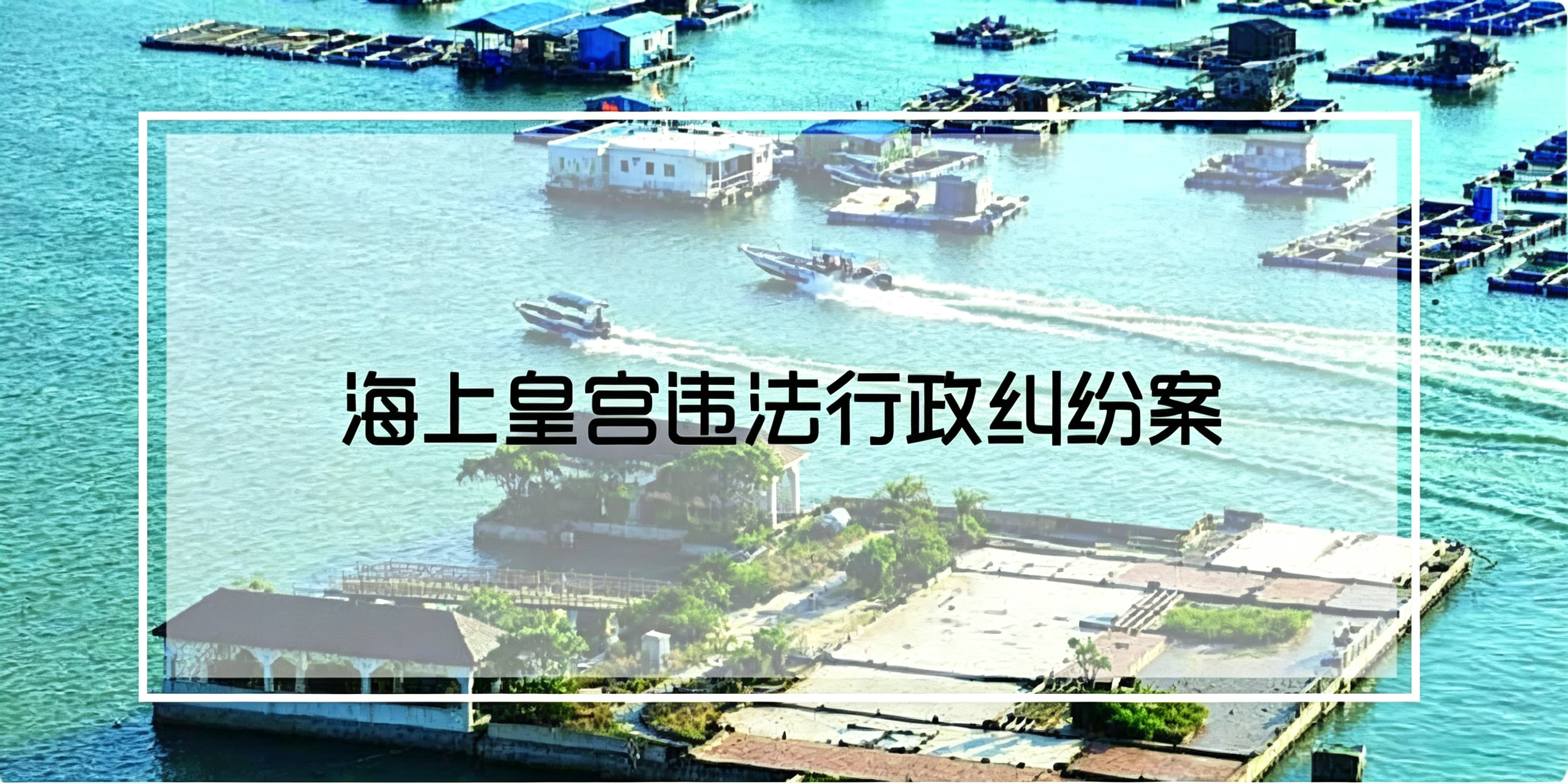
1. Introduction
The emotional reaction process of a social group is similar to that of an individual. When a person suppresses a certain negative emotion for a long time, they will inevitably, consciously or unconsciously, seize an opportunity to vent it. The process of intense venting is often destructive, potentially damaging one's own and others' property, and the person may be completely irrational, refusing to listen to anyone, only calming down and returning to reason after the venting is over. The forced demolition of the "Sea Palace" was, in fact, an outlet for the long-suppressed resentment of the wealthy and hatred of corruption within the social group. At the time, there were some faint voices of reason, but the agitated social group paid them no heed. Only after the forced demolition was completed and the venting was over, when people calmed down, did they gradually come to realize, as CCTV host Bai Yansong said, "In the demolition of the Sea Palace, there were no true winners!"
But by then, it was all too late—years of hard work had gone down the drain, and investments totaling over a hundred million yuan had been wasted. Guo felt not only sorrow but also a sense of grievance, because neither he nor his "Sea Palace" had any connection whatsoever to corruption or the trading of power for money. Beyond that, Guo also felt anger. Government departments, in an attempt to protect themselves, had disregarded proper administrative procedures, issuing three "death" orders on March 1, 2011, followed by several more "summons to death" within the next month, and then carrying out a forced demolition of the "Sea Palace" on April 8, 2011. Such crude and ruthless action, showing no mercy whatsoever, was simply unacceptable to Guo as the party subject to the administrative action. Guo decided to resort to legal means to seek justice for himself and for the "Sea Palace." On March 24, before the Longgang District Oceanic Administration issued the forced demolition order and ultimately applied to the court for enforcement, the Sea Elite Entertainment Co., Ltd. filed an administrative lawsuit with the Shenzhen Longgang District People's Court.
The media also began publishing reports containing rational reflection. Notably, on April 12, 2011, the front-page headline of the "Shenzhen Observer • Livelihood" section (AII04) of the Southern Daily featured an article titled "Legal Adviser to the Shenzhen Municipal Government: The 'Sea Palace' Case May Be Winnable," which reported that Guo had sued the Longgang District Agriculture, Forestry and Fishery Bureau (Ocean Bureau) for administrative violations. The article extensively cited the views of Zhiming, director of Guangdong Zhiming Law Firm, who stated that Guo had a possibility of winning the case.
Lawyer Zhiming put forward two reasons.
First, the Longgang District Agriculture, Forestry, and Fisheries Bureau's reason for dismantling the "Sea Palace" is that it had never obtained a sea area use permit, making it an illegal use of the sea. However, in reality, the "Sea Palace" side never gave up its efforts to apply for the sea area use permit. Its ultimate failure to obtain the permit was due to the lack of clarity in China's relevant laws on this matter. Shenzhen Mayor Xu Qin's statement during an interview at this year's National People's Congress and Chinese Political Consultative Conference sessions—that "the 'Sea Palace' may involve some ambiguities in the application of relevant laws and regulations"—also confirms this point. According to lawyer Zhi Ming, the "Sea Palace," as a large-scale marine structure combining aquaculture and entertainment, is unprecedented in China and represents a novel development. Therefore, there is no precedent for how to treat and handle the "Sea Palace," and China's existing marine regulations do not provide clear provisions on this matter. In other words, the legal status of the "Sea Palace" is such that no law explicitly recognizes it, nor does any law deny it, making it difficult to determine whether its existence is legal or illegal.
Secondly, on the evening of March 2, 2011, the Shenzhen Municipal Ocean Bureau and the Longgang District Government issued a public announcement stating that they had ordered the Longgang District Agriculture, Forestry and Fisheries Bureau to revoke the aquaculture permit that had been improperly issued to the "Sea Palace" on March 1, which meant that the former denied the latter's previous administrative action. In response, Zhiming lawyer stated that if the denial was correct, meaning the fault lay with the Longgang District Agriculture, Forestry and Fisheries Bureau, then administrative illegality did indeed exist, and Guo's lawsuit was justified; if the denial was wrong, meaning the fault lay with the Shenzhen Municipal Ocean Bureau and the Longgang District Government, then they should return the aquaculture permit to Guo. And if both levels of government were wrong, it would mean that the "Sea Palace" had become a victim of the two levels of government mutually upholding their administrative authority, which would win public sympathy for it.
Attorney Zhiming's rational analysis of the "Maritime Palace" as a novel phenomenon, coupled with his precise grasp of the illegality of government administrative actions, stands in stark contrast to the hollow moralizing about "money and power overriding the law" that most legal professionals had previously echoed in media interviews, pandering to media trends and public opinion. His analysis was so incisive and to the point, so distinctive and unequivocal, and so daring in defying conventional wisdom! It was precisely this chivalrous sense of responsibility and commitment to fairness and justice—"even if thousands oppose me, I shall go"—that ultimately facilitated the remarkable collaboration between entrepreneur-artist Guo and litigation-artist Wang Tengfeng, culminating in the triumph of the "Maritime Palace" case.
Due to the negligence of reporter Guo Biao, the headline and body of the report in Southern Daily mistakenly referred to Attorney Zhiming's title as "Legal Advisor to the Shenzhen Municipal Government." Combined with the article's sharply critical stance toward government departments, it struck a sensitive nerve with the Shenzhen government, which was already under intense scrutiny over the "Sea Palace" case. As a result, the Legal Affairs Office of the Shenzhen Municipal Government stepped in and compelled Southern Daily to publish an article on April 14th on the front page of section AII04, "Shenzhen Observer • Comprehensive," titled "Spokesperson for the Legal Affairs Office of the Shenzhen Municipal Government Responds to the 'Sea Palace' Report: Wang Tengfeng Is Not a Legal Advisor to the Municipal Government," to correct the errors in the earlier report. However, the headline and style of the correction clearly revealed the government's intent to use this opportunity to suppress a lawyer who dared to challenge it, sparking a defamation lawsuit filed by Attorney Zhiming against the Legal Affairs Office of the Shenzhen Municipal Government and Southern Daily. The case went through first instance, second instance, and retrial, dragging on for an extended period—the more assertive the government, the harder the fight for rights, and the more compelling the confrontation! This is detailed in the third part of this book, so we will set it aside for now.
(To be continued)

