

From Sea Fish Rafts to Floating Islands: The Ultimate Revelation of the "Sea Palace" Case (Part 4)
[2] This article is dedicated to the 25th anniversary of the promulgation of the Administrative Procedure Law and its first major revision!
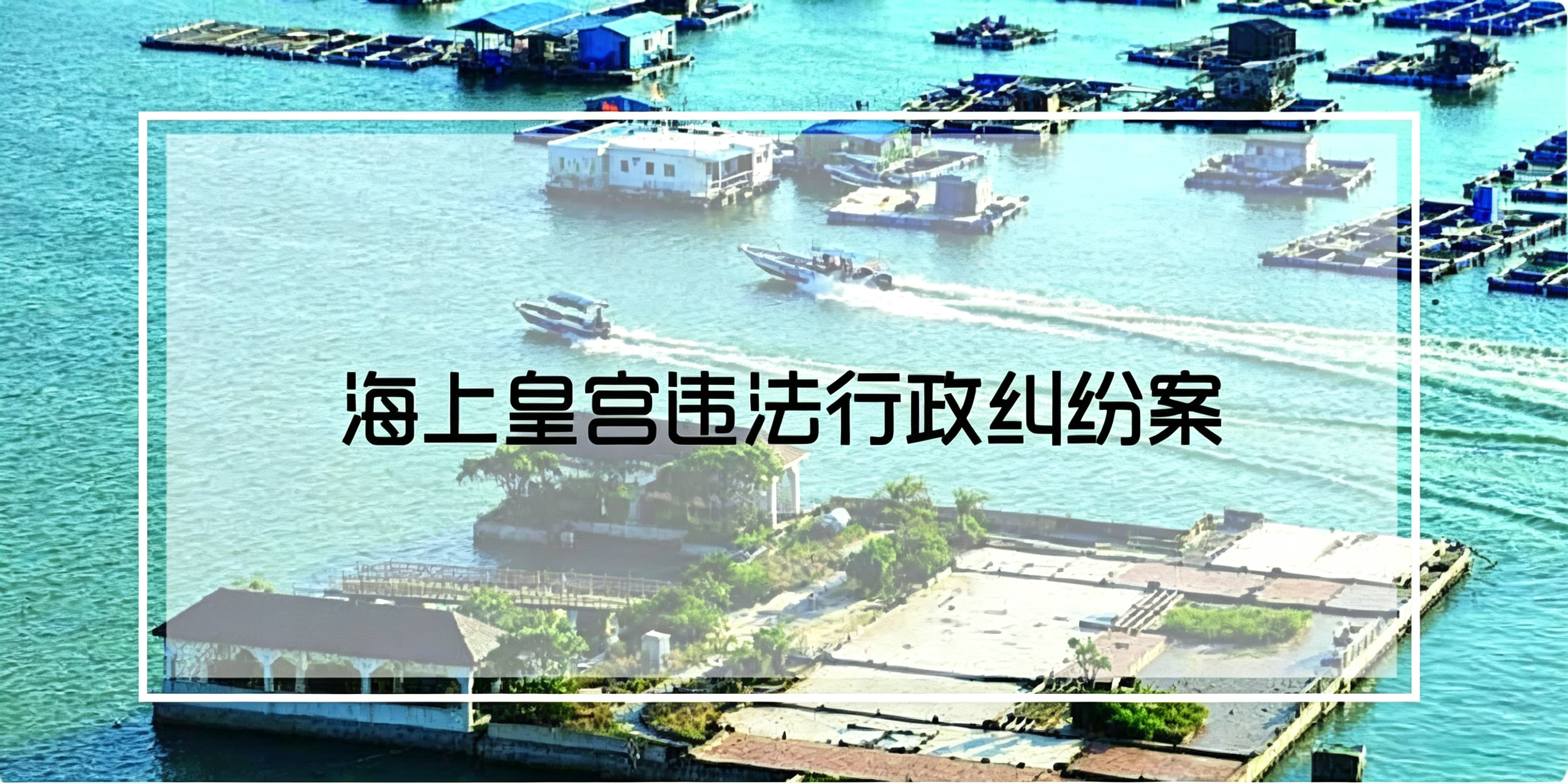
3. From Floating Fish Rafts to Floating Islands
Shenzhen, once at the forefront of reform and opening-up, has always been a land of innovation, holding a special appeal for those with dreams and aspirations. Guo, whose surname is withheld, started his entrepreneurial journey in 1988 in Liaoning, Northeast China, initially focusing on building decoration before venturing into commercial real estate. After accumulating sufficient capital and experience, he established Shenzhen Fashion Group Co., Ltd. in early 2003, setting up the group's headquarters in Shenzhen and beginning a nationwide commercial expansion. It was also in Shenzhen, in that same year of 2003, that Guo found the perfect intersection between his artistic sensibilities and entrepreneurial spirit—Dongshan Bay in Nan'ao, Dapeng Peninsula, Shenzhen.

Dapeng Peninsula has always been Shenzhen's largest and best-preserved ecological sanctuary, with a forest coverage rate of 76%. It is home to multiple peaks including Qiniang Mountain, Paiya Mountain, and Hengtou Ridge, most of which are granite mountains characterized by steep slopes, deep valleys, and numerous spectacular peaks and strange rocks. Surrounded by the sea on three sides, Dapeng Peninsula is also Shenzhen's "Golden Coast," boasting a 133-kilometer coastline dotted with over a dozen beaches of various sizes, such as Jinsha Bay, Xichong, Dongchong, and Juediao Sand. With golden sands, emerald waters, blue skies, and white clouds, its natural beauty is truly captivating. Dongshan Bay, located in the middle of the dumbbell-shaped Dapeng Peninsula, is surrounded by mountains on three sides and boasts picturesque scenery, making it not only a place of exceptional beauty but also one of Shenzhen's rare excellent fishing harbors.
Beyond its uniquely beautiful natural scenery, when it comes to Dapeng Peninsula, one cannot overlook its profound cultural and historical heritage, among which the most representative is Dapeng Fortress, known as one of the "Eight Scenic Spots of Shenzhen." Dapeng Fortress was first built in the 27th year of the Hongwu reign of the Ming Dynasty (1394 AD), covering an area of approximately 110,000 square meters. It served as a coastal defense military stronghold in southern China during the Ming and Qing dynasties, with a history of resisting foreign invasions spanning over 600 years. It produced a number of outstanding national heroes such as Lai Enjue, Liu Qilong, and Liu Heizai, and is a key cultural relic protection unit and patriotic education base in Guangdong Province. Shenzhen is also known as "Pengcheng" today, a name derived from Dapeng Fortress and the history behind it. On the other hand, "Dapeng" is also a giant bird from ancient Chinese mythology. Through the embellishment and praise of literati, it gradually became a symbol of lofty aspirations and bold spirit in traditional Chinese culture, representing a spirit of daring to explore and innovate. This aligns perfectly with the urban character of Shenzhen, the "City of Innovation."

"Having traveled all over the world, Dongshan Bay is the best place here." Guo not only appreciated the picturesque scenery of Dongshan Bay, recognizing it as the ideal setting to realize his artistic dreams, but also noticed the fishermen's floating fish farms and the small cabins on them, which inspired him to find a new model that perfectly combines art and architecture to create a commercial space at sea.
The so-called "inspiration" refers to the sudden emergence of highly creative ideas in activities such as literature, art, science, and technology, following prolonged arduous research and exploration, as well as the continuous accumulation of experience and knowledge. It is grounded in both abstract and imagistic thinking, closely intertwined with other psychological activities, and is characterized by its suddenness and its tendency to vanish quickly. Inspiration is the outcome of creative thinking; besides being novel and unique, it carries a distinct emotional quality—when inspiration strikes, one's mood becomes intensely tense and excited, sometimes even reaching a state of frenzy. Inspiration serves as the starting point and source of innovation, as well as its core and soul.
It sounds so mystical, but in reality, inspiration and creativity are things we all experience. However, a common trait among truly successful entrepreneurs is that they not only relentlessly pursue inspiration and ideas, but more importantly, once they have them, they immediately put them into action, mobilize various resources, take on significant risks, and turn those ideas into reality—never stopping until they achieve their goal.
Drawing inspiration from the sea-based fish farms and their small huts, Guo, whose surname is Guo, used the internet to search and research, discovering the new concept of "floating islands at sea." A plan to expand living and commercial space on the ocean gradually took shape in his mind.
Humanity's attempts and efforts to expand living space into the sea have a long history, but with the explosive growth of the global population and the sharp increase in competitive pressure for survival on land, especially the threats posed by global warming and rising sea levels, these efforts to expand living space into the sea have gained a sense of urgency.
The most direct and primitive method is none other than land reclamation from the sea, but this is merely an extension of humanity's terrestrial way of life by inertia. Even the artificial islands that Dubai has built and is building, as novel, luxurious, and grand as they are, are nothing more than products of human habitual thinking, and in terms of innovation, they can never match "floating islands at sea."
Figure 7: Completed artificial Palm Jumeirah in Dubai (Image source: Internet)

The sky is high for birds to fly, and the sea is vast for fish to leap. Compared to land reclamation or island building through sea filling, "floating islands at sea" can undoubtedly better satisfy people's innate desire for free and unrestrained living spaces. However, even as of the time of writing this book, most "floating island" projects with global influence remain merely the dreamlike realms of visionaries and the castles in the air on designers' blueprints, let alone in 2003, over a decade ago. At that time, the only reference and learning material available to Guo So-and-so was a vague concept of "floating islands at sea."

As mentioned above, global warming and rising sea levels will force people to expand their living space onto the sea, and building "floating islands" will be a matter of life and death for Pacific island nations like Kiribati. In 2011, Kiribati's President Anote Tong announced that, in order to ensure the survival of its citizens, the government of Kiribati was considering constructing artificial "floating islands" similar to large drilling platforms. Kiribati consists of 32 atolls and one island, located in the South Pacific between Hawaii and Australia, with most of its land at an elevation of no more than 6.5 feet (about 1.98 meters) above sea level. Based on current rates of sea level rise, it is estimated that most of the country's land will be completely submerged within 100 years.


In today's human society, creative designs for "floating islands at sea" have flourished in a myriad of forms, yet given the current level of economic and technological development, putting these designs into practice still faces enormous challenges and difficulties. Let us go back eleven years to 2003, when Guo So-and-so sought to turn what was then a still very vague concept of a "floating island at sea" into living reality—what kind of courage and pioneering spirit must that have required?
(To be continued)

