

The Sea Palace Administrative Case – A Classic Case of a Shenzhen Administrative Litigation Lawyer
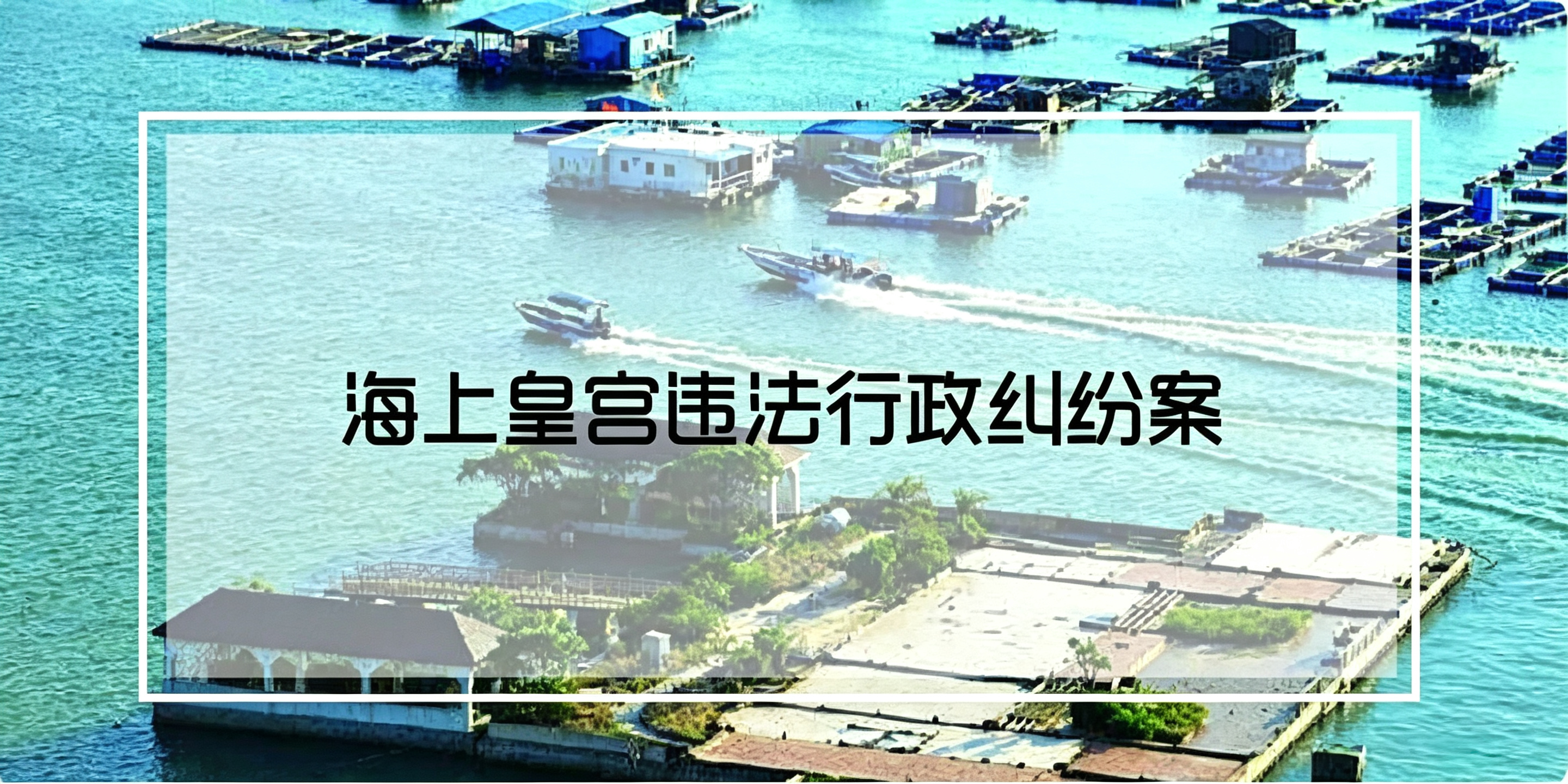
Case Review: Nan'ao Dongshan Bay in Longgang District, Shenzhen has long been an aquaculture area for local fishermen, where many fishing families have for generations built fish rafts and dormitories on this tranquil bay for production and daily living purposes. Around 2011, the "Sea Palace" (海上皇宫) in Shenzhen that shocked the nation referred to an offshore floating island floating atop Dongshan Bay. As early as 2003, entrepreneur Guo, on the basis of traditional fish rafts, innovated and began constructing a relatively large offshore floating island (later dubbed the "Sea Palace" by the media). Since the offshore floating island was a novel thing, for a time no agency was willing to issue it a sea area use right certificate. By January 2008, the former Longgang District Agriculture, Forestry and Fisheries Bureau (hereinafter referred to as the Oceanic Bureau) imposed a fine of 711,000 yuan on the "Sea Palace" party and ordered it to restore the sea area to its original state within a specified period. However, due to the active efforts of the "Sea Palace" party, Li Zhujiang, then Director of the Guangdong Provincial Oceanic and Fishery Bureau, in the spirit of encouraging innovation, gave an instruction on the "Sea Palace" matter, designating the Longgang Detachment to withdraw the case. But out of deference to the former Longgang District Oceanic Bureau, the "Sea Palace" party still chose to pay the fine. On January 13, 2010, some Shenzhen media published reports concerning the offshore floating island's "illegal" use of sea areas, and named the floating island the "Sea Palace," which immediately attracted nationwide attention. For a time, journalists from all directions gathered at Dongshan Bay, creating a great momentum as if to blast the "Sea Palace" flat. Under the media's narrative of "collusion between officials and businessmen," the "Sea Palace" was dismantled into three major sections on May 13 and towed away from its original sea area, but was left to float on the surface of Dongshan Bay, awaiting rectification. Following active rectification by the "Sea Palace" party, on December 26 of the same year, the former Longgang District Oceanic Bureau issued the rectified "Sea Palace" an "Aquaculture Registration Certificate" and an approval permit for recreational fishing. Just as the "Sea Palace" party was preparing to open the floating island to the public, with renewed intervention by some media outlets, the Shenzhen Municipal Oceanic Bureau and Longgang District jointly issued a notice on March 2, 2011, declaring that the "Sea Palace" had illegally occupied a sea area and ordering the former Longgang District Oceanic Bureau to revoke the "Aquaculture Registration Certificate" it had issued to the "Sea Palace" party. On April 8, without going through legally prescribed administrative procedures, the Longgang District Oceanic Bureau began organizing forces to forcibly demolish the upper structures of the "Sea Palace." As early as March 28 prior to this, the "Sea Palace" party had already sued the former Longgang District Oceanic Bureau over its administrative penalty of reneging on its word and illegal procedures. On April 20, the Longgang District Court decided to accept the administrative litigation petition filed by the "Sea Palace" party in accordance with law. The former Longgang District Oceanic Bureau also stopped the related demolition work after completely removing the main structures of the floating island's central atrium section. Subsequently, the plaintiff "Sea Palace" party entrusted lawyers of Guangdong Zhiming Law Firm to represent this case. The Art of Representation: From the moment I took on this administrative litigation case that caused a national sensation and was fervently hyped by media across the country, I clearly recognized that the "Sea Palace" was a "shell" imposed by public opinion upon the "offshore floating island" carrying a certain resentment-against-the-rich sentiment. Because of this luxurious, distasteful "shell," the "offshore floating island" was additionally burdened with frightening labels such as "illegal use of sea areas," "illegal construction," and "sea-based Scarlet Mansion." In fact, the "offshore floating island" was the true "identity" of Guo Mouzhang's offshore construction! The reason it was dubbed the "Sea Palace" and subjected to fierce attack was the result of the public's resentment-against-the-rich mentality being misled by the media. Therefore, resolving this misconception through reason and emotion naturally became the primary task of the Zhiming lawyers from the outset. In addition, I firmly grasped that the focus of judicial review in administrative litigation should center mainly on the issue of procedural legality of government administrative actions, while deliberately downplaying the issue of the legality of the administrative action's object itself, namely the "Sea Palace"; and clearly and emphatically advanced the conclusion that the three decisions made by the Oceanic Bureau of a certain District in Shenzhen on March 1, 2011, and the forced demolition implemented on April 8, were all procedurally illegal! I also noted that the special nature of the "Sea Palace" itself as a new thing, as well as the complex social background factors that led to the "Sea Palace" dispute, could not be ignored. To seize the moral high ground, reverse the unfavorable media atmosphere, and win the understanding and approval of the judges, this issue had to be advocated reasonably and persuasively both in court proceedings and in struggles outside the courtroom. Therefore, the representation opinions I prepared not only highlighted the key issue of procedural illegality of the administrative actions, but also made a reasonable and persuasive reconstruction and portrayal of the development of the "Sea Palace." Such litigation strategy ultimately achieved excellent courtroom results and extended to society at large, which was a naturally foreseeable outcome. The courtroom hearings of the "Sea Palace" administrative litigation case attracted eager attention and follow-up reporting from media of all levels and types across the country. With one closed-door hearing and two open court sessions, the courtroom and its surroundings were packed with observers, and reporters from dozens of media outlets, unable to find seats or even standing room, held their breath and stood quietly to listen! The brilliant performance in this case was first reflected in the collision of wisdom and contest of talent displayed in the intense courtroom debate. In court, the arguments of both sides focused on the visual image of the "Sea Palace" — it did not look like an aquaculture fish raft or a fishing venue, but rather more like a royal palace floating on the sea. From this, the inference was drawn as to whether the Sea Palace was an object "lawfully" conforming to aquaculture and fishing purposes. As for the defense lawyer's contentions that Guo Mouzhang's "sea company" (abbreviation for "Shenzhen Sea Mou Mou Entertainment Co., Ltd." — author's note) had not truly transformed the "Sea Palace" into an "aquaculture and fishing raft," and that the "Sea Palace" had always been an extremely luxurious private club or venue; that the "Sea Palace" had never obtained the "Sea Area Use Right Certificate" for the sea area it occupied...; that the sea area occupied by the "Sea Palace" should be "restored to its original state" in accordance with law; that the former Oceanic Bureau of a certain district had the legal authority to demolish the "Sea Palace"; and that the former Oceanic Bureau of a certain district's procedure for demolishing the "Sea Palace" did not violate any legal provisions — along with the evidence they adduced, I lightly brushed them all aside, focusing instead on deeply dissecting the four cognitive misunderstandings and erroneous practices in law enforcement by the Economic Development Promotion Bureau of a certain district (formerly the Oceanic Bureau of a certain district): 1. treating the acquisition of a sea area use right certificate as a prerequisite for obtaining an aquaculture registration certificate; 2. exaggerating a luxury fish raft into a "Sea Palace" and falsely accusing it of being an "illegal structure"; 3. characterizing the revocation of the aquaculture registration certificate and fishing permit approval as self-correction rather than admitting it was illegal administration; and 4. characterizing the forced demolition as "lawfully restoring old penalty measures" rather than admitting it had "unlawfully implemented new penalty measures." These points were fully refuted with sound reasoning and evidence. In refuting the error of the Oceanic Bureau of a certain district in "treating the acquisition of a sea area use right certificate as a prerequisite for obtaining an aquaculture registration certificate," I downplayed the actual circumstance that the "offshore floating island" as a new thing had never been able to obtain the so-called "normal Sea Area Use Right Certificate" throughout the entire process. Extricating myself through Article 7 of China's "Sea Area Use Management Law," which provides that "the administrative department for fisheries, in accordance with the Fisheries Law of the People's Republic of China, exercises supervisory management over marine fisheries," I utilized the provisions of Article 11 of China's "Fisheries Law," which provides that "the state makes unified plans for the utilization of waters, determining waters and tidal flats that can be used for aquaculture... the people's government at the corresponding level issues aquaculture certificates, permitting the use of such waters and tidal flats for aquaculture; the specific measures for issuing aquaculture certificates shall be prescribed by the State Council," as well as Article 5 of the national "Measures for the Administration of Aquaculture Certificate Issuance," which provides that "the administrative departments for fisheries of local people's governments at or above the county level are responsible for the administration of the issuance of aquaculture certificates for waters and tidal flats within their jurisdiction..." — seeking interlocking grounds and clearly demonstrating layer by layer that: the administrative department for fisheries of the local people's government at or above the county level is the statutory authoritative organ responsible for issuing aquaculture licenses, and once an aquaculture license is obtained, it naturally possesses the legal right to use the relevant designated sea (water) areas for aquaculture, and no legal provision requires additionally obtaining a separate "sea area…

