

[3] The public storm over the "Sea Palace" — The ultimate revelation of the "Sea Palace" case (Serial 9)
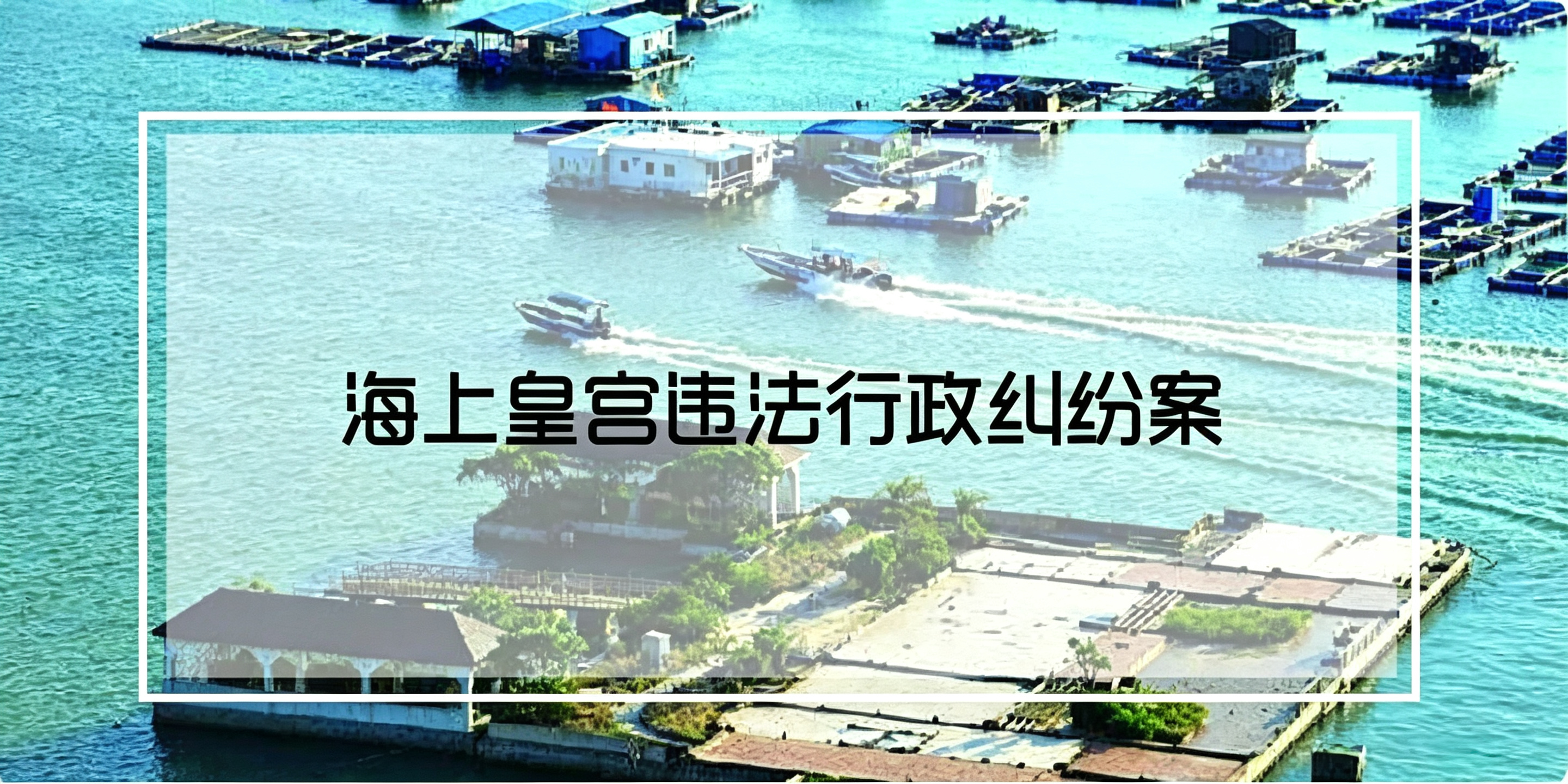
Part One: "Rich Tycoon" Guo XX and His "Sea Palace"
8. Storm of Public Opinion
On Wednesday, January 13, 2010, Shenzhen's *Crystal Daily* prominently released a lengthy report titled "Is the Hundred-Million-Yuan 'Sea Palace' Actually an Illegal Structure?" on pages A6-7 (Figure 33).

Looking back now and assessing it objectively, although this report had issues such as a somewhat sensationalist headline, descriptions of the "Sea Palace" that were largely based on secondhand sources, and images that overemphasized the luxury of the "Sea Palace," it still attempted in form to uphold the objective and fair stance of serious news reporting, listing "reporter's on-site visit," "netizens' exposé," and "statements from all sides" in an effort to present the full picture, and appended a "reporter's notes" with some degree of rational discussion. However, as mentioned earlier, due to the severe wealth disparity, social injustice, and polarization caused by corruption and monopoly, Chinese society at that time was permeated with an intense atmosphere of hostility toward the wealthy, and the development of information networks provided ordinary people with a convenient platform to vent pent-up grievances. Only one trigger was needed to ignite a nuclear explosion capable of destroying all rationality. In this sense, this report was to Guo So-and-so's floating island what the atomic bomb dropped near the end of World War II was to Hiroshima, Japan.
For the convenience of our readers, and to provide a complete sample and material for our rational reflection today, please allow us to quote the full text of this report verbatim below.
The 100-million-yuan "Sea Palace" turns out to be illegal construction?
The fishery administration department stated: "This constitutes illegal use of the sea."
“Master of the Imperial Palace” then said: “The province has agreed; we will take the lead in piloting this.”
White colonnades in European style, Southeast Asian-style gardens, swimming pools, horse racetracks, dappled tree shadows, small bridges over flowing water... In the present age of villas everywhere, these words seem hardly eye-catching. However, add "over the sea" before these words, and one cannot help but marvel.
In recent days, our newspaper has received numerous tips from readers reporting the discovery of a mysterious sea villa in Dongshan Bay, Nanao. Covering an area of several thousand square meters, its construction cost is estimated to be close to 100 million yuan. According to reports, the location is not open to the public and is only used for private gatherings during holidays, earning it the colloquial nickname "Sea Palace." Insiders have revealed that the "Sea Palace" has existed for five to six years yet has never obtained the right to use the sea area, making it, in fact, an illegal maritime structure.
Reporter's investigation
It wasn't difficult to inquire about this "sea palace"; the reporter simply asked a few locals and found it easily... This villa is clearly built on the sea, or rather, floats on the sea surface, like an "artificial island."
With this question in mind, the reporter recently drove to Dongshan Bay in Nan'ao. At 11 a.m., at the Dongshan Bay wharf, fishermen were busy unloading oyster shells onto the shore. This is the eastern shallow-sea aquaculture base, surrounded by mountains on three sides, with calm waters. Unless a major typhoon strikes, it is essentially safe, making it a sheltered bay for fishermen's aquaculture and a "safe harbor" for this "offshore palace."
It was not difficult to find out about this "Sea Palace." The reporter simply asked a few locals and easily located it; to the local fishermen, the place had become something of a "tourist attraction." However, unlike ordinary tourist attractions, although the "Sea Palace" is well known, getting aboard it is no easy task.
"I've never been up there," said the auntie who has run a shop at the dock for many years, "that's private property; you can't get up." Usually there aren't many people up there either; only on weekends or holidays do some men and women come and go. "But it's fine to take a stroll around it."
The journalist then decided to rent a speedboat to take a look around the vicinity first. The speedboat was operated by Fazai (pseudonym), who had been raising fish in Dongshan for many years. Speaking of this "neighbor," Fazai knew it inside and out—it was only a little over ten meters from his own fish raft. Watching the building go from its initial construction to its expansion, and now to its current glory, Fazai could hardly hide his envy and admiration for his "neighbor" in his words. "It's very luxurious up there."
The "luxury" that Fazi spoke of was not an exaggeration. Passing through a stretch of dark or simple fishing rafts on the sea, at one corner of Dongshan Bay, a luxurious Southeast Asian-style "palace" gradually came into view: first, a fenced-in area, and upon closer inspection, it turned out to contain several horses. Turning further, there was another world: a European-style villa, with verdant trees and exquisite carvings adorning its front. Turning again, at what appeared to be the main entrance, two stone-carved elephants stood before the gate, and not far away, there was also a swimming pool of several dozen square meters... If not for the rumbling motor sounds and the occasional splashing waves reminding the reporter, one might have mistakenly thought they had arrived at the front of some luxurious villa.
However, this villa is clearly built on the sea, or rather, floats on the surface of the water, like a "man-made island."
Even islands are fixed in place, yet this "maritime palace" can float on the sea as needed. According to reports, the "maritime palace" is actually composed of several parts, with the racecourse itself being one section, and it was only adjusted to its current position after Typhoon Hagupit last year.
"It's far more impressive than an artificial island," said Fa Zai. Even an island can only stay fixed in one place, but this "Sea Palace" can float on the sea as needed. Following Fa Zai's direction, the reporter then noticed that this massive structure was actually secured to the rocks on the shore by countless ropes. "They serve to resist waves and provide stability," said Fa Zai, who was born and raised by the sea. Although Dongshan Bay is relatively calm, getting a building to stay put "fixed" on the sea is no easy feat, let alone such a vast structure spanning several thousand square meters. "Generally speaking, the higher the building above, the taller the support structure below must be," Fa Zai said based on his own experience. But the buildings of the "Sea Palace" look much like ordinary villas, about six or seven meters tall. So, apart from being secured to the shore by ropes, what supports it to keep it afloat on the sea?
"Probably relying on floating objects like plastic drums and foam," but even as he said this, Fatt Chai himself wasn't sure. Then he shook his head again and sighed, "Impressive!"
In Fazai's eyes, the "Sea Palace" has more impressive features than these, including its splicing and assembly functions. According to Fazai, the "Sea Palace" is actually composed of several parts. The racetrack itself is one section, and it was not originally in its current location. It was only adjusted after Typhoon Hagupit last year.
That's a private club, not just anyone can get in.
"But when the reporter asked to 'go ashore' to see for themselves, Fazai immediately looked troubled. 'That's a private club—not just anyone can get in there.' He said that usually, although the 'master' of the 'Sea Palace' is not around, there are always several housekeepers on duty, cleaning up and feeding the horses. It's only on weekends or holidays that the place comes alive. 'Sometimes a lot of models come by,' Fazai said, adding that from their own fish raft they could watch the models' performances for free. Other times, it's celebrities—'famous hosts, for example. He has photos of himself with these celebrities hanging all over his home.' Fazai said these were things he had seen himself on one of his visits up there."
Besides model performances, sometimes fashion shows are held here, and there have even been occasions when fireworks were set off. On pitch-black nights over the pitch-black sea, colorful fireworks shot into the sky, leaving an indelible impression on all the surrounding fishermen.
"Sometimes people even go up there to shoot films," said Fa Zai. Just a weekend not long ago, a filming crew had come to shoot. "I hear it costs five to six hundred thousand per session."
This news was also confirmed by another fish raft owner, Uncle Wu. He has been running a marine fish raft here for over a decade and has witnessed the growth of the "Sea Palace" with his own eyes. He said he knew the "boss" of the "Sea Palace" and had been up there more than once. "I heard he's from Shandong, or is he from the Northeast?" He also agreed to try contacting him by phone for the reporter. However, a few minutes later, Uncle Wu's answer to the reporter was still: "Can't go up." "I heard that only honored guests invited by the owner can get in," Uncle Wu said.
Netizen exposure
"Sea Imperial Palace" has already become an internet buzzword.
Clearly visible from satellite maps
Although repeated attempts to enter failed, the reporter unexpectedly found a large number of photos of the "Sea Palace" online. Discussions about the "Sea Palace" could be seen on Tianya, Baidu, Xici Hutong, and elsewhere.
Many netizens have also posted a large number of interior photos of the "Sea Palace": an elegant Southeast Asian garden, with an elephant sculpture standing at the entrance; a double-height lobby in the center of the first floor furnished with European-style sofas, facing two samurai swords and suits of armor on display, with a Mongolian prince's robe hanging on the back wall; on the other side, some Taoist-themed wall hangings and traditional Chinese ornaments. Further inside, one could reach the bar where the owner gathered friends for parties and revelry, located on one side of the terrace, facing the sea. Lifelike deer heads hung from the ceiling; the bar counter, seating, musical instruments, and dice were all arranged like scenes from an old Western film.
The bedrooms on either side are done in a rustic countryside style, with delicate and refined cabinetry, plain small-print floral patterns covering the beds, and dark red wooden floors. In the master bedroom, a polar bear fur rug lies on the floor, and in front of the bookshelves are displayed photographs taken on various public and private occasions. Looking closely at these pictures, there are quite a few familiar public figures: Sammo Hung, Wang Shi, Yang Lan, Chen Luyu, Dou Wentao... Beyond the floor-to-ceiling glass windows of the room, a wooden terrace extends out directly to the sea.
Now this is what you call a luxury home. People today have been so fooled by developers' advertising that they've almost forgotten what a real luxury home actually is.
It's more apt to call it a private club rather than a luxury home—this isn't a place to live, it's a social venue.
Many netizens also marveled at the racecourse on the "Maritime Palace."
"I visited once in 2007 and was astonished by its luxury... The rooms were filled with priceless oil paintings and crafts, resplendent and magnificent, truly breathtaking," said netizen "White-robed Scholar."
Even on Google Maps, the exact location of this "Offshore Palace" can be clearly identified. In satellite imagery, numerous sea restaurants can be seen clustered together near the shore, with the "Offshore Palace" situated alongside them. The structure of the building is clearly visible, and its scale is so vast that it remains discernible even when the map scale is zoomed out to 1 kilometer. Based on the capture dates of the satellite images, it is evident that this "palace" has existed for several years.
"It has been under construction for five or six years," a local fisherman told reporters. Over just a few years, the "Sea Palace" kept "expanding" in size. Originally there was only a main hall and main room, but later a large garden was added, and a horse-racing track was also built. "I heard it was worth 30 million before, but now, they say it takes nearly 100 million to complete!" Another fisherman said that the annual maintenance cost of the "Sea Palace" is no small amount. "Whenever a typhoon hits, it destroys a lot of things, and repairs cost at least several hundred thousand."
But for this "sea palace," which costs a fortune to build and maintain, while netizens marvel at its luxury, many are also questioning: "Why can a private individual just build a house at sea?" "Are there legal procedures?" Some netizens even decided to follow suit, returning to their hometowns and spending hundreds of thousands to build a house on a lake.
statements of all parties
"Whether in terms of construction or positioning, the 'Sea Palace' runs counter to the goal of 'modern recreational fishery' and has escaped the supervision of government departments. Therefore, we imposed penalties in accordance with the law and filed a lawsuit." — Head of the Longgang Fishery Administration and Supervision Brigade.
Longgang Fishery Administration: "Sea Palace" constitutes illegal use of sea areas.
Amid doubts raised by netizens, the reporter decided to seek verification from the relevant authorities. During the search, a piece of information on the website of the Guangdong Provincial Ocean and Fisheries Administration, regarding an "Administrative Penalty Hearing on the Dongshan Offshore Structure in Longgang District, Shenzhen," caught the reporter's attention. The notice indicated that:
The maritime structure located in the shallow-sea aquaculture area of Dongshan, Nan'ao, Longgang District (referred to by the public as the "Maritime Palace") has not obtained a sea area use certificate, constituting illegal use of the sea. It was also indicated that the Ocean Bureau of Longgang District, Shenzhen, had approved the filing of a case for investigation in January 2008, and it was verified that the "Maritime Palace" illegally occupied a sea area of 1.58 hectares. In accordance with the "Sea Area Use Management Law of the People's Republic of China" and relevant laws and regulations, the Ocean Bureau of Longgang District, Shenzhen, imposed an administrative penalty of 711,000 yuan on the supervisory unit of the "Maritime Palace" and ordered it to restore the sea area to its original state within a specified period.
Subsequently, a reporter contacted the Longgang Fishery Administration and Supervision Brigade, and its head confirmed this information. He stated that the "Sea Palace" had indeed engaged in illegal use of sea areas, and that the brigade had lawfully filed a lawsuit with the Longgang District Court, demanding that the structure be restored to its original state of the sea area within a specified period. The head also mentioned that regarding the "Sea Palace," there had indeed been prior instructions from the provincial level allowing the project to develop as a modern recreational fishery. However, later on, both in terms of construction and positioning, the "Sea Palace" deviated from the goal of a "modern recreational fishery" and slipped out of government supervision. "Therefore, we imposed penalties in accordance with the law and initiated legal proceedings."
We have the approval document from the Guangdong Provincial Oceanic Administration. As a high-end marine leisure project, the Sea Palace has been inspected by relevant leaders from the Provincial Oceanic Administration, and in 2008, they issued an approval allowing us to proceed on a trial basis. — Guo XX, Chairman of a real estate company in Shenzhen.
The owner of the "Sea Palace": holds an approval document for "pioneering pilot initiatives"
The reporter went to great lengths to get in touch with the owner of the "Sea Palace," a certain Mr. Guo, chairman of a real estate company in Shenzhen. Regarding the statement made by the fishery administration team, he expressed a differing opinion.
Crystal Daily: I heard that the Sea Palace has not obtained the sea area use right certificate. Does that mean it constitutes illegal use of the sea?
Guo Moumou: We have the approval document from the Guangdong Provincial Ocean Bureau. As a high-end marine leisure project, the Sea Palace has been inspected by relevant leaders from the Provincial Ocean Bureau, and in 2008, the approval document allowed us to proceed on a trial basis. Since this form had never existed before, the Sea Palace is considered a floating structure, and there were no prior laws or regulations governing it.
Crystal Daily: But hasn't the Sea Palace existed since 2003?
Guo Moumou: At that time, we signed a contract with the village, and that contract is still valid today. In addition, we also have the approval document from the Nan'ao Sub-district Office. At the time, this was a poverty alleviation project, because the village also wanted to address some employment issues and boost economic development through it. Think about it—such a large project required a huge investment and couldn't be built overnight. There's no way I would have started construction rashly without obtaining any approval documents.
Crystal Daily: How many original villagers have been employed by the Sea Palace?
Guo某某: More than ten.
Crystal Daily: Why is the Longgang Fishery Administration and Supervision Brigade still exercising administrative power according to the law?
Guo Moumou: It may be that the local and provincial levels have different understandings of the issue. We will continue to communicate with the relevant departments in Longgang.
Crystal Daily: But the Longgang Court has already initiated the legal process. Will the Sea Palace be demolished?
Guo Moumou: No, that won't happen.
Crystal Daily: The Sea Palace is a private club, isn't it? If you're not a friend of the owner, you can't get in.
Guo Moumou: Yes. But many friends from all walks of life in Shenzhen have come here to have fun, and I've hosted them all for free.
Crystal Daily: Since it is built on public waters, is it possible to increase the openness of the club so that more citizens and entrepreneurs can share in this leisure?
Guo某某: That's unlikely. I never intended to profit from it; it's all been free.
Crystal Daily: How much is the investment in this project?
Guo XX: About 70 to 80 million.
Reporter’s Notes
Standardized use of marine resources is worth exploring.
On one side, they argue that "without a sea area use certificate, it constitutes illegal use of the sea," demanding the restoration of the sea area to its original state. On the other side, they claim that "with the approval document from the Guangdong Provincial Oceanic Administration," it falls under the province's "pilot and trial" project. During the interview, as each mystery was unraveled, new doubts continued to emerge.
Can the "Sea Palace" be classified as an "illegal structure at sea" and demolished?
"Because this form didn't exist before, the 'Sea Palace' is a floating structure, and there were no relevant laws or regulations governing it either." Guo's remark inevitably sparked the reporter's thoughts. As a coastal city, Shenzhen's marine resources have drawn increasing attention in recent years. How can we make good use of these blue resources while protecting them? Currently, the use of sea areas for tourism and recreation in our city is still in its early stages, accounting for only about 1.8% of the city's total sea area usage. The management of related sea area use needs to be further clarified and regulated.
While the report "Is the Hundred-Million-Yuan 'Sea Palace' Actually an Illegal Structure?" still maintained a semblance of formal objectivity, fairness, and rationality, the series of follow-up feature articles clearly orchestrated by the *Daily Sunshine* unapologetically revealed the media's—and indeed the general Chinese public's—partisan stance.
The next day, January 14, 2010, the *Crystal Daily* published a lengthy detailed report on pages A8-9 titled "It Was Born Under the Name of 'Aquaculture'" (Figures 34, 35). The article cited the views of the Longgang Brigade of the Guangdong Provincial Marine Surveillance Corps, first unequivocally determining that the "Sea Palace" "did not obtain a sea area use permit and constituted illegal use of the sea," and that what Guo had referred to as "provincial approval documents" were "not approval documents, but approval notations." Meanwhile, without possessing any evidence or facts, the reporter blindly followed the prevailing social sentiment of the time and conjectured that "it was precisely this 'approval notation' from 'above' that brought considerable pressure to bear on their (the Longgang Marine Surveillance Brigade's) law enforcement." This subjective inference was built on a misunderstanding of the dialectical relationship between government regulation and market innovation, completely disregarding the positive significance of affirmation and support given to Guo's innovative activities by leaders at various government departments. It directly insinuated corruption involving the exchange of power and money, effectively placing government authority and Guo's wealth in opposition to the law, and providing a justifiable outlet for the already surging public opinion. The report also devoted extensive space to tracing the failed attempt of the "Sea Palace" to obtain legitimate recreational fishery status, dramatized details of Guo and his company "evading" administrative penalties, and synthesized the views of the Longgang Marine Surveillance Brigade, Nan'ao Subdistrict Office, and Dongyu Community Residents' Committee to conclude that the "Sea Palace" had not contributed to the local economy. All of this objectively portrayed Guo as a wealthy, unkind, and emboldened "villain," conveniently providing a live target for the public's resentment against the rich. Although Guo had once solemnly declared that he and his company had never actively or passively bribed government officials, who would believe it?
On the same day, the same page of *The Crystal Daily* also featured a short article titled "Guo Moumou's Blog Flaunts 'Sea Palace' and Draws Online Backlash." The article stated, "Before our newspaper reported on the 'Sea Palace,' Guo Moumou had already been showing off his hundred-million-yuan luxury mansion on his own blog." "From Guo Moumou's words, it's not hard to see that he is quite pleased with his 'work': 'Every day I wake up facing Dapeng Bay, watching the tides come and go, the sun rise and set. At night, I stroll in front of the courtyard, a cup of Pu'er tea accompanying me as I sit under the moon amidst the flowers. It feels as if my world has fallen silent. There, I feel as though I'm in a paradise away from the world. I think even Tao Yuanming couldn't compare to me.'" — The impression this report gives: Isn't this just the "Guo Meimei" of the men's circle?


The January 15, 2010 issue of *Crystal Daily* continued to publish reports and commentaries such as "The Past and Present of the 'Sea Palace'", "Provincial Ocean Bureau: Never Issued Approval Documents", and "'Sea Palace' Challenges the Dignity of the Law" (Figures 36, 37, 38). Among them, the report "Provincial Ocean Bureau: Never Issued Approval Documents" stated, "Yesterday, the 'Sea Palace' side indeed showed reporters the 'approval document' from the Provincial Ocean Bureau, the approval document from the Longgang District Agriculture and Forestry Fisheries Bureau, as well as the contract with Dongyu Community. But when reporters verified these one by one with the three units, they unanimously stated: these materials were deliberately misinterpreted by the 'Sea Palace'." The report attached photocopies of the documents submitted by the "Sea Palace" side, which, though blurry, were sufficient to prove that the affirmative and supportive attitude various parties had long held toward Guo's innovative activities was not fabricated. But now Guo and his "Sea Palace" had become public enemies, coinciding with an era when online public opinion supervision was exploding in power, and government departments lacked experience in dealing with it. At such a moment, no government official would dare step forward to say a fair word for Guo and his "Sea Palace." Was it that government officials lacked responsibility? Not necessarily. Was it that government officials, whom ordinary people assumed "no official is not corrupt," could not achieve "a straight foot is not afraid of a crooked shoe"? Perhaps. The aforementioned Director Li Zhujiang of the Guangdong Provincial Ocean Bureau later fell from power and stood trial for corruption and bribery. On October 21, 2014, the first-instance judgment of the Shanwei Intermediate People's Court found him guilty of accepting bribes and sentenced him to life imprisonment, but Guo was not among the bribe-givers involved in the case! It seems that Guo and his "Sea Palace" were indeed "clean" back then! But the surging public opinion is both short-sighted and forgetful, and even more so, devoid of any sense of guilt. If an individual had wronged Guo and his "Sea Palace" in such a manner back then, after the truth came to light, they should have felt some guilt and had the moral obligation to say "I'm sorry," but when public opinion, in a moment of fleeting satisfaction, drowns someone with spittle, it rarely has moments of conscience-stricken reflection or self-reproach!
Perhaps feeling the pressure of the surging public opinion, Guo XX formally met with reporters, primarily from the Crystal Daily, on January 17, 2010. From the perspective of modern management, this should have been a crisis public relations move, but judging by the results, it was a completely failed crisis PR effort. What Guo XX intended to display was his artistically spontaneous temperament and confidence in his innovative masterpiece, yet in the eyes of the media and the public, it came across as the arrogance and audacity of a nouveau riche. This was made abundantly clear in the lengthy report published by the Crystal Daily the following day.
Look at the photo on the front page of the newspaper featuring the free-spirited and jovial Guo So-and-so being interviewed (Figure 39)!
Look at those eye-catching headlines: "Guo So-and-so: 'Sea Palace' cannot be demolished," "'Sea Palace' is not 'Red Mansion'" (Image 40), "I've never met Li Zhujiang" (Image 41).
Take another look at the almost arrogant "Q&A quotes of Guo So-and-so" as compiled in that day's issue of the Crystal Daily.
The media coverage has been extensive lately, and the advertising we've received is worth hundreds of millions! I should thank everyone for that!
There's been a lot of media coverage, but I don't really care! Honestly, I don't! Many people have texted me saying: Old Guo, your click-through rate has surpassed Zhang Ziyi's now!
There have been a few madmen in history. One was some "Great" emperor of Egypt who built a pyramid—mad, right? Another was Qin Shi Huang, who built the Great Wall—mad, right? And then there's me (who built the "Sea Palace").
(Pointing at the fishermen working on the fish rafts) Take a look! We're both using the sea area—does my "Sea Palace" have more value, or do these shabby fish rafts?!
Last year when the typhoon hit, half of this house was destroyed and tilted into the sea. They called me and said, "Brother, the house has been destroyed."


The Crystal Daily's series of reports on the "Sea Palace" ran from January 13 to January 21, 2010, before coming to a close. During this period, other major newspapers and online media also actively followed up. Online community sentiment was overwhelmingly critical, with some people even dubbing the "Sea Palace" another "Red Mansion" in the style of Lai Changxing! The government departments, forced into a passive position, could only "follow the lead of public opinion in all their actions." On January 18, 2010, the Shenzhen Municipal Ocean Bureau published the following "Notice on the 'Sea Palace' Case" via the municipal government website "Shenzhen Government Online," in which the hasty wording aimed at absolving government responsibility was quite familiar in the current environment of online public opinion oversight.
Recently, the illegal sea use case involving the marine structure commonly known as the "Sea Palace" built by Shenzhen Hai Shang Jing Ying Entertainment Co., Ltd. in Dongshan Bay waters, Nanao Subdistrict, Longgang District, has drawn widespread public attention. Relevant provincial departments and the Shenzhen municipal government have attached great importance to this matter. The Oceanic and Fishery Administration of Guangdong Province immediately established an investigation team to conduct a comprehensive inquiry into the case. The investigation confirmed that the "Sea Palace" structure built by Shenzhen Hai Shang Jing Ying Entertainment Co., Ltd. in Dongshan Bay waters occupied sea areas that did not conform to the marine functional zoning plan, did not meet the conditions for sea use approval, and had never obtained a sea area use certificate. Furthermore, no approval documents for its sea use had ever been issued by marine authorities at the provincial, municipal, or district levels. The company's illegal occupation of sea areas is clearly established with conclusive evidence. The Oceanic and Fishery Administration of Guangdong Province has issued the following handling decision:
(1) According to Article 3 of the "Marine Area Use Management Law of the People's Republic of China," Shenzhen Maritime Elite Entertainment Co., Ltd. constructed the "Maritime Palace" without obtaining the right to use the sea area, and this act constitutes illegal occupation of the sea area.
(2) The Shenzhen Municipal Ocean Bureau and the Longgang District Ocean Bureau, in handling the illegal case of the "Maritime Palace," adhered to lawful administration, conducted thorough investigations, followed legal procedures, applied the law accurately, and imposed appropriate penalties. We firmly support their actions.
(iii) Given that the Longgang District Oceanic Administration has already applied to the Longgang District People's Court for compulsory enforcement of this case, the Shenzhen Municipal Oceanic Administration and the Longgang District Oceanic Administration should actively communicate with the Longgang District People's Court, cooperate with the court in carrying out enforcement in accordance with the law, and strive to conclude the case as soon as possible.
(4) List the illegal case of the "Sea Palace" as a case supervised by the provincial bureau, establish a case supervision team, and follow up on its supervision.
(5) The discipline inspection and supervision department of the provincial bureau will conduct follow-up investigations. If any maritime surveillance law enforcement personnel are found to be suspected of illegal or disciplinary violations, they will be strictly dealt with in accordance with laws and regulations once verified.
Did the Daily Sunshine make a mistake? Probably not. Although the reporters and editors of the Daily Sunshine lacked a more rational, scientific, and comprehensive analysis and understanding of the social background of the "Sea Palace" incident, and were subconsciously influenced by the irrational hatred and suspicion of money and power pervading society as a whole, they were, after all, fulfilling the sacred duty of media oversight according to their own understanding. Even though their reporting methods involved issues of exaggerating and amplifying the news value of the event itself, it cannot be considered malicious sensationalism. Here, we will excerpt part of the "Proposed 2010 Daily Sunshine News Award Citation" (Figure 42) to express our understanding and respect for the reporters and editors of the Daily Sunshine:
This year's Best Series Award goes to the "Hundred-Million-Yuan 'Sea Palace' Turns Out to Be Illegal Construction" series, with the winners being Huo Min, Liang Rui, and Wang Liming. Early last year (referring to 2010), the Crystal Daily was the first to reveal that a mysterious sea villa stood at Dongshan Bay in Nan'ao, covering an area of several thousand square meters and costing nearly 100 million yuan, commonly known as the "Sea Palace." Astonishingly, this "Sea Palace" had existed for five to six years without ever obtaining sea area usage rights, making it in fact an "illegal sea construction." If it was illegal, how could it stand so brazenly for years, and who was its mysterious owner behind the scenes? With such enormous value, should it be demolished or not? Surrounded by numerous questions, Crystal Daily reporters pursued the story relentlessly for dozens of days, and the follow-up reports they published sparked huge repercussions in Shenzhen and even nationwide. In the end, the "Sea Palace" was ordered to be dismantled and relocated. This heavyweight series, showcasing the strength of Crystal Daily's public opinion supervision, came from the hands of three gentle and lovely reporters. Now, Wang Liming, one of the participants in the reporting, has a cute little baby, and Huo Min has become a happy expectant mother. Those extraordinary days and nights of chasing the "Sea Palace" may well become touching stories that these mothers tell their children.

(To be continued)

